

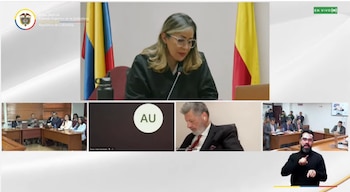
On August 1, 2025, Judge Sandra Liliana Heredia , of the 44th Criminal Court of the Circuit of Bogotá, sentenced former president Álvaro Uribe Vélez to 12 years in prison . This ruling stemmed from his conviction for procedural fraud and bribery during a criminal action, as detailed in the 114-page ruling read on July 28.
This decision ignited a significant response within Colombia’s political sector, particularly among supporters of Uribe, the natural leader of the Democratic Center party. According to multiple sources, several actors in the political arena publicly voiced their concerns regarding the judge’s decision, while members of the opposition celebrated what they viewed as a critical step for justice.
Now you can follow us in Facebook and in our WhatsApp Channel.
Among those reacting was the Colombian School of Jurists , which issued an official statement expressing substantial unease about the ruling and its impacts. They specifically raised concerns about judicial guarantees in what they referred to as a social and democratic state of law. They stated, “The Colombian School of Jurists expresses its concern about the scope and effects of the judgment of first instance issued against former president Álvaro Uribe Vélez , as long as it raises serious questions of constitutional relevance about the observance of judicial guarantees essential in a social and democratic state of law.”
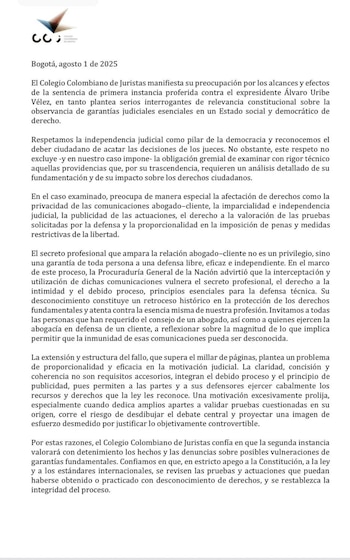
They acknowledged that while respecting the judicial decisions is a civic duty, it is equally crucial for the judicial system to ensure a thorough analysis of the evidence and to uphold the rights of the accused during the investigation. This applies especially to fundamental rights , which must be inherently safeguarded.
The statement continued: “In the case examined, in particular, the affectation of rights such as the privacy of lawyer-client communications , the impartiality and judicial independence, the advertising of the actions, the right to assess the evidence requested by defense, and proportionality in the imposition of penalties and restrictive measures of freedom .” These concerns highlight the potential impact on not only Uribe’s situation but the broader framework of judicial fair play in Colombia.
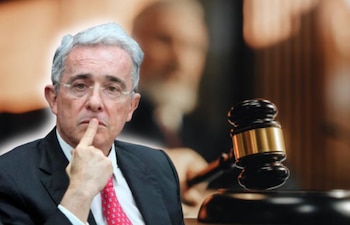
Concerns also arose regarding alleged violations concerning the privacy of attorney-client relationships . The Colombian School of Jurists highlighted that, during proceedings, private communications were exposed, an action that they insisted violates not only professional secrecy but also fundamental rights to privacy and due process. Such violations could hinder technical defense, potentially diminishing the effectiveness and trust in the judicial system.
The institution also expressed concerns about the complexity and sheer volume of the original ruling. They contended that the definitive document spans more than a thousand pages, making it challenging for defendants to comprehend the ruling in its entirety, which complicates their ability to formulate an adequate response.
The extension and structure of the ruling are being labeled as problematic in terms of proportionality and effectiveness concerning judicial motivations. The legal community suggests that clarity, conciseness, and coherence are vital to ensuring due process. An excessively elaborate ruling could obscure essential debates and lead to confounding interpretations.
In conclusion, the Colombian School of Jurists affirmed their faith in the appellate process and expressed hope that Uribe’s rights would be fully acknowledged and reinstated during subsequent reviews, emphasizing the need for transparency and fairness in the judicial proceedings against him.