
A powerful magnitude 8.8 earthquake shook the eastern coast of Russia on Tuesday, as confirmed by the United States Geological Service (USGS). The earthquake, whose epicenter was located 136 kilometers east of the city of Petropávlovsk-Kamchatski in the Kamchatka Peninsula, occurred at a depth of 19 kilometers and generated tsunami alerts in several Pacific regions.
The Japanese authorities issued warnings for the possible arrival of waves up to three meters high to its coastline. “Do not venture inside or approach the coast until the alert is lifted,” said the Japan Weather Agency. The Pacific Tsunamis Alert Center indicated that the waves could impact the coasts of Russia, Japan, Alaska, Hawaii, and the American island of Guam within three hours after the earthquake.
This event occurs just ten days after a 7.4 magnitude earthquake in the same region, which caused multiple aftershocks but didn’t leave significant damage. The Kamchatka Peninsula is a seismically active zone due to its location on the border between the Pacific and North American tectonic plates.
Next, the live coverage of the powerful earthquake on the eastern coast of Russia:
The Tsunami waves arrived at the states of Washington, Oregon, and California
The tsunami waves reached the west coast of the USA during the early hours of Wednesday, affecting the states of Washington, Oregon, and California. The phenomenon occurred after an alert issued by the National Meteorological Service warned of the possibility of hazardous and strong currents following the initial waves.
Authorities have kept active tsunami alerts throughout the region, including the San Francisco Bay.
According to available records, the largest waves so far were observed in Arena Cove (California), with a height of 48.8 centimeters; in Crescent City, where they reached 45.7 centimeters; and in Monterey, with 42.7 centimeters.
The northern California zone remains under special surveillance due to the intensity of the impact. Meteorological organizations indicated that new waves or sea-level variations could be recorded for several hours.
Colombia ordered the preventive evacuation of the Pacific Ocean beaches
Colombia has ordered the preventive evacuation of beaches and coastal areas on the Pacific Ocean in response to the tsunami alert issued after the 8.8 magnitude earthquake off the eastern coast of Russia. The measure was announced by the National Unit for Disaster Risk Management (UNGRD) through their official network.
“Tsunami alert for Chocó and Nariño,” the agency reported, urging the evacuation of beaches and low-lying regions in both areas. The UNGRD indicated that this measure aims to reduce the risk of potential waves generated by the seismic event that occurred in the North Pacific.
Chocó and Nariño, located on the western coast of Colombia, are home to fishing communities and populations close to the coastline. Authorities maintain surveillance on sea behavior and coordinate actions with local emergency agencies.
The recommendations include moving away from low areas and following the instructions of the Regional Risk Management Committees.
The first tsunami waves were recorded in California
California has begun to register the first waves of tsunami after the 8.8 magnitude earthquake in the Russian Peninsula of Kamchatka. According to data from the National Oceanic and Atmospheric Administration (NOAA), a wave of more than 30 centimeters was measured in Crescent City, in the north of the state, near the border with Oregon.
Authorities warned that more waves are expected in the coming hours. Crescent City is part of a 160-kilometer section of northern California’s coast that is currently undertsunami alert, the highest warning level. This area is particularly vulnerable due to its underwater geography, which can amplify the tsunami’s effects, as detailed by the National Meteorological Service.
The rest of the west coast of the United States, including parts of Oregon and Washington, remains under tsunami alert. Local and federal authorities are closely monitoring sea levels and urging the population to follow official instructions, staying away from coastal areas until further notice.
Hawaii remains on alert while the tsunami waves advance: no damage is reported
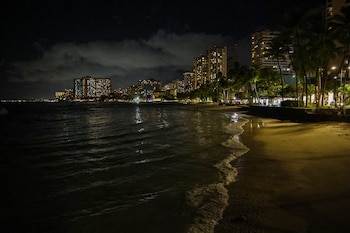
The governor of Hawaii, Josh Green, reported that although several tsunami waves have been recorded—some exceeding one and a half meters—no material damage or victims have been reported. “Everything is fine until now. We have not seen a great wave, which is a great relief,” he stated during a press conference.
Governor Green explained that the phenomenon mainly affected the Great Island of Hawaii, without significant activity reported beyond that point.
“We expect at least two or three more hours before we can declare ‘all clear.’ For now, all is good, but we don’t want anyone to let their guard down,” he warned.
Authorities canceled all flights to and from Maui, stranding about 200 passengers at the airport. While airports have not experienced direct impacts from the waves, this precautionary measure was taken.
The Coast Guard has closed all commercial ports, relocating ships and aircraft in preparation for potential responses once the tsunami’s full impact is confirmed. So far, no power outages have been reported, nor are they expected.
Green urged the population to avoid traveling through the streets and to refrain from calling 911 except in genuine emergencies. He also noted that the abnormal retreat of water in areas like Haleiwa, where some boats were left stranded on dry sand, signals that a major wave could be imminent. “That doesn’t happen without a reason,” he commented.
The moment when a team of Russian surgeons was surprised by the tremor of 8.8 in full operation
The intervention took place in a Petropavlovsk-Kamchatsky hospital, where medical staff decided to continue despite the earthquake’s shakes.
A team of surgeons in the city of Petropavlovsk-Kamchatsky at the eastern end of Russia continued an ongoing operation during the magnitude 8.8 earthquake. The incident was confirmed by the regional Minister of Health, Oleg Melnikov.
A quick camera captures the moment when the sea backed up more than 30 meters before the tsunami hit Hawaii
The phenomenon was recorded in Hanalei Bay on Kauai Island and generated alerts in other areas such as Oahu and the capital, Honolulu.
A fast camera installed in Hanalei Bay on the Hawaiian island of Kauai captured the moment when the sea level receded more than 30 meters from its usual shoreline, just before the arrival of the tsunami caused by the magnitude 8.8 earthquake in front of the Kamchatka Peninsula.
Hawaii confirmed the tsunami impact on its coasts: “You must act immediately”
The Pacific Tsunamis Alert Center (PTWC) confirmed that tsunami waves are already impacting various coastal areas of the state of Hawaii.
The agency urged the population to take urgent measures to protect lives.
“You must act immediately,” warned the center in its most recent bulletin. Local authorities have maintained evacuation orders for coastal areas and are advising residents not to return until the emergency is officially declared over.
Part of a kindergarten building collapsed in Kamchatka after the magnitude 8.8 earthquake
Authorities confirmed that there were no children present at the site during the earthquake.
A kindergarten in Petropavlovsk-Kamchatsky suffered structural damage after the powerful 8.8 earthquake that shook the region. In a video shared on social media, the regional minister for emergency situations of Kamchatka Krai, Sergei Lebedev, inspected the site and confirmed the collapse of the building’s façade.
Japan warns that tsunami risk could persist for more than 24 hours
The Japan Weather Agency warned that tsunami conditions could extend for at least 24 hours along the east coast of the country, while continuing to record waves of up to 60 centimeters.
“Based on past tsunami observations caused by earthquakes of similar magnitude, we expect elevated sea levels to remain for at least one day,” stated an agency spokesperson. They also cautioned that if the waves coincide with high tide, the water level could rise further.
The agency reiterated that tsunami waves can arrive in multiple phases and advised residents to stay in shelters until official announcements are made. Although initial waves were smaller than the three meters initially predicted, authorities have not ruled out potential changes in conditions.
Hawaii anticipates the impact of the first tsunami wave at 7:17 PM local time
Governor Josh Green announced that the first tsunami wave is expected around 7:17 PM local time. Sensors in the Midway Atoll, located northwest of the archipelago, detected a wave of approximately one meter.
Authorities maintain evacuation alerts and have advised the public to remain away from coastal areas. The governor reiterated the seriousness of the threat and warned that the wave could engulf several islands.