
Every year, the International Mathematics Olympiad (IMO) gathers some of the brightest young minds from around the globe . While many participants aim for the coveted medals, others challenge themselves to solve six mathematics problems that would baffle even seasoned professionals. This year marked a significant turning point – for the first time, two advanced artificial intelligence models , developed by Google DeepMind and OpenAI, entered the competition. Not only did they perform remarkably well, but they also raised profound questions about the future of intelligence, both human and machine.
The IMO is renowned for its rigorous selection process, making it a prestigious event that only the top mathematics students qualify to attend. Historically, it has been a domain monopolized by human intellect . However, in 2025, DeepMind’s new AI, named Gemini Deep Think , and OpenAI’s experimental model made waves by achieving gold scores, a feat never accomplished by AI in previous contests. Nevertheless, a handful of human participants surpassed their scores, igniting a debate: is the age of machines dominating human contenders approaching?
For many years, machines have been gaining ground in the field of mathematics. Until now, no AI model had reached a score high enough to compete with the best. DeepMind’s prior attempt only attained 28 out of 42 points in 2024. This year, things changed dramatically. Gemini Deep Think managed to solve five out of six problems in the designated time frame of four and a half hours. OpenAI’s model achieved an impressive score of 35 out of 42 points. However, it’s essential to note that both AI systems scored a big fat zero on problem six.
Despite their groundbreaking performance, the AI models did not emerge victorious. According to the official results, 26 human students managed to outperform both AI models. For instance, Alexander Wang, an American participant, achieved his third consecutive gold medal by scoring 37 points. However, the standout performers of the competition were Chinese students Reed Deng and Hengye Zhang , who achieved the perfect score of 42 points, including the challenging problem six that left the AI stumped.
The infamous problem six involved arranging a grid of 2025 × 2025 boxes with rectangles of varying sizes, ensuring that each row and column contained exactly one free box. This challenging problem required not just mathematical prowess but also a degree of creativity and strategic thinking that the AI struggled to replicate.
In terms of national performances , China reclaimed its leading position in the medal tally with a total of 231 points, followed closely by the United States with 216 points, and South Korea scoring 203. The Chinese team had six representatives, all of whom won gold medals; two of them scored a perfect 42 points. Among these remarkable individuals was Qiming Xu , who excelled despite competing with cerebral palsy, proving that human perseverance can indeed transcend formidable challenges.
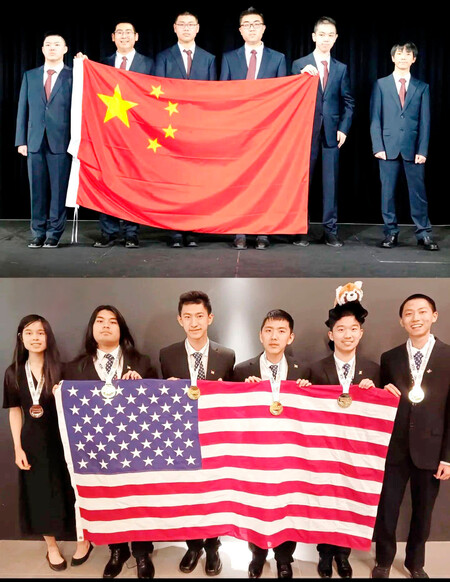
Above, the Chinese team that led the medal tally; below, the American team that came in second.
The emergence of advanced AI tools for mathematical problem-solving has led to intense discussions among researchers. Despite the concerns, lead researcher Thang Luong emphasized that these AI models are designed to be *complementary tools * and do not aim to replace human intellect. He envisions AI as the next generation calculator , assisting mathematicians in their quest for knowledge.
The leap in AI’s capabilities is staggering: a year ago, machines needed days of computation involving complex formal languages, while now they can produce coherent solutions in mere hours. This rapid advancement presents both opportunities and challenges for educational institutions and academic competitions worldwide .
As for the future, the big question remains: will 2025 mark the last year that human beings outshine machines at IMO? Alexander Wang believes that by 2026, AI will conquer all six problems. In contrast, Qiao Zhang sees a balanced fifty-fifty possibility, while Thang Luong suspects that this may indeed be the final IMO sporting a human edge . Yet not everyone agrees; former Midralist Junehyuk Jung argues that the challenges posed by problems like six will remain beyond the reach of machines “at least for a decade.”

Jensen Huang, CEO of Nvidia: “I have created more billionaires in my management team than any other CEO in the world.”
For now, however, the young mathematicians leave with more than just accolades: they depart with the knowledge that, at least for the time being, human intelligence holds its ground. As 2026 approaches, the world will wait with bated breath to see whether human ingenuity continues to prevail over machines or if a new era of artificial intelligence supremacy is set to unfold.