
The Transformative Power of Extreme Plasmonics in Quantum Science
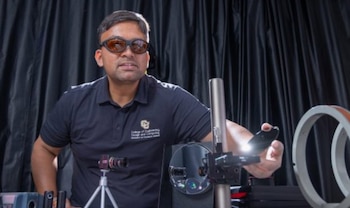
In an astonishing breakthrough within quantum technology, a recent study has unveiled a development known as extreme plasmon, which holds the potential to make science fiction a reality. This groundbreaking research spearheaded by Aakash Sahai, an associate professor of electrical engineering at the University of Colorado Denver, paves the way for the creation of gamma ray lasers that could provide concrete evidence for theories postulating the existence of a multiverse.
Understanding Extreme Electromagnetic Fields
At the core of this advancement lies the creation of extremely powerful electromagnetic fields produced when electrons within materials vibrate at unprecedented speeds. This phenomenon is anticipated to fundamentally improve a plethora of systems ranging from modern computer chips to particle colliders seeking elusive particles like dark matter.
The scientific community has recognized Sahai’s work, with his research gracing the cover of Advanced Quantum Technologies, a prominent publication in the field. This signifies not just an academic achievement, but also an important milestone for the future of quantum physics.
Revolutionizing Experimental Facilities
Traditionally, generating the sorts of extreme fields required for advanced experiments has been an expensive endeavor, often demanding large facilities like the Large Hadron Collider (LHC) in Switzerland. The LHC, an impressive 26.9 kilometers long, is dedicated to high-energy particle collisions and requires substantial resources to operate. The cost and operational scale of such experiments can be a barrier to research, deterring new entrants into the field.
From Massive Colliders to Miniaturization
Sahai’s research introduces a novel silicon-based material that can endure high-energy particle collisions while also managing energy flow efficiently. This innovative material can operate in a space comparable to the size of a thumb. By harnessing the quantum gas of electrons, this method enables scientists to access electromagnetic fields developed through rapid electron oscillations.
One of the most significant features of Sahai’s technique is its ability to manage heat flow generated by these oscillations, ensuring the sample remains stable and intact during experimentation. This technology presents an extraordinary opportunity to observe unprecedented activity, potentially minimizing the size of experimental colliders to fit onto a chip.
Impacts on Science and Medicine
Kalyan Tirumalasetty, a graduate student in Sahai’s laboratory, articulates the transformative nature of this technique, stating, “Manipulating such a high energy flow while preserving the underlying structure of the material is a remarkable advancement. This technological progress has the potential to enact real change in the world. It’s about understanding how nature works and using that understanding to generate a positive impact.”
The research did not remain confined to the university; it was tested at the National Accelerator Laboratory (SLAC), which is operated by Stanford University. The collaboration emphasizes the practicality and real-world applicability of the findings, promising a substantial leap forward in experimentation capabilities.
Patent Applications and Future Prospects
As a testament to the significance of this work, the University of Colorado Denver has already filed for provisional patents on this groundbreaking technology both nationally and internationally. This proactive step aims to secure the intellectual property rights associated with these innovations, marking a step toward commercialization and wider adoption.
Sahai articulates the exciting future possibilities: “Gamma ray lasers could become a reality. We could gain insights not only into the cells’ core but down to the nuclei of atoms. This advancement can accelerate our understanding of the forces governing such small scales, potentially leading to improved medical treatments, including targeted therapies for diseases like cancer.”
Moreover, extreme plasmonics could also serve as a fertile ground for validating various theories about the universe’s fundamental workings, including those exploring the possibilities of a multiverse.
In summary, the breakthrough achieved by Aakash Sahai and his team represents not just a leap in quantum science but a potential turning point in how we understand and manipulate the very fabric of our universe. The implications of this work reach far beyond theoretical physics, promising transformative advances in technology and medicine that could reshape our understanding of reality itself.