
Recently, a Xiaomi Su7 Max was spotted being transported to Hyundai’s offices in Seoul, raising eyebrows in the automotive world. This particular model was seen with a provisional research registration, leading to speculation about the intentions behind its transfer. According to Bloter, a South Korean publication, Hyundai has imported multiple units of this Chinese electric vehicle to conduct an in-depth analysis at their R&D centers. Xiaomi is gaining a considerable foothold in the auto sector with its innovative models, and this move by Hyundai suggests a keen interest in understanding the success of Xiaomi’s groundbreaking design.
Hyundai’s Query on the Su7
The Xiaomi Su7 has quickly gained a reputation as the electrifying phenomenon of the year. Xiaomi has achieved the seemingly impossible: matching the performance of a Porsche Taycan at a significantly lower price point. Surpassing 300,000 units sold within just 15 months, it has even secured the Nürburgring record for a production electric vehicle. As a result, traditional automakers are feeling the heat, and many are left wondering how Xiaomi managed to pull off such a feat.
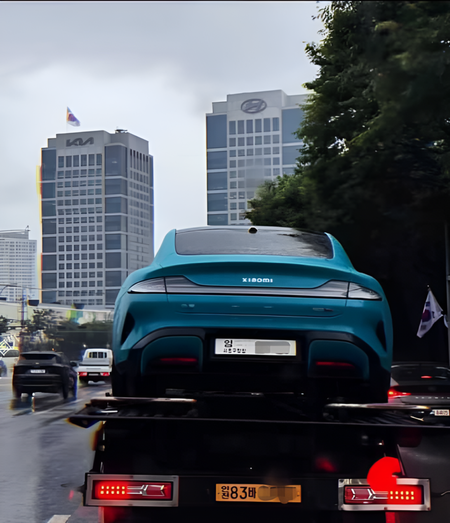
<span>Su7 Max being transported to Hyundai Research Center. Image: Weibo</span>Investigating the Su7
The South Korean automaker is slated to transfer the acquired units to their research facility in Namyang, Hwaseong, as well as their Seoul headquarters. Engineers will conduct a comprehensive examination, delving into aspects such as the vehicle’s electrical architecture and its hyper-responsive infotainment system, which draws from Xiaomi’s extensive smartphone expertise. This reverse-engineering effort aims to uncover every technical nuance that contributes to the vehicle’s success.
User Experience and Entertainment Systems
Among the multiple components under the microscope, Hyundai engineers will primarily focus on the user interface and entertainment system of the SU7. Xiaomi’s user experience in software is already being perceived as superior, particularly when compared with Hyundai’s own Bluelink Connect system. The impressive performance of Xiaomi’s infotainment system within the SU7 has been well-received by both users and industry analysts, making it a key topic of interest.
A Sector in Turmoil
The rapid advancement of Chinese automobile manufacturers like Xiaomi has sent shockwaves through traditional car companies. Euisun Chung , executive president of the Hyundai group, has openly communicated concerns regarding competitive pressures in internal meetings, specifically citing the challenges posed by manufacturers like BYD and Xiaomi. Acknowledging this competitive landscape, Hyundai has ramped up its investment in the electric vehicle sector, with recent figures showing a 15% increase over the past year, now totaling $32.4 billion .
<img alt="Pre-owned Xiaomi Yu7 selling for more than new ones" width="375" height="142" src="https://i.blogs.es/542d89/gvztmjbwaaa2zz1/375_142.jpeg"/>The Future of Automotive Innovation
Hyundai has announced an ambitious plan involving an expected $17.6 billion investment by 2025, with nearly half of that earmarked for R&D. The company aims to solidify its position in a rapidly evolving marketplace. While the SU7 may not officially enter the European market until 2027 , its anticipated impact is already shaping discussions within the automotive sector.
As companies adapt to the shifting landscape of automotive innovation, the Xiaomi Su7 Max stands as a prime example of how disruption can create new paradigms. Traditional manufacturers will need to sharpen their competitive strategies to contend with this new era defined by electric vehicles and smart technologies.