
Seeing satellites gliding silently across the night sky has become increasingly common. There are even tools available to track which satellites are passing over or when the Starlink trains will fly above your city.
From the GPS that guides us along roads to broadcasts of sporting events, and the fleet of weather satellites that have greatly improved weather forecasting : if undersea cables are the pillars of the digital age, satellites are the braces that hold the bridge together.
What is a Satellite (and What isn’t)
The word comes from the Latin satelles, meaning “attendant.” Essentially, a satellite is any object that orbits a larger body, held in place by its gravity . The Moon is Earth’s natural satellite.
According to data from the European Space Agency, there are currently 14,690 artificial satellites in Earth’s orbit, including both operational and inactive ones. Eighty-six percent reside in low Earth orbit (LEO) , less than 2,000 km high, completing up to 16 orbits of Earth each day. About 2.5% operate in medium Earth orbit , making two to six daily orbits. The remaining 5.5% are in geostationary orbit (GEO) , situated at 35,786 km where they constantly observe the same point on Earth. The rest follow elliptical orbits .
<img alt="Every day, three large pieces of space debris re-enter Earth: "One day our luck will run out and they will fall on someone"" width="375" height="142" src="https://i.blogs.es/04d55e/basura-espacial/375_142.jpeg"/>However, not everything we launch into space qualifies as a satellite. Interplanetary probes (or even interstellar probes , such as the Voyager spacecraft) are designed to escape Earth’s gravity and venture into deep space. They do not orbit Earth, thus are not recognized as satellites of our planet. A recent example is the European probe Hera, currently en route to an asteroid, having recently utilized Mars’ gravity to accelerate its voyage.
Although they could technically qualify, rockets, spacecraft, or space stations that orbit Earth are not considered satellites. Another potential classification is space debris , which includes all defunct satellites, abandoned rocket stages, and even paint fragments orbiting our planet. The danger lies not in their origin or size, but in their speed of up to 28,000 km/h, turning any small piece into a projectile .
After decades of satellite launches—some more responsible than others—space debris has become a serious issue. Each time a satellite explodes in orbit or disintegrates into hundreds of pieces, the risk of chain collisions increases. Once an artificial satellite exhausts its fuel or its components fail, it becomes new debris until it falls back to Earth under the influence of gravity and atmospheric drag, where the atmosphere cleans it up. Each day, three large pieces of space debris re-enter the atmosphere, and this number is on the rise.
Types of Satellites
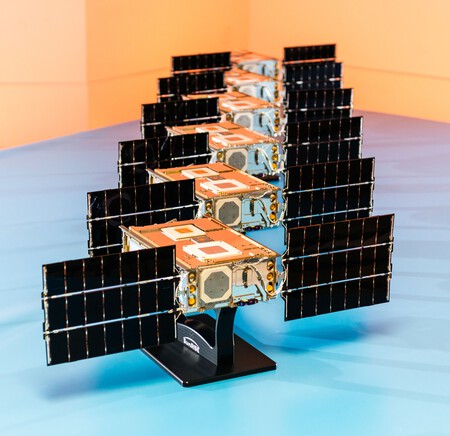
<span>NASA's SunRISE minisatellites. Image | Space Dynamics Laboratory</span>There’s a fundamental division between natural satellites and artificial satellites. The former are part of the cosmos, while the latter are products of human engineering.
Natural Satellites
Commonly referred to as moons. These celestial bodies naturally formed and orbit planets, asteroids, or even larger bodies. In our solar system, only Mercury and Venus lack satellites. Their origins fall into three categories: co-formation, gravitational capture, or a giant impact, such as the one believed to have formed our Moon.
Gaseous giants like Jupiter and Saturn boast so many moons that they each form “mini solar systems.” Some are fascinating worlds in their own right. Ganymede , Jupiter’s largest moon, is even larger than the planet Mercury. Europa , another Jovian moon, is a leading candidate in the search for extraterrestrial life, believed to harbor a vast subsurface ocean beneath its icy crust.
On Saturn, the icy moon Enceladus erupts geysers of water vapor into space from a subsurface ocean. Titan , another Saturnian moon, is the only one with a dense atmosphere that maintains rivers and lakes of liquid methane on its surface. This is where NASA plans to deploy the Dragonfly helicopter following the success of Ingenuity on Mars.
Artificial Satellites
These are the uncrewed vessels we constantly send into space for various missions. Since the launch of Sputnik 1 by the Soviet Union in 1957, we’ve sent tens of thousands into orbit.
The dominant player in satellite deployment in recent years has been SpaceX , whose Falcon 9 rocket can reuse most of its mass. Elon Musk’s company has launched 8,000 Starlink satellites in just five years. This satellite internet provider serves five million users with virtually no competition, although alternatives like Amazon’s Project Kuiper are set to launch massive deployments starting in 2025, as China and Europe invest in their own alternatives to address their strategic disadvantages.
Artificial satellites can be classified based on their orbit, size, and function. The orbit is a key factor, as it determines what each satellite can observe, its frequency of communication, and how it connects with us.
Low Earth Orbit (LEO): This ranges from about 160 km to 2,000 km above the Earth. In this orbit, satellites complete an orbit every 90-128 minutes, providing low latency for communication satellites and high resolution for Earth observation satellites, along with lower launch costs. However, the disadvantages include limited coverage (requiring megaconstellations) and atmospheric drag, which shortens their lifespan or necessitates orbital maintenance maneuvers. LEO is home to both megaconstellations like Starlink and the majority of Earth observation satellites.
Medium Earth Orbit (MEO): This extends from 2,000 km to 35,786 km in altitude, with orbital periods of 2 to 12 hours. MEO provides global coverage with moderate latency, but traverses the Van Allen radiation belts , necessitating more durable components. This is the natural domain for satellite navigation systems (like GPS , Galileo , GLONASS , and BeiDou ).
Geostationary Orbit (GEO): Positioned at 35 786 km above the equator, a satellite completes an orbit in exactly 23 hours, 56 minutes, and 4 seconds, remaining fixed above the same terrestrial region. This makes GEO ideal for telecommunications, television, and meteorology: each satellite covers nearly a third of the planet. However, high latency (250 ms round trip) and lack of coverage at extreme latitudes are downsides. A recent example is a Chinese geostationary radar surveillance satellite.
Highly Elliptical Orbit (HEO): These satellites feature a very low perigee (around 1,000 km) and a very high apogee (above GEO). Their eccentricity allows them to remain over high latitudes for extended periods during each orbit, providing coverage GEO cannot in polar regions but requiring complex tracking and also crossing radiation belts. The most well-known types are Molniya orbits , used for communications and monitoring in polar regions.
Another way to classify satellites is by mass, where the space industry has made significant strides. Miniaturization has enabled everyone from universities to startups to launch their own satellites. This classification clearly illustrates diversity: large satellites (over 1,000 kg) include observatories like the Hubble Space Telescope . Minisatellites (100-500 kg) are common in constellations like OneWeb .
Continuing down the scale, microsatellites (10-100 kg) are used for research missions, while nanosatellites (1-10 kg), popularized by the CubeSat standard, have opened space access to education and startups. Finally, picosatellites (weighing from 100 grams) are employed for experiments and formation flying.
Ultimately, a satellite is defined by what it does. Its missions serve as the backbone of our global infrastructure. The principal missions include:
Communications: Satellites act as repeaters for TV, telephone, and internet. Innovations in this field have been constant; SpaceX has enabled direct LTE cellular connections with its Starlink satellites, a service purchased by Apple for $5 billion to provide connectivity to iPhones.
Earth Observation: Weather or scientific missions monitor climate or the health of our planet. Recently, the European Space Agency launched a sophisticated radar satellite capable of scanning through forests to count forest biomass.
Navigation (GNSS): These systems inform us of our location. Systems like the U.S. GPS or China’s BeiDou, which has convinced over 140 countries, are critical infrastructures.
Astronomical Research: They serve as our eyes in the cosmos, monitoring near-Earth asteroids, creating artificial eclipses to study the sun, or capturing deep-space images.
Military Use: Satellites are utilized for intelligence, surveillance, and secure communications. From Russian “matrioshka” satellites that separate to harass enemies to advanced military satellites from Spain serving NATO , their role has increased since the war in Ukraine showcased the superiority of the Starlink megaconstellation. The term “Starlink killers” is now openly discussed for disabling them in conflict scenarios.
Anatomy of a Satellite: The Bus
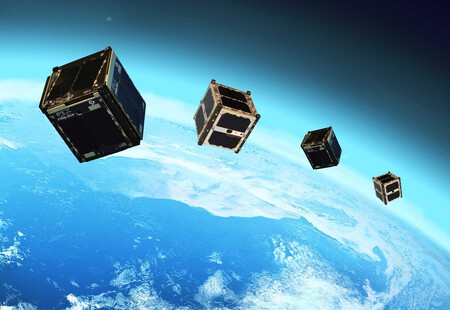
<span>Four CubeSats, a standard design for nanosatellites. Image | NASA</span>A satellite consists of two fundamental parts: the payload , which includes the instruments that carry out the mission (such as a camera or antenna), and the bus , which is the platform supporting everything else. The bus is the machinery that keeps the satellite alive and functional. The current trend favors modular and standardized buses with software-defined payloads, allowing for mission reconfiguration once in orbit, thus enhancing flexibility and value.
Key subsystems include the structure (the chassis supporting everything), the power system (typically solar panels and batteries), thermal control (maintaining an appropriate temperature), attitude control (orienting the satellite), propulsion (for orbital maneuvers), telemetry, tracking, and command systems (for communicating with the ground), and the onboard computer (the brain managing all operations). Occasionally, these systems fail, but a recent case demonstrated that a German hacker could revive a satellite that had been non-functional for 12 years with a firmware change.
Orbital Governance: The Rules of the Game
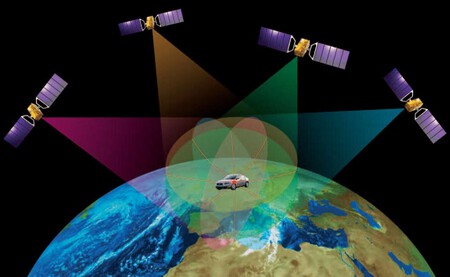
<span>Diagram of how satellite navigation works. Image | ESA</span>Despite the growing issue of space debris, launching and operating a satellite is not a free-for-all. There exists a complex legal and regulatory framework aimed at ensuring the peaceful and sustainable use of outer space.
The foundation of this framework is the Outer Space Treaty of 1967 , which establishes space as a common heritage for humanity, prohibits weapons of mass destruction in orbit, and holds states accountable for their space activities. This is followed by other agreements like the 1972 Convention on Responsibility and the 1976 Registration Convention .
The agency coordinating radio frequency use and allocating orbital positions for satellites in the coveted GEO is the International Telecommunication Union (ITU) , a part of the UN. Then, each nation has its regulations to authorize and oversee launches within its jurisdiction. Agencies like the FCC in the United States and the CNMC in Spain issue the necessary spectrum licenses to prevent interference.
A significant bottleneck today is the management of space traffic . With thousands of satellites and over a million pieces of debris, the risk of collision is real. Incidents such as the near miss between a Russian and an American satellite, or the mysterious movements of an old British satellite, highlight this danger. Services like Space-Track or LeoLabs monitor objects in orbit and issues conjunction alerts to allow satellite operators to perform evasive maneuvers.
To mitigate this risk, efforts to remove space debris (albeit still in their infancy) are burgeoning, and regions like the United States and Europe have imposed stricter rules to prevent satellites and dead rockets from remaining in orbit. The international recommendation is that satellites in LEO should be deorbited within 25 years after their mission concludes.
The Satellite Ecosystem and the Future
The current space era is a complex ecosystem that relies on both the technology in orbit and the capacity to reach it. The cost and availability of launches are key factors. The trend is highlighted by reuse , spearheaded by SpaceX’s Falcon 9, which has significantly lowered access to space, raising concerns from competitors like Arianespace that Elon Musk might monopolize the industry. Next in line is the enormous Starship rocket.
A new generation of microlaunchers has also emerged, including Miura 5 from PLD Space , dedicated to servicing small satellites. Flexibility is now the norm: even giants like Amazon have contracted their competitor SpaceX to launch part of their Kuiper constellation, underscoring that launch capacity is a strategic asset.
However, innovation is not limited to launch vehicles. SpaceX has standardized laser communication with optical links between its satellites, while NASA is testing the capability to refuel, repair, and assemble satellites directly in space with missions like OSAM-1 . China has already implemented its first “space gas station”.
China is also developing systems to beam solar power back to Earth from orbit, where solar panels are more efficient and harness more hours of sunlight. If satellites are already the foundation of our digital world, they could soon become a vital source of the energy we consume.
Image | ESA
In Xataka | What are solar storms and why has society become so vulnerable to something that has been occurring for millions of years