

The Return of U.S. Nuclear Weapons to Europe: Analyzing Its Symbolism and Strategic Implications
The recent return of U.S. nuclear weapons to Europe has sparked significant debate, shifting the landscape of global deterrence. Belicist machinery has long served as a symbolic language among military units, from uniform emblems to the flags raised in conquered territories. These insignias communicate intentions, honor history, and project future strategies. The recent developments in the deployment of nuclear weapons at RAF Lakenheath in England highlight this rising tension in geopolitical affairs.
Unraveling Hidden Politics: A recent discovery within the visual culture of the U.S. Air Force has indicated that nuclear arms have re-entered European soil—specifically at RAF Lakenheath—after nearly two decades of absence. This military base is pivotal in the U.S. strategy, acting as a hub for modern tactical capabilities .
The key to understanding this dynamic is through Challenge Coins , often referred to as “round metal objects” or RMO. These coins encapsulate the essence of military tradition, highlighting unit designations and traditions. They can imbue the bearer with a sense of pride and history, making them vital components of military heritage.
One prominent example is the commemorative currency of the 493rd Fighter Generation Squadron (FGS). Reactivated in 2023, this unit within the 48th Fighter Wing prominently displays imagery of the B61 nuclear bomb alongside symbolic representations of atomic warfare. Such visuals are meticulously crafted to reaffirm nuclear capabilities , indicating an active mission.
Supporting this mission, Lakenheath has gained infrastructure that enables the operation of F-35A fighters, the most advanced aircraft in the Western arsenal compatible with the latest B61-12 bomb. This modern variant is notably more potent than its predecessors and serves as a crucial deterrent in Eastern Europe.

One of the faces of the currency, emphasizing its symbolic representations.
The Silent Return of Deterrence: Despite the Pentagon’s longstanding policy of “neither confirming nor denying” the location of nuclear weapons, multiple indicators suggest that B61 bombs have either been deployed or are soon to arrive at Lakenheath. Highlighting this is the flight of C-17A RCH4574, recently detected at Lakenheath after a stopover in McChord, which raises questions about the operational transfer of nuclear materials rather than mere logistical exercises.
Furthermore, ongoing upgrades to aircraft shelters at Lakenheath signal an effort to enhance nuclear storage capabilities . The base’s modernization aligns with NATO’s Safety Investment Program, aimed explicitly at fortifying nuclear facilities in Europe. Contracts from the Department of Defense have also begun to reflect the imminent nuclear mission of the 48th Security Forces Squadron.
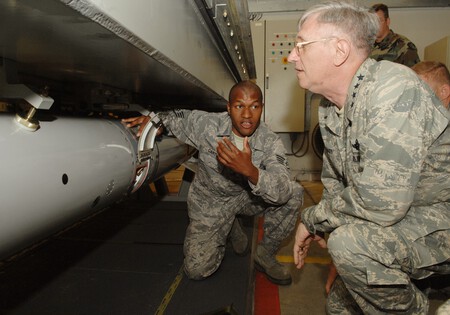
Inert training version of a B61 bomb, enhancing safety protocols.
Lakenheath as a Strategic Pivot: The potential establishment of nuclear weapons at Lakenheath should be seen not as a solitary maneuver but as part of a larger strategic readjustment in America’s nuclear posture. This base may serve as a permanent location for storage or a fallback platform, crucial in maintaining the deterrent capabilities of NATO.
The advantage of Lakenheath lies in its infrastructure, which not only supports F-35A operations but also plays a significant role in NATO’s tactical nuclear deterrence doctrine. Moreover, ongoing discussions involve the UK potentially integrating into the B61-12 deployment, which could further complicate European security dynamics.
As it stands, approximately 100 B61-12 bombs are believed to be deployed in Europe, making Lakenheath a key hub in the U.S. nuclear strategy . The F-35A’s enhanced capabilities, combined with the B61-12’s precision guidance systems, present a formidable deterrent against any aggressive moves from adversaries, particularly Russia.
In conclusion, while the return of U.S. nuclear weapons underlines an essential aspect of military strategy, it also serves as a stark reminder of the geopolitical tensions underpinning this decision. The symbolism inherent in military insignia and weapons systems cannot be ignored; they reflect the complex interactions of power, deterrence, and alliance formations in our evolving world. As criticisms regarding U.S. commitments grow among allies, this renewed focus on European nuclear deterrence shows that the traditional architectures of power are under both scrutiny and transformation.