
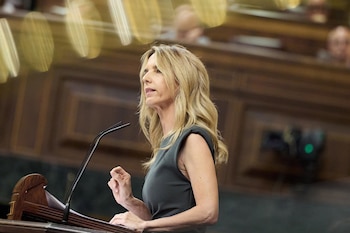
The political landscape in Spain is a rollercoaster of dynamics and drama , often taking center stage with controversial statements and cutting criticisms . Recently, this was exemplified by Cayetana Álvarez de Toledo, the deputy and deputy spokesman for the Popular Group in Congress, who vehemently criticized Spain’s current Prime Minister, Pedro Sánchez. She described him as a ” failed Democrat ” and even labeled him a ” zombie ” under the so-called ” assisted breathing ” of his political allies.
This incendiary rhetoric came during an interview on CNN Chile , where Álvarez de Toledo did not mince words. She stated, “Sánchez is a failed Democrat (…) is a zombie who is with assisted breathing, his partners keep him to continue squeezing and removing concessions at the expense of the unity of Spain.” This comment was made in light of Sánchez’s trip to Chile to participate in the ‘Democracy Always’ forum , organized by Chilean President Gabriel Boric.
The summit, which aimed to address democratic values with leaders from Brazil, Colombia, and Uruguay, posed a stark contrast to Álvarez de Toledo’s accusations. She emphasized that Sánchez lacks the moral authority to advocate for democracy, stating that he is actively undermining it back home in Spain. “That is the problem that Sánchez has; he has no moral legitimacy to defend democracy while he destroys it in his own country,” she asserted.
The Popular Group’s critique extends beyond mere insults; it encapsulates a broader concern regarding the perceived decline of democratic institutions in Spain. Álvarez de Toledo contends that Sánchez is at the helm of a process that “leads Spain from a full democracy to a failed democracy.” This alarm is rooted in claims that the Prime Minister is attacking crucial democratic counterweights , such as a free press , independent judiciary , and a functioning parliament .
The implication of such accusations is profound. She criticized Sánchez’s approach to handling institutions, alleging that he is “colonizing” them for political gain. In her comments, she stated, “He has his attorney general charged or prosecuted for a crime of the revelation of secrets, and has his family, his environment, his first right hand, his second right hand, his wife, his brother, his team, imputed or processed when not in jail.” Such allegations not only fuel the political discourse but also raise concerns about accountability and the rule of law in the country.
Despite the harsh tone of her criticisms, Álvarez de Toledo did express a broader view of democracy’s fragility . “Although democracy has its fragility and that is why you have to take care of it, there are also limits,” she noted, underscoring the notion that democratic systems are not infallible and must be protected from erosive forces.
The ramifications of such statements are twofold. On one hand, they may galvanize support among the political right, who share concerns about Sánchez’s governance and its implications for Spain’s future. On the other hand, these criticisms risk deepening the political divide within Spain, fostering an environment of hostility and discontent . Álvarez de Toledo’s fears that Sánchez will extend his “antidemocratic process” to Chile raise eyebrows, as they indicate a climate of distrust between political factions.
Moving forward, the future of democracy in Spain hangs in the balance. The charged statements made by opposition leaders like Álvarez de Toledo reveal significant tensions within the government and illustrate ongoing conflicts that shape Spanish politics. As each side exchanges barbs and critiques, the essence of democracy —deliberation, debate, and mutual respect—seems increasingly vulnerable. In light of the current political climate, it’s paramount that all leaders remain vigilant to uphold democratic ideals while navigating the tumultuous waters of national and international relations.