

Understanding Songbun: The Caste System of North Korea
In North Korea , the concept of Songbun plays a pivotal role in shaping the lives of its 26.4 million inhabitants from the very beginning. Translated as “origin” or “seed,” Songbun effectively serves as a caste system based on the merits of one’s ancestors. If an individual’s grandparents and parents have a positive affiliation with the regime, their Songbun is deemed favorable, ensuring various advantages throughout their life. Conversely, a background marked by disloyalty to the regime entails a negative Songbun , which places significant obstacles in one’s path.
The Surname Question: A Spanish Perspective
While the term Songbun may seem distant and foreign to some in Spain, there was a time when certain surnames complicated the futures of those who bore them. Today, tens of thousands of Spaniards share a particularly prevalent surname, which underlines how names can influence life’s trajectory.
The Significance of Surnames
From birth, each individual possesses a surname that speaks volumes about their heritage. The history of surnames is extensive and intricate; ancient Rome employed a system known as Tria Nomina , identifying citizens with a triad of names that went beyond mere first names, thus revealing family clans and origins.
The Evolution of Surnames
Over the centuries, surnames have adapted, sometimes due to significant shifts, such as the one prompted by Cardinal Cisneros in the 16th century, resulting in the dual surname system ubiquitous in Spain today.
What Happens When There Are No Parents?
Most people inherit their surnames from their parents; however, what occurs when those parental figures are absent? What about orphaned infants abandoned at the doorsteps of churches? These vulnerable children often found themselves in orphanages, struggling to carve out an identity devoid of familial ties. Institutions often resorted to particular naming formulas, but these methods could be strikingly devoid of sensitivity.
Many children were assigned surnames such as Incognito , Diosdado , Blanco , or Lying . In Catalonia , a notable surnaming practice was to use Deulofeu , which translates to “God did,” reflecting a somewhat creative, albeit impersonal solution to the dilemma of naming abandoned children.
Imaginative Naming Solutions in Historical Contexts
In some instances, more imaginative approaches were adopted, often referencing religious themes or even geographical locations where the children were found. For example, in Gipuzkoa , numerous orphans were given the surname Goñi as a tribute to Don Ramiro de Goñi , a benefactor of a local hospital between the 16th and 18th centuries.
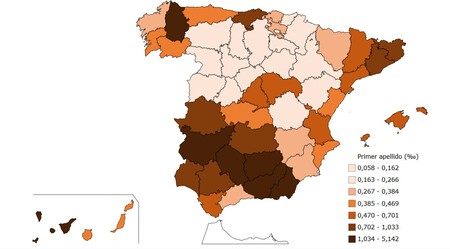
Distribution of the surname Expósito (as the first last name).
The Label of Expósito
One particularly notable solution was the surname Expósito , derived from the Latin expositus , meaning “put out.” This surname became synonymous with the abandoned, essentially marking individuals whose parents had either been unable or unwilling to care for them. While some may have ended up in the care of the State or Church, the stigma associated with the surname was profound and long-lasting.
More Than Just a Last Name
Mireia Nieto, a genealogist, articulates this notion eloquently, stating that Expósito represents more than a surname; it serves as a label identifying individuals with unknown parentage, extending to their descendants. The surname thus becomes a societal marker, indicating a stained heritage that shaped their experiences.
In her essay about the abandonment of children, historian Lola Valverde describes how the figure of the Expósito was often viewed with social condemnation, creating a narrative that suggested they were guilty of their situation.
The Legacy of the Expósito Surname
Despite the passage of time and changing societal views, the surname Expósito continues to serve as a reminder of abandonment and societal judgment. A regulation from 1958 acknowledged the power of judges to manage changes of surnames linked to “unknown origins,” which highlights the enduring impact of these labels.
Current Statistics on Expósito
Today, while the legacy of historical orphanages and societal stigma may be less pronounced, the surname Expósito is still relevant. According to data from the INE , about 34,084 individuals identify as Expósito as their first surname, primarily found in Lugo , Badajoz , and parts of Andalusia . An additional 37,332 use it as a second surname.
In summary, both concepts of Songbun and the historical treatment of surnames like Expósito showcase the influential power of heritage in shaping identity and societal perceptions. Names carry a weight that reflects historical injustices and enduring legacies, illustrating the ongoing narrative of abandonment and societal acknowledgment within two distinctly different cultures.