
The Amazon: A Crucial Battleground for Climate Action
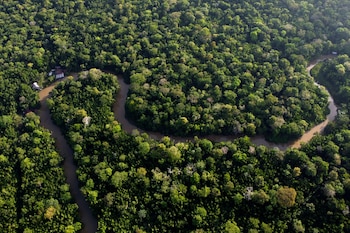
As the world gears up for a new United Nations Conference on Climate Change, the focus on the Amazon region intensifies. This year, the city of Belém in northern Brazil will play host to COP30, drawing fresh attention to one of the most biodiverse and threatened areas on the planet.
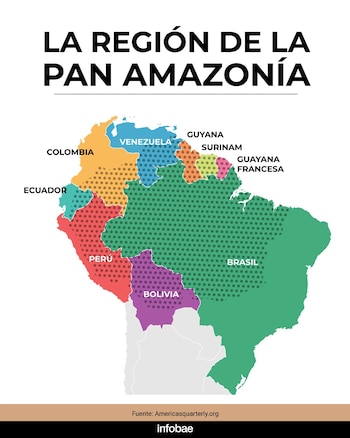
The Amazon is the largest continuous tropical forest globally, housing 20% of the Earth’s surface fresh water and spanning across eight countries: Brazil, Bolivia, Peru, Colombia, Venezuela, Ecuador, Guyana, Suriname, and the French Guiana.
According to a report by Americas Quarterly, the term PAN-Amazon refers to the zone covering countries whose jurisdictions are within the Amazon River basin. This massive area encompasses 8.3 million square kilometers and is home to about 46.9 million people.
However, the Amazon is not only vulnerable to global climate change; it faces numerous threats stemming from illegal activities and exploitation of natural resources.
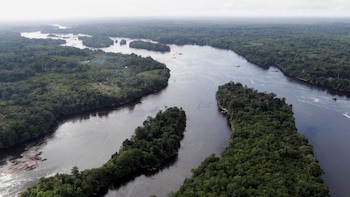
The variety of environmental threats in the Amazon varies by country. In Peru, illegal logging is rampant; in Venezuela, illegal mining of coltan prevails; in Ecuador, there is significant land being converted for oil palm plantations; while in Colombia, the growth of illicit crops continuously pressures the jungle.
Such activities, often linked to criminal networks, accelerate deforestation, heightening the loss of biodiversity and increasing levels of carbon emissions.
From 2021 to 2025, it is estimated that the Amazon lost over 165,600 km² of forest cover, an area equivalent to nearly the entire size of Uruguay. Brazil alone accounts for 83.3% of Amazonian deforestation, while Bolivia follows with 6.6%, according to the report by Americas Quarterly, based on project data from Amazônia 2030.
In Brazil, the region known as Legal Amazon covers around 5 million square kilometers, constituting almost 61% of the entire PAN-Amazon. It includes nine states such as Acre, Amazonas, Pará, Mato Grosso, and Rondônia, along with indigenous territories totaling 1.15 million square kilometers.
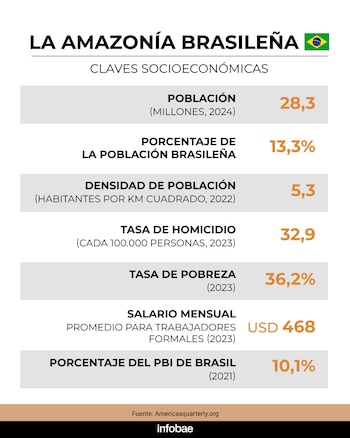
Despite its vast territory and ecological importance, the Legal Amazon grapples with serious social inequalities. As of 2024, around 28.3 million people reside in this region, yielding a scant density of only 5.3 inhabitants per square kilometer.
The poverty levels soar to 36.2%, and formal workers earn an average monthly salary of merely $468. Although the Legal Amazon occupies 59% of Brazil, it contributes a mere 10.1% to the national Gross Domestic Product (GDP).
Moreover, in 2023, this region produced around 1,100 million tons of CO₂ equivalent, accounting for 48% of Brazil’s total emissions, predominantly in areas facing rampant deforestation and forest degradation.
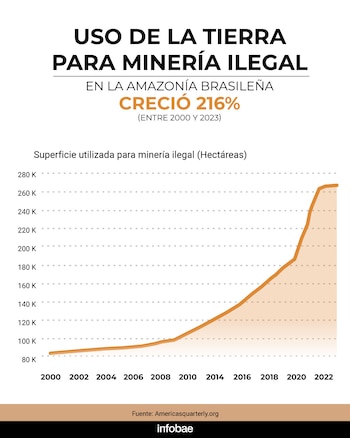
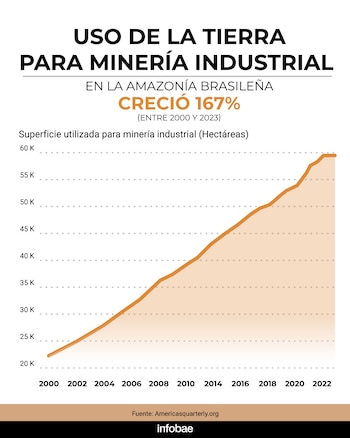
The expansion of mining has emerged as one of the most destructive forces of transformation. Over the past 23 years, the area designated for mining activities rose significantly, reaching approximately 3,300 km² as of 2023.
Among these mining activities, around 2,700 km² is attributed to illegal mining, which surged by 216% from 2000 to 2023, compared to a 167% increase from industrial practices during the same period. Such circumstances have dire implications for rivers, vegetation, and indigenous communities. One of the most severe repercussions is the mercury pollution resulting from gold extraction, with riverside populations bearing the brunt of this environmental disaster.
Intensive agriculture also plays a significant role in these transformations. In the Brazilian Amazon, essential export crops such as soy and corn are cultivated, along with pastures for cattle, which continuously encroach upon previously untouched areas. Between 2000 and 2023, the total area harvested for crops tripled, from 8.5 to 29.3 million hectares, while the bovine population doubled from 47.2 to 104.8 million heads.
Belém, chosen to host COP30 in 2025, is marked by contrasts between structural challenges and transformative expectations.
This city has socioeconomic indicators below the national average, with a GDP per capita of just USD 3,995—less than half the Brazilian average of USD 8,596. Further, 57.2% of its population resides in favelas compared to just 8.1% nationally.
Belém also experiences higher infant mortality rates and a level of air pollution 172% above what the WHO recommends, significantly worse than the national average of 98%. With high urban informality, the city grapples with persistent deficiencies in basic services; only 67.1% of households have access to clean water, starkly lower than the 83.9% national average, and merely 59.9% are connected to a sewer system against 64.7% in the rest of Brazil.
Despite these challenges, Belém displays slightly better educational outcomes. The average years of schooling stand at 10.5 for men and 10.9 for women, outpacing the national averages of 9.3 and 9.8, respectively.
Ahead of the climate summit, the city has received USD 1.3 billion in investments, targeting infrastructure (37.2%), mobility (28.5%), and sanitation (24.8%), as data from April 2025 indicate.
These funds are being funneled into 38 projects, marking significant urban transformation efforts. Thus, COP30 positions Belém as a symbol of the critical interplay between environmental urgency and social justice, acting as a gateway to the Amazon biome.
*Graphics: Marcelo Regalado