
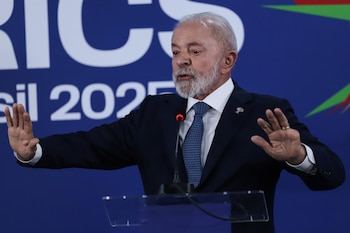
The Tense Exchange Between Lula and Trump: Political Fallout in Brazil
In a recent turn of events, Brazilian President Luiz Inacio Lula da Silva launched a series of sharp accusations against former President Jair Bolsonaro. These statements were made in light of Bolsonaro’s ongoing legal troubles related to his actions during and after the 2022 elections. The tension simmered as Lula claimed that Bolsonaro sought help from former U.S. President Donald Trump, asking for threats of tariffs as a means to exert pressure on the Brazilian government.
Lula’s remarks were particularly pointed during a public address in the state of Holy Spirit, where he accused Bolsonaro of a cowardly maneuver. “That coward, who prepared a blow in this country, sent his son to the United States to ask Trump to threaten us: ‘If they do not release Bolsonaro, I will impose tariffs,'” he claimed. This marks a significant escalation in the already fraught political climate between the two leaders, adding a transnational dimension to the ongoing crisis in Brazil.
The accusations follow a week during which Trump made comments regarding Bolsonaro, referring to the legal scrutiny faced by the former Brazilian leader as “very unfair.” Trump has not only defended Bolsonaro publicly but has also hinted at the possibility of engaging in dialogue with Lula. “I may talk to Lula at some point. Let’s see what happens,” Trump stated, leaving the door ajar for future discussions.
The Impact of Trade on Diplomatic Relations
In response to Trump’s threats of tariffs on Brazil—reportedly up to 50%—Lula has indicated that his government will not back down easily. He mentioned plans to escalate the matter to the World Trade Organization (WTO), expressing readiness to take reciprocal actions if diplomatic channels fail. The looming threat of tariffs has created an atmosphere of uncertainty for Brazilian industries that rely heavily on trade with the United States.
This scenario highlights how intertwined economic policies and political relations can become. Lula, in his bid to maintain the integrity of Brazil’s sovereignty, is now positioned against what he perceives as an attempt by Trump to meddle in Brazil’s internal affairs.
Political Persecution as a Narrative
As the political turmoil continues to evolve, the narrative of political persecution emerges as a common thread. Trump, aligning himself with Bolsonaro, has labeled the investigations against the former Brazilian president as a “witch hunt.” He remarked, “This is neither more nor less than an attack against a political rival, something that I know a lot about!” Such statements resonate with Trump’s own political struggles, creating a symbiotic relationship between the two leaders.
Bolsonaro, alongside several associates, faces serious allegations that include criminal association, attempts to undermine the rule of law, and coup attempts following the dramatic events of January 8, 2023. These serious accusations come as part of an investigation into mobilizations that sought to challenge the legitimacy of the current Brazilian government, thereby making the political stakes increasingly high.
The Broader Implications of Lula and Bolsonaro’s Conflict
The ongoing conflict signifies more than just a personal rivalry; it symbolizes a broader struggle for political legitimacy in Brazil. By positioning himself as a protector of Brazilian democracy, Lula aims to galvanize public support against perceived external interference from figures like Trump. Bolsonaro’s narrative of victimhood and orchestrated persecution plays well among his base, creating a polarizing effect among voters.
The dynamics at play will likely influence how Brazil navigates its future relationships not only with the United States but also with other global powers. The heightened tensions suggest that Brazil is at a critical juncture, as both leaders seek to assert their agendas amid a landscape marked by economic uncertainty and political strife.
As these events unfold, observers will be keenly watching to see how Lula’s government will respond to the pressures both domestically and internationally, and whether Bolsonaro’s ties with Trump will continue to complicate Brazilian politics. This saga underscores the intricate interplay between international diplomacy and internal governance, serving as a cautionary tale of how political rivalries can extend beyond borders and affect nations on a global scale.
The intricate web of accusations and counter-accusations not only shapes the Brazilian political landscape but also reverberates across the international community, potentially altering alliances and trade relationships in the process. Amidst this turmoil, the future of Brazil’s political landscape remains uncertain, with serious implications for both its citizens and foreign relations.