

Greenland: The Geopolitical Chessboard of the Arctic
As of 2025, the name Greenland has echoed incessantly through the corridors of power in the United States . The Trump administration ignited a fiery interest in acquiring this minor yet strategically vital territory, underscoring the underlying significance it holds in the broader context of Arctic geopolitics . This island—bordered by the United Kingdom and Iceland —functions as a crucial western edge in the navigation of global influences.
Recently, developments have further highlighted the growing importance of the Arctic, notably marked by the arrival of the USS Newport News , a Los Angeles-class fast attack nuclear submarine . This historic event represents the first instance of a US nuclear submarine docking in Iceland, and it serves as a clear indicator of the increasing importance of this region amid escalating geopolitical tensions .
In January 2023, the Icelandic government made a pivotal decision, permitting the docking of nuclear submarines in its territorial waters. The USS Newport News’s recent port call in Reykjavik not only showcases the depth of US-Iceland relations but also emphasizes their ongoing cooperation under the protective umbrella of NATO . The American Navy heralded this moment as a “decisive moment,” reinforcing its commitment to collective defense in the Arctic.
American diplomats expressed that this operation was conducted in full coordination with Iceland , a nation that relies on allies for its defense, given it has no standing naval forces of its own.
The backdrop to these operations lies in the Giuk gap , a crucial maritime corridor that connects Greenland , Iceland , and the United Kingdom . This area is routinely trafficked by submarines from the Russian Northern Fleet , including advanced Yasen-class cruise missile carriers. Controlling the waters around Iceland is vital for tracking these vessels before they can vanish into the depths of the Atlantic, presenting a potential threat to the eastern coast of the United States .
Historically, Iceland served as a base for the 57th Fighter Wing of theUS Air Force during the Cold War , alongside detachments using P-3 Orion aircraft for maritime surveillance. Modern operations continue, with NATO fighters rotating to maintain control of Icelandic airspace. The Newport News’s arrival complements this renewed defense framework, particularly in light of increased Russian activities in the Baltic Sea , highlighting vulnerabilities in crucial underwater infrastructure.
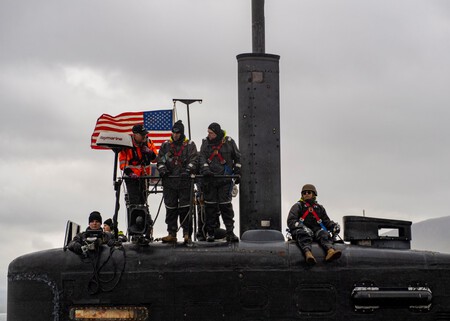
<span>Sailors onboard the submarine maintain guard during its arrival in Reykjavík, Iceland.</span>Moreover, the strategic significance of this region cannot be overstated. If nations such as Russia or China were to penetrate the Giuk corridor , tracking their movements would become remarkably complex due to the acoustic properties of the underwater terrain and the vastness of the oceans. From concealed positions, these adversaries would have the capacity to launch missile strikes against targets along the eastern coastline of the US.
In response to the evolving threat, the United States established the Task Group Greyhound in 2021, a specialized fleet aimed at hunting Russian submarines in the Atlantic. This initiative further indicates that the eastern seaboard is no longer viewed as a secure haven, necessitating the creation of surveillance and defense points in critical locations, including Greenland .
Highlighting the escalating stakes, Russian naval exercises have illustrated their keen awareness of the corridor’s importance. In 2019, they conducted their most significant naval drill since the Cold War, deploying at least ten submarines through the Giuk gap to reach the Atlantic undetected, showcasing their capabilities to project power toward the US coast.
The intent was clear: to demonstrate the West’s capacity to monitor their fleet movements while simultaneously asserting their military presence in crucial regions. Such exercises indicate Russia’s strategic ambitions in the Arctic, thereby stressing the importance of maintaining vigilance in these waters.
The recent docking of USS Newport News is more than just a symbolic gesture; it marks a meaningful operational stride toward establishing a logistical support base for nuclear submarines within the Arctic. The submarine, equipped with twelve vertical launch tubes for Tomahawk missiles and sophisticated anti-submarine warfare systems, plays a pivotal role in countering Russia’s enhanced military posture, particularly its increased presence near Finland.
The Icelandic Foreign Ministry has recognized that visits from American submarines significantly enhance the effectiveness of underwater surveillance, particularly in protecting submerged critical infrastructures. While this marks the first official port visit, it follows multiple brief entries by American submarines for crew rotations, solidifying ongoing bilateral agreements with respect to defense.
Furthermore, the Newport News’s visit highlights a broader trend aimed at revitalizing Iceland’s role as a central node in NATO’s northern defense strategy. The island, which had largely been sidelined post-Cold War, is now recognizing its strategic importance in confronting the resurgence of Russian submarine threats.
In essence, the arrival of the USS Newport News is not merely a naval operation; it signals a paradigmatic shift wherein the United States positions itself to project power and defend interests in Arctic waters . This increased military presence serves as a silent declaration of intent , firmly establishing Iceland as a critical bastion in the ongoing geopolitical landscape.
As the Arctic increasingly takes center stage in global politics, the games of power appear more intricate and consequential than ever. With tensions simmering, it is clear that this region represents the next great frontier for maritime security and international strategy.