
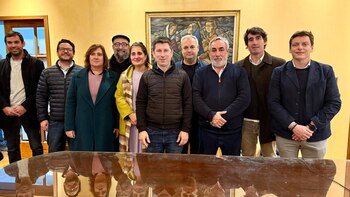
In a significant political shift, the Radical Civic Union (UCR) has officially launched the “We are Buenos Aires” Front . This new alliance includes parties such as Juan Schiaretti’s We Do It For Our Country, the Civic Coalition, the Dialogue Party led by Emilio Monzó , Forward with Facundo Manes , Gen, the Socialist Party, and several neighborhood parties. This coalition aims to present a robust opposition to the united Peronist front along with the alliance between Libertad Avanza and the PRO in the upcoming elections on September 7.
The formation of this political front was anything but smooth. Behind the scenes, political tensions and disagreements were rife. Infobae reported that intense discussions persisted throughout the day, culminating in a verbal confrontation between Miguel Fernández , a prominent UCR leader, and Monzó. Furthermore, there were concerns regarding the silence of Maximiliano Abad , a leading figure in Buenos Aires radicalism. Internal divisions regarding electoral strategy between Abad and Fernández became apparent as these discussions unfolded.

Earlier in the day, the alliance between Libertad Avanza and PRO was solidified with support from mayors who had previously opposed uniting with libertarians, particularly those loyal to Jorge Macri . This development limited the UCR’s options in establishing the much-discussed center coalition. Following this, Peronism also made its strategical moves, unveiling its own coalition, “Fuerza Patria” , as internal talks among Sergio Massa , Axel Kicillof , and Máximo Kirchner drew to a close. In the hours that followed, the substantial center coalition that many had anticipated began to crystallize.
In a statement released around midnight by the UCR, they articulated their intent: “Within the framework of a plural and democratic call, a new political front has been officially presented, seeking to build an alternative that is away from the extremes currently governing the nation and the province.” The UCR underscored the urgency of the situation: “Faced with the political, economic, and social crisis that Argentina and our province are undergoing, we aim to offer Buenos Aires a serious, modern, and sensible alternative .”
The members of this new alliance voiced a commitment to the principles of public education, social rights, healthcare, and democratic institutionality. They proudly stated, “This front expresses a new hope for those who do not feel represented by the extremes.” The primary focus, they reiterated, is to center the real problems of the citizens, fostering dialogue, production, and equity in development.

As developments unfolded, it became clear that the UCR’s internal dynamics played a pivotal role in negotiations. Days prior, message sources from Fernández’s camp insisted: “There will only be an agreement if there is a serious project that respects the central role of radicalism.” Their perspective emphasized that any electoral alliances needed solid foundations to foster long-term proposals, mutual respect, and cohesive strategies. They highlighted the UCR’s strong voter base, asserting its necessity in negotiations and the importance of respecting the party’s centrality to unify those dissatisfied with both the peronism and libertarian factions.