
Young People Building the Future
The director of the Institute of Social Security and Services of State Workers ( ISSSTE ), Martí Batres , recently highlighted a promising statistic: 7 out of 10 young people find employment after completing their training programs. This initiative is designed to equip youth with skills necessary for today’s job market. On the 28th of each month, financial support payments are issued, and recently 222,000 young beneficiaries received a stipend of 8,480 pesos . This funding enables them to pursue further education or enter the workforce, significantly enhancing their future prospects .
Progress in Social Programs
Ariadna Montiel , Secretary of Welfare, reported significant advancements in the government’s social programs . As of August 2025, there are 12,947,124 beneficiaries receiving pensions aimed at older adults. This financial support plays a crucial role in alleviating poverty among the elderly population.
Additionally, the Women Welfare Program boasts 1,258,000 beneficiaries , while people with disabilities number at 1,606,382 . Moreover, 151,422 working mothers and 418,515 individuals enrolled in the “Sowing Life” program are also being supported. These programs are designed to uplift some of the most vulnerable segments of society, including women and disabled individuals.
In total, these social initiatives have benefited 16,125,501 individuals , with an impressive investment of 90,957 million pesos . This allocation of resources reflects a commitment to improving the living conditions and opportunities for the marginalized communities in Mexico.
On the agenda for this Monday, issues related to Mexican humanism were discussed with various public officials addressing crucial topics such as prices and social programs. These discussions are vital for keeping the government accountable and responsive to the public’s needs.
During a recent address, the president highlighted that the constitutions of 1824 , 1857 , and 1917 all acknowledged the rights of indigenous and Afro-descendant peoples. This historical context is essential in understanding the government’s current efforts to rectify past injustices.
Land Restitution Is Not Limited to the Yaqui Nation in Sonora, Says Sheinbaum
The President Explained that the Constitutions of 1824, 1857, and 1917 Fully Recognized Indigenous and Afro-descendant Peoples
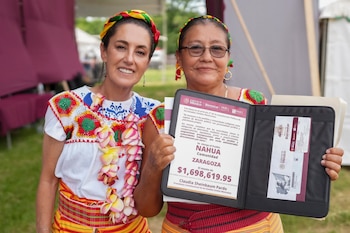
During her visit to Veracruz, President Claudia Sheinbaum emphasized a new resource allocation policy aimed at indigenous and Afro-descendant peoples , which have now been recognized by the Constitution for the first time in history. This significant step reflects an understanding of historical injustices and aims at fostering equity in resource distribution.
The commitment of the Mexican government towards the welfare of its marginalized communities, especially the youth and indigenous populations, is evident in both policy and practice. As social programs evolve and resources are allocated to address long-standing disparities, there is an optimistic outlook for a future where citizens can thrive in a just and equitable society.