
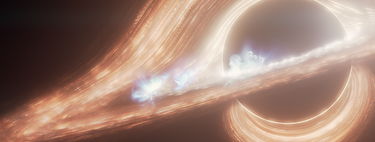
Bridging the Gap: Black Holes and Quantum Gravity
The two families of physics have not spoken for 100 years . Einstein’s general relativity effectively describes the large-scale universe —from the gravitational interactions of planets to the warp of space-time created by enormous masses. However, on the other end of the spectrum lies quantum mechanics , which delves into the bizarre world of subatomic particles . While both theories form the pillars of modern science, their fundamental incompatibility has made unifying them—a task dubbed the “Holy Grail of Physics”—a significant challenge. Exciting new research suggests the key to this unification might be hidden in the very heart of the universe’s most enigmatic objects: black holes .
The Impassable Wall of Physics presents a straightforward problem but a truly complex reality. Quantum mechanics has successfully explained three of the four fundamental forces of nature: electromagnetism , the strong nuclear force , and the weak nuclear force . Yet, gravity remains elusive. According to general relativity , our best current theory of gravity, the equation loses coherence in extreme environments—precisely where quantum effects should come into play, like in the heart of a black hole.
The most illustrative examples of this rupture are the singularities , points of theoretically infinite density found at the centers of black holes. For physicists, an infinity in any equation serves as an alarm signal, indicating that the theory has hit its limits. “We believe that general relativity only works on large or ‘macroscopic’ scales. However, at very short distances, or microscopic scales, it must be replaced by a quantum theory of gravity ,” explained Theoretical Physicist Xavier Calmet , author of a study published in Europhysics Letters .
A New Recipe for Black Holes is beginning to shed light on this frontier of physics. Previously, string theory stood as the primary candidate for unifying gravity and quantum mechanics, albeit without experimental validation . Calmet and his team have proposed an alternative approach, employing the effective action of Vilkovisky-Dewitt to calculate the universal quantum corrections needed for Einstein’s equations, taking precedence over any fixed underlying theory.
Upon applying these corrections, the team unearthed something remarkable: alongside black holes generated through general relativity, there exist black holes resulting from “quantum solutions.” These do not merely modify our existing black hole models but instead introduce entirely new theoretical constructs that thrive within a realm of quantum gravity .
What All This Means is a topic of profound significance. Einstein’s relativity holds up effectively for massive entities like planets and galaxies, presenting a smooth continuous world. Conversely, quantum mechanics operates at the microscopic level, where transactions appear to “jump.” However, explaining black holes poses a dilemma: while relativity engenders a singularity, implying that the theory ceases to function beyond that point.
What researchers have accomplished is akin to a mathematical “patch” to integrate fundamental quantum rules into the framework of relativity. This patch, the Vilkovisky-Dewitt action developed by physicists Georgy Vilkovisky and Bryce Dewitt , not only rectified the conventional understanding but also unveiled the existence of an entirely new type of black hole —one that defies the prior limits imposed by Einstein’s equations.
Can We Ever See Them? presents a puzzling question. The study elucidates how these quantum solutions might manifest near the event horizon , a demarcation beyond which nothing can escape the black hole’s grasp. Although these solutions theoretically differ from classical black holes, distinguishing between the two is currently an almost insurmountable task, as the polarities become evident solely in close proximity to the event horizon, a locale we cannot observe directly.
“The astrophysical black holes we are currently observing might actually be described by our new solutions rather than those of general relativity,” Calmet notes. “Given that both theories align over vast distances, it will be quite challenging to propose conclusive evidence delineating between these two types of solutions.”
The implications of this theory suggest that there could indeed be black holes framed within a quantum context. However, the enigmatic secrets of quantum gravity are firmly guarded by these cosmic giants: the resolution to one of modern physics’ greatest enigmas resides not in a particle accelerator , but quietly orbiting in the darkness of space .
Image | POT
In Xataka | The Webb Telescope has observed quasars where they should not be. Something fails in the theory of black holes.