
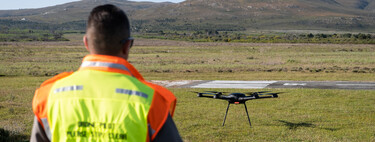
The Rise of Drones and Robots in Firefighting
In recent days, a video has gone viral on Chinese networks, showcasing a dramatic scene: a 150-meter skyscraper engulfed in flames at its upper levels. What makes this incident particularly fascinating is that the firefighting effort is being carried out not by human firefighters, but by drones .
Adding to the futuristic allure are robotic dogs that have been integrated into the Fire Department, assisting in combating the flames. This innovative approach represents a significant leap in firefighting technology.
Fire Drones. Fire can erupt suddenly, and fighting it poses risks to firefighters. In regions like Spain, where wildfires are prevalent, the use of robots and drones offers a safer and more efficient solution. These devices can reach great heights and locations that would take human firefighters much longer to access.
The viral video illustrates two distinct firefighting strategies utilizing drones. One is the most eye-catching: drones equipped with hoses that discharge water and foam to extinguish external flames. We’ve witnessed similar applications in China over the years.
Fighting Fire with Precision. Some drones can ascend to 200 meters and initiate firefighting efforts within 30 seconds —a feat no human can achieve under similar circumstances. This advance allows ground teams crucial time to prepare for rescue operations and secure the vicinity.
One such model, the HZH CF30, boasts six rotors and a payload capacity of 30 kilograms . Its versatility allows it to carry various tools, from emergency response kits to direct fire suppression missiles that can be deployed inside burning structures.
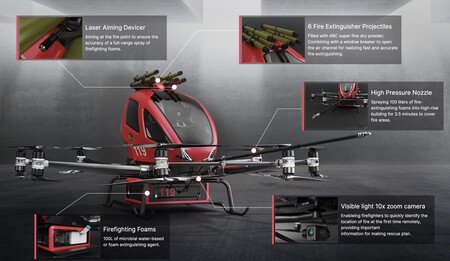
EHANG 216F, is another noteworthy example. This manned vehicle is designed for firefighting and assessment situations in high-rise buildings. With 16 propellers , a maximum speed of 130 km/h , and a flight duration of 21 minutes , this drone allows firefighters to access hard-to-reach areas and can function in two key capacities: identification and direct intervention.
Firstly, it helps in locating critical hot spots with its state-of-the-art camera and sensors like LiDAR . Secondly, it can actively discharge firefighting fluids through a pressurized nozzle, enhancing its functional versatility.
The drone can carry a payload of 220 kilograms , enabling fire stations to respond effectively to emergencies within a three-kilometer radius of their location.
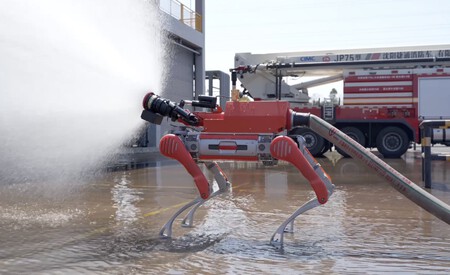
Unitree B2 is an exceptional addition to firefighting technologies, being a modular robot that prioritizes safety in hazardous environments. This robot is equipped to navigate through burning buildings, assess gas levels, and deploy water and foam to combat flames directly.
The Unitree B2 features a unique “shield” option to protect itself from overheating, enabling it to function even amidst extreme conditions.
Rescue Robots are becoming increasingly important in China, driven by backing from various companies and the government . The recent International Emergency Exhibition of the Yangtze River Delta showcased over 500 companies from 20 countries , displaying cutting-edge technology focused on safety, rescue, and disaster prevention.
This event highlights not only China’s advancements in firefighting technology but also reflects a global trend. Countries like Japan are also innovating, introducing devices like the “dragon firefighter” for similar essential roles. The convergence of technology and firefighting is essential in building safer communities, and innovations will continue to evolve in their ability to address both urban and natural disaster challenges.