
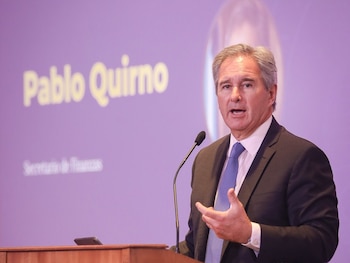
The Secretary of Finance, Pablo Quirno, recently made headlines by publicly responding to former president Cristina Kirchner‘s criticisms. Quirno’s response was laced with pointed questions revolving around Kirchner’s management and her claims regarding the nation’s economic situation, branding her policies as a form of “economic shamanism” that led to unprecedented levels of inflation and poverty.
His message directly challenged Kirchner’s comments on public debt and the prevailing financial climate, asserting, “How good he has time to write while we are correcting the economic barbarities he did during his direct participation in three national governments.” Quirno did not stop at mere criticism; he also pointed to Kirchner’s past judicial troubles, noting, “his direct participation in the facts for which he has been recently condemned after more than a decade of actions.”
Adding to his criticism, Quirno expressed disappointment over what he perceives as a lack of self-reflection on Kirchner’s part: “I regret that you do not use this time to reflect for the tremendous damage that has inflicted our beloved country.” He accused Kirchner’s government of instilling a brand of economic policy that only exacerbated the nation’s distress, resulting in historic inflation and escalating poverty levels.
Quirno’s critique extended to the restrictions on capital movement, which, according to him, painted Argentina as an uninviting environment for investors. He advocated for what he described as “a basic principle that he who invests his money can do with him what he wants,” highlighting the need for a more open and encouraging investment landscape.
In a strong rebuke, Quirno specifically criticized past economy ministers from Kirchner’s administration, using scathing descriptors. He labeled Amado Boudou as “the ideologue of expropriations” and criticized Hernán Lorenzino for his decisions that allegedly harmed the economy. He further ridiculed Axel Kiciloff for leaving behind a legacy of judicial cases, linking his policies directly to the current issues of insecurity and poverty.
Quirno also targeted Martín Guzmán, saying he was “responsible for the worst debt restructuring in history” and described Sergio Massa as someone who left the economy on the brink of hyperinflation. Each accusation was laden with consequences, showcasing Quirno’s inclination to hold former leaders accountable for their economic decisions.
Critically, Quirno emphasized the anti-deficit stance of the current government under Javier Milei, arguing that since its inception, the administration has made strides in correcting previous imbalances. He asserted that there is now an “unprecedented financial surplus in Argentine history,” an assertion he believes sets the foundation for not only refinancing but also reducing existing debt.
Highlighting achievements, Quirno cited an agreement with the IMF, which he described as a critical step in “strengthening the balance of the BCRA.” According to him, this agreement also allowed for a significant debt reduction amounting to “US $ 50,000 million from November 2023 to May 2025.”
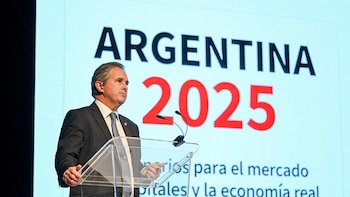
Quirno refuted any notion of a new model of indebtedness, asserting, “You will see then that there is no such structural indebtedness model but quite the opposite since we have reduced debt.” He aimed to debunk claims attributing financial woes solely to the current administration, insisting that the economic management of his government is far removed from past failures.
Further, Quirno championed the regime of incentives for large investments (Rigi), reiterating its pivotal role in private sector development. “The Rigi has more than a dozen investment projects of which 4 have already been approved,” he said, emphasizing their entirely private financing without state interference. This contrasts starkly with the past, which he characterized as a time when public works primarily benefited officials.
In response to Kirchner’s accusations, Chief of Cabinet Guillermo Francos reiterated a similar viewpoint, stating during an interview that there is an “indisputable improvement” in the economy, coupled with a noticeable increase in consumption rates in Argentina. This stands in stark contrast to Kirchner’s stark assessments regarding the financial stability of the nation.
In her recent publication on X, Kirchner articulated her concerns over Argentina’s fiscal policies, alleging, “You stay with Guita that is from the provinces. You have a half Argentina that does not arrive at the end of the month.” This indicates deep-rooted visibility of economic distress across various social strata, contending that borrowing has become a necessity for survival amid declining economic indicators.
Her commentary on currency outflows further underscored a critical observation, citing record amounts transferred abroad by the non-financial private sector. This exchange of currency paints a worrying picture, suggesting a lack of confidence in domestic financial stability and the sustainability of current policies.