
Unveiling the OpenAI Mafia: The New Wave of Tech Innovators
When eBay acquired PayPal in 2002 for a staggering $1.5 billion, it set off a seismic shift within the company. In just four years, only 12 of the original 50 employees remained. PayPal was a hotbed of talent, innovation, and brilliant minds; those who "escaped" from eBay ended up redefining the tech landscape. Now, we are witnessing a similar phenomenon, but this time surrounding OpenAI.
The PayPal Mafia: A Legacy of Innovation
The term PayPal Mafia refers to a group of exceptional former employees who left PayPal to establish their own startups, leading to remarkable successes in business and technology. This event is noteworthy in the history of Silicon Valley, as it highlights the potential that lies dormant within a talent pool. The most notable figures from this collective include:
Elon Musk: Perhaps the most recognizable figure from the PayPal Mafia, Musk went on to found or co-found SpaceX, Neuralink, and The Boring Company. He also acquired a majority stake in Tesla and bought Twitter (now known as X).
Peter Thiel: Serving as chairman of Palantir, Thiel also established the Founders Fund, attracting several ex-colleagues, including Ken Howery and Luke Nosek. He was also the first external investor in Facebook.
Steve Chen, Chad Hurley, and Jawed Karim: These three ex-PayPal employees co-founded YouTube, which revolutionized online video sharing.
Reid Hoffman: The founder of LinkedIn, Hoffman’s transition from PayPal to a tech titan showcases the potential for greatness that lies within the ranks of successful companies.
Russel Simmons and Jeremy Stoppelman: These two also left PayPal to co-found Yelp, a vital platform for consumer reviews.
Yishan Wong: After a stint at Facebook, Wong briefly served as CEO of Reddit.
- David O. Sacks: He went on to found Geni.com and Yammer.
Transformation of the Internet
These engineers and entrepreneurs played an integral role in the transition toward a consumer-focused internet. This change was particularly striking following the dot-com bubble burst in 2001. Few instances in history showcase former employees of a single company launching even more successful ventures than the one they departed, but there is a remarkable historical parallel worth exploring.
The Eight Traitors: Pioneers of Silicon Valley
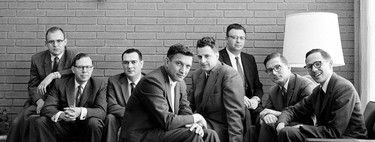
In 1957, eight engineers fed up with their boss at Shockley Semiconductor Laboratory decided to venture out and create their own semiconductor company. They named it Fairchild Semiconductor Corp and became known as the "Eight Traitors." Fairchild achieved tremendous success, but within a decade, several of its engineers sought new directions. Three of them—Gordon Moore, Robert Noyce, and Andy Grove—banded together in 1968 to create Intel, further cementing their legacy in technology.
The Genesis of the OpenAI Mafia
Today, a similar trend appears to be forming around OpenAI. This organization has emerged as a reference point in the field of artificial intelligence (AI). However, the internal conflict among engineers and their CEO, Sam Altman, has led to significant turmoil within the company. Internal tensions were highlighted by Altman’s firing and subsequent return in November 2023, marking a turning point for OpenAI.
Members of the OpenAI Mafia
The divisions that emerged within OpenAI began shortly after its formation. The first member of this new "OpenAI Mafia" also happens to be a prominent figure from the PayPal Mafia: Elon Musk. Other notable members include:
Dario and Daniela Amodei: These siblings co-founded Anthropic, focusing on developing the Claude AI model family.
John Schulman: Formerly a lead researcher at OpenAI, Schulman transitioned to Anthropic, joined by other ex-OpenAI talents such as Tom Brown and Jared Kaplan.
Jan Leike: After contributing to research at DeepMind and OpenAI, Leike joined Anthropic, working on scalable and "safe" AI models.
Ilya Sutskever: A co-founder and Chief Scientist, Sutskever left OpenAI in 2024 to start his own venture, Safe Superintelligence.
Mira Murati: The former CTO of OpenAI later founded Thinking Machines.
Josh Tobin and Vicki Cheung: These engineers left OpenAI to establish Gantry, another AI startup.
David Luan: Once a key engineering lead at OpenAI, Luan went on to co-found Adept AI Labs.
- Andrej Karpathy: After working on Tesla’s autonomous driving systems and later with OpenAI, Karpathy founded Eureka Labs.
A World of Promises and Uncertainties
The fundamental difference between the PayPal Mafia and the emerging OpenAI Mafia lies in the level of success achieved by the startups founded by these innovators. While the ventures stemming from the PayPal Mafia achieved massive success, the current startups from former OpenAI engineers remain largely untried. For instance, Safe Superintelligence has already raised $1 billion, and Thinking Machines is expected to secure $2 billion, but as of now, neither has launched a product. The excitement surrounding these ventures is palpable, but it remains to be seen if their impact will parallel that of the PayPal alumni.