
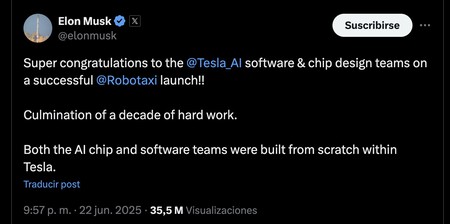
Elon Musk’s boastfulness was on full display this past Sunday, and rightfully so. Tesla’s robotaxis are finally coming to life, marking a significant leap forward in autonomous vehicle technology . Musk celebrated this milestone with a post on X , commending the team responsible for the launch. The achievement is notable not only because the robotaxis are functional but also because they are powered by Tesla’s homemade chips and software .
Tesla’s Robotaxis: A Vision Realized
“It’s good to have autopilot in planes; we should have it in cars.” This quote from Musk in 2013 initiated his ambitious quest to create fully autonomous vehicles. Since then, Musk has made numerous promises, and while some have been delayed, last weekend marked a significant breakthrough : the rollout of Tesla’s robotaxi service. However, it’s not the fully autonomous experience he initially envisioned. These vehicles began operating in Austin, Texas , but their functionality comes with strict limitations and only in designated areas of the city.
The Long Journey of Autopilot
Those 2013 statements sparked a remarkable journey for Tesla, which soon decided to move away from partnerships and develop its autonomous driving technology in-house. Initially, Tesla collaborated with Mobileye to utilize its sensors and hardware. However, this relationship took a decisive turn in July 2016, when Tesla began developing its own hardware for autonomous systems.
Evolution of Hardware
In late 2016, Tesla began to integrate its first proprietary hardware platform, Hardware 2 (HW2), into its vehicles, succeeding the Mobileye-dependent Hardware 1 . In August 2017, an upgraded version, HW2.5 , was released. However, the most critical version to date is Hardware 3 (HW3), launched in March 2019. This version featured 14 nm chips and was the basis for Tesla’s vehicles until early 2023, when Hardware 4 (HW4) was introduced, emphasizing Tesla’s commitment to improving its autonomous systems. The next iteration is expected to arrive in three to four years and will also utilize chips manufactured by Samsung .
Powerful AI Chipsets
Both HW3 and HW4 utilize chips derived from Samsung’s Exynos line. The HW3 model employed a 14 nm chip that featured 12 CPU cores and two neural network (NN) processors , offering an AI computing power of 36 TOPS. With the upgraded HW4 version, the chip is produced using 7 nm technology and includes 20 CPU cores along with three NN processors, delivering 50 TOPS of computing capacity. The cameras have seen significant enhancements too, upgrading their sensors from 1.2 MP to 5 MP, alongside improvements in Tesla’s Vision system.
Level 2 Autonomy
Despite these advancements, Tesla’s autonomous driving software remains classified as Level 2 autonomy , which positions it behind competitors such as Mercedes and Ford. Currently, the Full Self-Driving (FSD) system can autonomously control the vehicle, but the driver must always monitor its operation and be ready to take over. According to a comparative analysis conducted in March 2024, FSD was rated as having “poor” capabilities, although this assessment applied to most systems reviewed.
The Role of Software
The hardware innovations are complemented by advancements in the software platform that supports the FSD system. Tesla employs deep neural networks (DNN) that have been trained using extensive datasets gathered from millions of kilometers driven by Tesla vehicles worldwide. A particularly noteworthy upgrade was the transition from FSD version 11 to version 12, which adopted an end-to-end architecture . This innovation has allowed vehicle control to be managed directly by the neural networks, eliminating reliance on distinct programming rules or modular systems for perception and driving management.
The Dojo Supercomputer
In 2021, Tesla revealed its supercomputer , dubbed Dojo , designed to enhance the FSD models through more effective machine learning. By April 2024, Dojo had already integrated 35,000 NVIDIA H100 chips , illustrating the company’s commitment to refining its AI capabilities.
Avoiding LiDAR
From the outset, Tesla chose not to incorporate LiDAR technology , which is a staple in systems employed by companies like Waymo. Despite critiques from industry experts, Musk has remained steadfast in his decision to avoid this technology, opting instead for a combination of radar, cameras, and ultrasonic sensors . In 2021, Tesla shifted its focus to an array of eight cameras and 12 ultrasonic sensors, which helped cut hardware costs, although some analyses suggest this could lead to avoidable accidents.
The landscape of autonomous driving is continually evolving, and while Tesla’s latest developments are promising, challenges remain. The onus is on the company to prove that its technology can match or exceed the capabilities of its rivals, and to ensure that it provides a safe, effective solution for consumers. As the journey toward full autonomy continues, the world will be watching closely to see how Tesla navigates this transformative era.