
The NATO Summit and Spain’s Military Spending Debate
As the highly anticipated NATO summit approaches in The Hague, an unexpected player has emerged in the discussion surrounding military spending: Spain . The Spanish Prime Minister, Pedro Sánchez , has resisted calls to boost military expenditure to 5% of the country’s GDP, sparking a tug-of-war between Madrid and the NATO Alliance. This has led to a last-minute pact that grants Spain increased flexibility regarding its military budget obligations. The crux of the situation will revolve around whether Spain meets the agreed targets, not the necessity of reaching the 5% threshold.
This position opens up a fundamental debate: should defense capabilities be determined based on an arbitrary percentage or based on the actual needs of each country? Furthermore, do general spending thresholds truly serve a purpose?
A Percentage: 5%. Central to the ongoing discussions within NATO is a specific figure: 5% , the proportion of GDP that, according to the Alliance, every member should allocate to defense investment. More specifically, NATO proposes that 3.5% should cover basic spending, while the remaining 1.5% is allotted for “related investments,” enabling the inclusion of infrastructure or expenditures on defense industries.
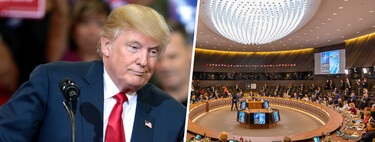
This figure is not random. It mirrors the demands set forth by former President Donald Trump , who, prior to even taking office, criticized NATO for the perceived underinvestment by its members, claiming that the Alliance was “taking advantage” of the United States.
A Protagonist: Spain. With this backdrop, the NATO Alliance recently specified its new demand: members should increase defense spending to 5% of GDP by 2035. This agreement was complemented by an investment plan and a set of new targets to be validated at this week’s summit in The Hague. However, before the meeting, Spain emerged as a vocal opponent, unwilling to meet the 5% target.
“For Spain, committing to a 5% target would not just be unreasonable; it would be counterproductive,” warned Pedro Sánchez in a letter addressed to NATO Secretary-General Mark Rutte . In his correspondence, he emphasized that increasing defense investment to 5% of GDP would be “incompatible with our welfare state and worldview.” With this stance, La Moncloa positioned itself as a lone voice within the Alliance, even causing frustration in Washington.
The Shift: A Letter. The disconnect between NATO’s leadership and Madrid was short-lived. Recently, Sánchez announced that both parties reached a new agreement that allows Spain greater discretion in determining how much of its GDP will be dedicated to meeting NATO’s objectives. In essence, the country commits to achieving NATO’s new military capacity objectives without needing to allocate 5% of its GDP. The focus will be on reaching the goals, not on the means to achieve them.
Sánchez even shared Mark Rutte’s letter via social media, confirming that NATO would allow for this flexibility . In it, Rutte stated: “I assume Spain is confident in its ability to meet the new capacity objectives with spending below 5% of GDP.” He also confirmed that the agreement to be reached at the upcoming NATO summit would grant Spain the sovereignty to chart its own path towards meeting the target, with progress evaluations scheduled for 2029 .
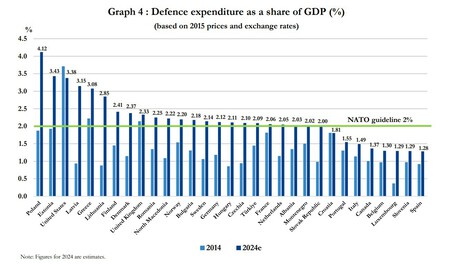
A New Percentage: 2.1%. This raises the question: how much is Spain set to invest? In 2014 , NATO set a goal for defense spending to hit 2% of GDP, yet many member nations fell short of this benchmark. Countries like Portugal , Italy , and Canada have made efforts to achieve compliance ahead of the summit. Data reveals that Spain’s defense spending was approximately 1.3% of GDP last year, prompting its government to aim for 2% this year. However, it seems disinclined to extend beyond that threshold.
“Spain will require 2.1% of its GDP to acquire and maintain all personnel, equipment, and infrastructure required by the Alliance to address the threats we face,” asserts Sánchez. He emphasizes: “The 2.1%, neither more nor less.” Transitioning from 2% to 5% by 2035 would necessitate an extra €350 billion , a burden that could only be alleviated through significant tax increases or cuts to social spending.
The Underlying Debate: Capability vs. Percentage. The Spanish case is notable not just for its implications within NATO but also for the broader discourse it initiates: does it make sense to tie defense objectives to GDP expenditure percentages? What purpose do such general thresholds serve? Sánchez has delved into this discourse, questioning the efficacy of a shared 5% spending objective among NATO’s 32 members.
“Consider that, for instance, in some countries, the average salary of a soldier is three times higher than in others that are also NATO members. Moreover, producing or acquiring those defense capabilities can cost half as much in certain nations,” reasons the Socialist leader. Such insights are not isolated, as they have been echoed in various discussions about defense adequacy and funding allocations.
A Warning: “Insufficient”. In a recent piece published by the Australian Strategic Policy Institute , authors Andrew Horton and Putri Handrianti argue that quantifying defense spending as a percentage of GDP can be simplistic and potentially misleading. They caution that relying on this percentage may overlook the complexities of modern defense scenarios, potentially misallocating valuable resources. They highlight that in today’s nuanced landscape, mere percentages may not reflect actual deterrent capabilities or the defense of national interests.
A Question: Political or Defense? Professor Aurelia Valiño Castro contributed to this discussion with reflections in the essay published by ICEI: “The 2% of GDP for defense is more a political commitment than a definitive guarantee of security. However, its effectiveness hinges on smart investment.” She emphasizes that the central challenge for Spain is not merely to boost spending but to redesign how that expenditure responds to contemporary European security threats.
Additionally, she warns of the importance of ensuring precise comparisons to avoid discrepancies. “GDP calculations can vary significantly across nations,” she notes, pointing out that illegal activities included in GDP measurements by the EU could distort overall figures, thereby skewing the perceived allocation for defense spending.
In summary, Spain’s situation highlights ongoing tensions within NATO regarding military spending, prompting essential conversations around defense strategies that weigh funding against actual capability needs. The discussions are set to continue notably at the upcoming summit, where key decisions regarding member nation responsibilities will take shape, shaping not just military capability but also alliances in an ever-evolving global landscape.
Images | General News – 2