
Understanding the Current State of the Diamond Market: A Diamond Dilemma
Few things symbolize luxury quite like a beautiful diamond . Sparkling in displays on the most exclusive miles of Paris, Milan, or New York, they adorn the hands of Hollywood actresses and the watches of the planet’s most valued athletes. However, the diamond market is going through turbulent times. Specifically, we are witnessing a dramatic drop in prices as various intrinsic and extrinsic factors combine to create a perfect storm, leading many analysts to suggest that diamonds are now at their lowest values in over two decades.
Price Trends: A Downward Spiral
No matter which source you consult, the word is clear: the diamond industry is not currently thriving. The pinnacle of luxury, diamonds are experiencing a sharp and sustained decline in value, following a brief period of exceptional demand between 2021 and 2022. Back then, the market boomed, largely due to couples who postponed engagements and weddings during the pandemic.
Recently, Barchart, a financial data platform, unveiled a graph illustrating the plummeting trajectory of diamond prices since 2022. According to Paul Zimnisky’s price index, there has been a marked decline since the pandemic, though it hasn’t yet reached historical lows. Similarly, DiamondSE and PriceScope data reveal that natural gem prices are currently at levels not witnessed since 2008.
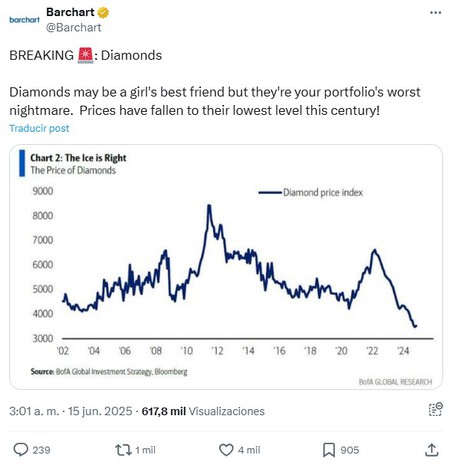
Click on the image to view the tweet.
When examining the figures, it becomes evident that the diamond industry has seen better years. In February, Bloomberg reported that, in just two years, prices for rough diamonds had plummeted by nearly 50% and polished stones by around 35%. Around the same time, The Guardian revealed that natural diamonds were now priced around 26% lower than two years ago, a substantial drop that appears even more dramatic when compared to the sharp increase in prices of lab-created diamonds since 2020.
The Causes Behind the Collapse
So, what is driving this price decrease? The reality is that there is no single answer; rather, a combination of factors has contributed to this downturn. Analysts point to a shift in demand following the health crisis, where initial increases post-pandemic gave way to market saturation. In the U.S., there has also been a decrease in weddings, which means fewer engagement rings are being purchased. Additionally, the ongoing Russo-Ukrainian war has had its ripple effects on the diamond sector.
Another crucial factor is the situation within the Chinese market. According to Bloomberg, Chinese demand has dropped by 50% since the pandemic. Industry experts note that retailers in China are sending back between 30 and 40 million dollars worth of polished diamond excesses to the Indian wholesale market each month. All this occurs in a challenging economic landscape for Beijing.

Real Diamonds vs. Lab-Created Diamonds
One significant factor affecting the global diamond industry is the emergence of synthetic diamonds , grown in labs, which have fundamentally changed the market landscape. Unlike natural diamonds that require millions of years to form, lab-grown diamonds can take just weeks or even hours to create.
Synthetic diamonds are not a recent innovation; their inception dates back to the 1950s. However, their presence in the market has significantly surged in recent years for various reasons. They are often considered more ethical due to easier traceability compared to mined diamonds, particularly appealing to *millennials*. Moreover, they can be up to 70% cheaper than natural stones, allowing consumers to afford more sizable gemstones.
According to a jeweler interviewed by *The Guardian*, “These stones are often two or three times larger. In lab-grown diamonds, three-carat stones are common, even four or five-carat.” Their allure has attracted the attention of high-end jewelry and watch brands, capturing market shares that even exceeded expectations. However, not everyone agrees on their value; some jewelers argue that these synthetic diamonds are mass-produced and lack the historical significance of natural ones, leading them to predict ongoing price declines.
The Growing Influence of Synthetic Diamonds
In 2023, *Cinco Días* published a graph illustrating the increasing market share of lab-grown diamonds, particularly in the U.S. engagement ring segment . Beginning in early 2021 with only 3.5% of market share, that figure ballooned to nearly 18% by the summer of 2023. Further reports from *The Guardian* speculated that lab-grown diamonds may soon account for 45% of the bridal jewelry market.
This growing market share has been accompanied by the phrase overproduction . Analyst Paul Zimnisky noted in a conversation with *The New York Times* that a small group of large producers in China and India are rapidly increasing output with improved processes. This has led to unit costs becoming significantly lower; estimates suggest that lab-grown diamond prices dropped by 85% from 2015 to 2025.
As a result, lab-created diamonds have become exceedingly accessible: you can now acquire a beautiful, round, ideal lab-grown diamond of one-carat for approximately $900 , compared with around $5,000 for its natural counterpart. This price disparity has significantly disrupted traditional players in the industry.
Industry leader De Beers began 2024 with a whopping $2 billion worth of diamonds unsold, compelling them to drastically lower their mining output. Other companies in the sector have faced similar fates, with some Indian factories being forced to shut down or go up for sale. As one analyst from RBC Capital Markets noted, “There’s no clear solution right now. The market needs to recalibrate.”
In conclusion, the diamond market is currently undergoing an unprecedented transformation. Factors such as dwindling global demand for natural stones, the shift towards more ethical lab-grown alternatives, and overproduction in China’s diamond industry are redefining the landscape of luxury jewelry. As prices continue to fluctuate, it remains to be seen how consumers and industry leaders will adapt to these changing tides.
Images | Dillon Wanner (Unsplash)