
The recent expansion of Line 11 of the Madrid Metro aims for more than just adding stations; it aspires to become a major diagonal axis that connects the city in a transversal way. This ambitious and complex project demands machinery that meets the rigorous expectations of urban tunneling. At the heart of this operation is Mayrit , the tunnel boring machine (TBM) specifically designed for the geological and geotechnical conditions of the Madrid territory. As it prepares to be integrated into one of the most significant public transport developments in the capital, its role cannot be overstated.
A Tunnel Boring Machine Tailored for Madrid’s Subsoil
Mayrit has been completed and manufactured by Herrenknecht AG , a globally recognized firm specializing in tunneling machinery. The TBM was developed in their factory located in Schwanau, Germany, over a period of 20 months. Mayrit stands out not just for its design but also for its practicality—it’s an EPB (Earth Pressure Balance) model, crafted specifically to excavate cohesive soils similar to those found in Madrid. This colossal machine measures 98 meters in length, weighs 1,500 tons , and can advance up to 15 meters per day . Typically, it is capable of completing around 500 meters a month , operated by teams of twelve personnel per shift.
The Logistics of Transporting Mayrit
The logistical complexity of transporting such a machine to Madrid is considerable. Mayrit must be completely disassembled piece by piece at its origin within three months. Following that, it will undergo a 2,000-kilometer journey involving road transport to Antwerp, maritime shipping to the Port of Santander, and finally, truck transport to the new Comillas station in Carabanchel. Upon arrival, a reverse assembly process will take place, expected to last until March 2026 , when operations are set to commence.
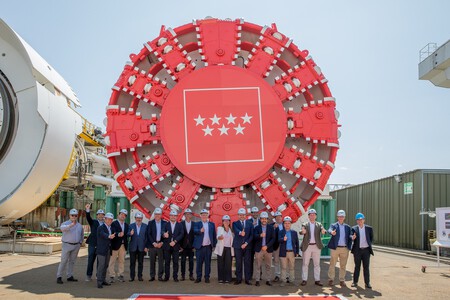
The primary function of Mayrit will be to bore the tunnel for the section between Plaza Elíptica and Conde de Casal , one of the most challenging phases of the expansion. Work in this section is currently 18.4% complete , with the regional government announcing a hefty investment of 518 million euros for this phase alone. Additionally, manual excavation works are already underway, spanning 700 meters between Comillas and Plaza Elíptica, advancing at a rate of approximately 50 meters per month . This groundwork aims to ready the terrain for when Mayrit begins her task.
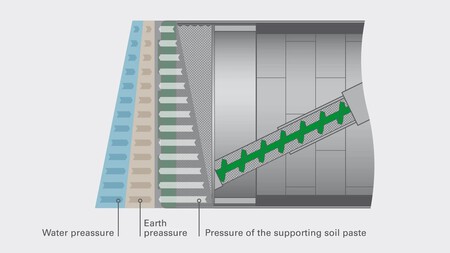
But beyond the rhetoric, the technology driving Mayrit is highly sophisticated. Inside the machine, a screw conveyor transports the excavated material to a conveyor belt, while pressure sensors provide the ability to monitor the balance of forces in real time within the excavation chamber. This technology is crucial for maintaining front stability and preventing subsidence, even in environments with heterogeneous materials like gravel, water, or sand.

Moreover, the system can adapt on the fly to different geological scenarios. Herrenknecht has integrated several solutions that convert the output of the spoon into a washing circuit, allowing it to handle slurry conditions when necessary. Other modules enable the adjustment of soil consistency through injections of bentonite, water, or foam. The arrival of Mayrit in Madrid is expected in December, setting the stage for a new era in urban underground transport.
Images sourced from Metro de Madrid and Herrenknecht.