

U.S. Involvement in Israeli Operations Against Iran: A Turning Point
In a significant geopolitical development that has captured the attention of U.S. media, former President Donald Trump and Israeli Prime Minister Benjamin Netanyahu engaged in a critical phone call just hours ago. While the specifics of their conversation remain undisclosed, it signals a possible shift in U.S. policy regarding direct intervention in Israel’s efforts to undermine Iran’s nuclear capabilities. The underlying sentiment seems to suggest that the only way to reach the Fordow facility—an underground complex crucial to Iran’s nuclear program—is through a decision by Washington.
A Pivotal Decision Ahead. Trump now finds himself at a crossroads that may define the remainder of his presidency: deciding whether or not to join Israel’s military endeavors against Iran. Following his attendance at the G7 summit in Canada, Trump convened a high-level meeting that included discussions with Netanyahu. On social media, he asserted that the U.S. had “total control of Iranian airspace,” warning Supreme Leader Ali Khamenei that he was an “easy target” and demanding “unconditional surrender,” though failing to clarify the terms.
Until recently, Trump had advocated for a diplomatic solution to Iran’s nuclear ambitions. However, his recent rhetorical shift and military posturing—including the deployment of bombers and naval destroyers—indicate that he is seriously contemplating direct intervention.
Shifting Postures. Reports from The New York Times indicate that this transition toward a more assertive U.S. stance has been developing over recent weeks. Trump has increasingly leaned toward a military approach, spurred by Netanyahu’s persistent pressure for action. While attempting to keep channels open for negotiation with Tehran—reaching out even with a personal letter to Ayatollah Khamenei—U.S. intelligence flagged that Israel was planning an imminent attack on Iran’s nuclear program, irrespective of American support.
According to the Times, Netanyahu expressed frustration at the prolonged restraint he has encountered from U.S. presidents, hinting at a willingness to launch a significant offensive, not only against nuclear facilities but potentially against the Iranian regime itself.
This direct threat, combined with Trump’s growing skepticism about Iran’s commitment to a legitimate agreement, has shifted the discourse. Initially resisting Netanyahu’s request for bunker-busting bombs, Trump has since offered intelligence support and now weighs the potential deployment of B-2 bombers and heavy weaponry against Fordow, the heart of Iran’s nuclear enrichment efforts.
Symbolic Weight of Military Action. The implications of this shift are not merely military; they are also symbolic. Trump’s intent to portray himself as a strong leader defending Israeli interests influences this change. As military successes—such as the killing of Iranian military leaders—mount, Trump appears to be nudging toward a more visible American role in the conflict.
The Objective at Fordow. The key to this evolving conflict centers on the Fordow facility, an underground site that is heavily fortified against aerial attacks. Housing centrifuges crucial for uranium enrichment, this location is deemed nearly impenetrable due to its extensive protection—consisting of up to 90 meters of rock. Recent reports indicate Iran’s acceleration of uranium production at Fordow to 60%, dangerously close to the threshold for weapons-grade material.
While Israel has made attempts to strike at its core infrastructure, success has been limited due to the absence of advanced weaponry like the GBU-57 Massive Ordnance Penetrator (MOP). This bomb, designed for deep penetration of fortified structures, signifies that only the United States possesses the technical capability to target such locations effectively.
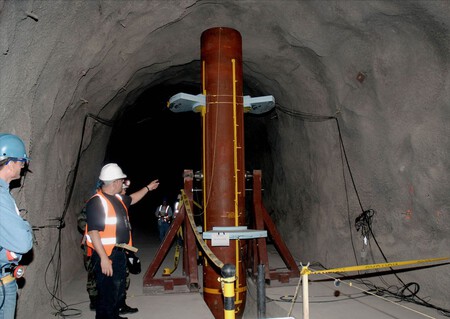
MOP tested before its first explosion in 2007
The MOP is not merely any explosive; it is a precision weapon capable of penetrating up to 60 meters into solid rock before detonating. This capability is crucial for effectively striking subterranean and fortified Iranian installations that are designed to withstand extensive bombing.
Consequences of U.S. Involvement and the Path Ahead
While the U.S. possesses the technology and logistical capability to launch an attack on Fordow, such a move would have irreversible consequences. Striking this underground facility would not merely involve targeting centrifuges; it would symbolize an all-out assault on Iran’s nuclear resilience and send a resounding message on a global scale. However, it would also cross a point of no return, raising stakes not just militarily but politically.
As the situation develops, many will be closely monitoring U.S. movements. The eyes of the world are now fixated on a mountain just south of Tehran, where the future of regional stability hangs in the balance.