

AI: A Tale of Two Economies
The world of artificial intelligence (AI) is rapidly evolving, mirroring the dynamics of other technology-driven markets. Just as various products are available at different price points—with a basic smartphone costing around 200 euros and high-end models reaching 1,000 euros—the same duality exists within the realm of AI. This divide raises important questions about accessibility, performance, and the future of AI applications for everyday users.
Affordable AI Solutions: The Introduction of Gemini 2.5 Flash Lite
Recently, DeepMind introduced its latest model, Gemini 2.5 Flash Lite, as a more cost-effective alternative for users. Priced at three to six times less than its standard counterpart, this model is designed for users who prioritize affordability and quick processing times over performance. Despite not being the most advanced model available, Gemini 2.5 Flash Lite demonstrates a growing trend towards budget-friendly AI solutions that cater to a broader audience.
The McDonaldization of AI
The commercialization of AI has ushered in a "McDonaldization" effect, where users can choose between basic, low-cost models and high-end, premium solutions. This distinction became even more pronounced as the market has expanded to include various pricing tiers for AI models. While free and low-cost AI models provide satisfactory services for the masses, higher performance tools come at a higher price. Users must now navigate a landscape where price and quality are inextricably linked.
Free vs. Premium AI: A Changing Landscape
The disparity between free AI services and those costing around 200 to 250 dollars per month continues to widen. Premium models from giants like OpenAI and Google are often priced to reflect their advanced capabilities, making them accessible primarily to those who can afford them. While this shift may seem unnecessary, it highlights a distinct pay-to-play approach in the AI industry.
Advantages of Free AI Models
However, it’s essential to acknowledge that free AI models are still highly effective. For the majority of users, these offerings cater to everyday tasks and perform remarkably well. The competitive landscape has forced companies to improve their free models significantly, ensuring they remain viable alternatives to pricier options.
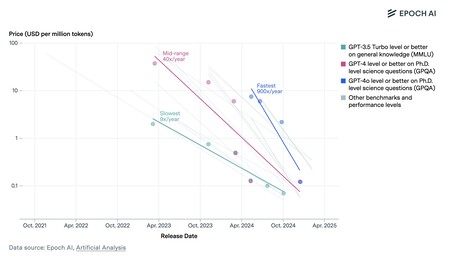
The cost per million tokens (in dollars) has been on a declining trend for two years. Source: Epoch AI (click on the image for an interactive graph).
Cost Trends in AI
Recent price cuts by OpenAI on its models underscore an ongoing trend of decreasing costs. For instance, the introduction of their advanced model, o3 Pro, comes with a hefty price tag but promises greater capabilities. Yet, these advanced models are only necessary for specific users who require detailed, specialized input for their tasks, particularly in competitive fields.
The Price of Exclusivity
The availability of premium features is increasingly limited to users willing to pay hefty fees. For instance, Google’s AI Ultra plan, priced at 250 euros per month, is set aside for users who need to exploit more extensive features like advanced video generation. Such exclusivity raises questions about market accessibility and potential barriers for those unable to afford it.

The Value of Investment in Advanced AI
Spending on AI can seem excessive, especially when free models are available. Nevertheless, investing in superior AI tools often results in higher productivity—whether that means doubling output or cutting work time in half. The value derived from premium services, therefore, can justify the expense. As noted by industry experts, a good AI model can alleviate the burden of 80% of a user’s workload.
The Future: A Two-Tier Market
As seen in various industries, this dual pricing strategy in the AI field may lead to a widening gap between the AI-rich and the AI-poor. Those with access to premium tools may harness greater capabilities, subsequently leading to an unbalanced competitive landscape where opportunities are unequally distributed.
The AI sector is evolving into a marketplace defined by both quality and cost, akin to the automotive industry. Just as consumers differentiate between basic and luxury vehicles based on their needs and budgets, the same can be said for AI tools. Companies that can afford the latest advancements will likely dominate, while others may find themselves at a disadvantage. Consequently, the impact of economic disparity on AI access will shape the landscape for years to come.