
The Complexity of Iran’s Nuclear Aspirations
Few phrases have been as recurrent in Western geopolitics as “Iran is five years away from a nuclear bomb.” For over three decades, we’ve heard predictions placing the Iranian regime on the brink of crossing the nuclear threshold, a countdown that resets repeatedly without the prophecy being fulfilled.
The real issue isn’t necessarily what we know about Iran’s nuclear program, but rather the enormity of what we don’t know. It is within this fog of uncertainty that some of the most dangerous decisions are made.
An ambiguous red line as a casus belli. Israeli Prime Minister Benjamin Netanyahu has launched a war against Iran, framing it as the regime being “close to completing the construction of a nuclear bomb.” This language transforms a longstanding threat into an immediate danger , turning the rhetorical red line into a justification for war.
Although the United States initially denied direct involvement in any attack, political and military support has been growing . A bold statement from former President Donald Trump declaring, “IRAN MUST NOT HAVE A NUCLEAR WEAPON!” serves as a blank check for Israel.
Three decades of unfulfilled predictions. When suspicion, rather than evidence, becomes a reason for war, it’s worth revisiting history to place rhetoric in context. The sense of an “imminent nuclear bomb” in Iran is nothing new. It’s a political construct that has been developing for decades, with Netanyahu as its chief architect.
As far back as 1992, Netanyahu warned that Iran was “three to five years” away from obtaining nuclear weapons. In 2012, he became iconic for drawing a red line on a caricatured diagram of a bomb at a UN meeting, claiming that Iran would cross the line by the summer of 2013. Each deadline has passed without the weapon materializing.
What intelligence agencies say. Despite having the United States as its primary political ally, Israeli rhetoric about Iran was not convincingly echoed by American intelligence agencies. In 2007, the CIA’s National Intelligence Estimate concluded with “high confidence” that Iran had halted its nuclear militarization program, known as Project Amad .
This cessation was verified in 2015 with the Joint Comprehensive Plan of Action (JCPOA) , an agreement in which Iran limited its uranium enrichment to 3.67% in exchange for sanctions relief.
The rupture that ignited the fuse. Paradoxically, the US withdrawal from the JCPOA in 2018—driven by the same “imminent bomb” rhetoric—provoked the very response it sought to avoid. Iran began enriching uranium at unprecedented levels: initially to 20%, then to 60%, drastically shortening theoretical timelines for a bomb, which has triggered the current crisis.
However, beyond the expansion of enrichment facilities, there is no evidence that Iran possesses the technology necessary or is developing those weapons. Logically, there wouldn’t be, as much of the activity is underground .
A leap of faith between enrichment and a nuclear bomb. To understand how “close” Iran is to a nuclear bomb, it’s crucial to differentiate between two core processes. First, there’s the fuel : uranium enrichment, the visible part of the process. This involves raising the concentration of the fissile isotope U-235 from its natural state of 0.7% to 90% (the weapons-grade level). Following the JCPOA’s withdrawal, Iran has amassed a substantial amount of uranium enriched to 60% . Transitioning from 60% to 90% is a technically feasible leap within weeks.
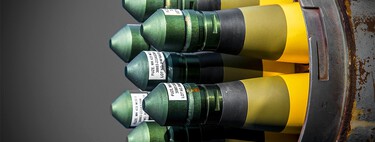
However, having fuel does not equate to possessing the motor, which the Anglophones refer to as “weaponization.” This requires a complex series of steps to convert fissile material into a functional warhead that can mount onto a missile. The uranium must be transformed from gas into a metal sphere , encapsulated with high-precision explosives that must detonate simultaneously within microseconds to compress the core and trigger a chain reaction.
Furthermore, all of this must come in a package small and light enough to fit into a missile warhead and survive launch. Here we enter an area of almost total uncertainty . We know Iran investigated this with Project Amad, but what remains unknown is the current status of their progress. Nevertheless, no one knows for sure because intelligence on underground activities is incredibly difficult to obtain.
What we know for certain. Despite decades of sanctions, sabotage, targeted killings of scientists, and cyberattacks (such as the infamous Stuxnet , which destroyed uranium centrifuges), the Iranian nuclear program has not only survived, but has become more robust and self-sufficient.
Iran designs and mass-produces its own advanced centrifuges. In fact, Israel’s primary objective is to destroy the Fordow facility , which Iran built underground to protect it from air attacks. Concurrently, Iran has developed the largest and most diverse ballistic missile program in the Middle East, supported by a fleet of launch-ready trucks.
This resilience indicates that technical knowledge is deeply rooted within the regime, which is why Israel has targeted key figures responsible for the nuclear program, as well as Iranian missile launchers. Simultaneously, each Israeli attack may reinforce Tehran’s belief that acquiring a bomb is the only guarantee of survival—a vicious circle driven by Netanyahu’s rhetoric.
Iran in the reflection of North Korea or Pakistan. Beyond Western rhetoric, two countries provide key lessons regarding Iran. North Korea developed its nuclear program to ensure the regime’s survival. Isolated and economically devastated, it viewed the bomb as its only insurance against potential US-imposed regime change. Sanctions and pressure merely strengthened its resolve.
Pakistan pursued a strategic imperative to neutralize India’s military superiority. After India tested its first bomb in 1974, the Pakistani bomb became a matter of national survival.
Iran represents a hybrid and more complex case. It shares the survival logic of North Korea against Israel and the US, while simultaneously holding regional strategic ambitions akin to Pakistan’s against Saudi Arabia. This duality adds complexity to diplomacy and makes its “red line” difficult to decipher.
Thus, the narrative of a clear countdown to an Iranian bomb is a dangerous fiction . It fixes our attention on a singular measurable metric: uranium enrichment. Yet whether Iran can transition from there to mustering the technology necessary for developing nuclear weapons remains to be seen. What seems to have accelerated matters is that, if the Iranian regime survives, an Israeli attack might only push it toward a more determined nuclear race.
Image | Omid Vahabzadeh (Fars News)
In Xataka | What Israel seeks in Iran is hidden: it’s called Fordow and it is concealed beneath a virtually impenetrable mountain.