

The Challenge for AMD in the AI GPU Market
AMD has consistently struggled to compete with NVIDIA in the highly competitive AI GPU market. Despite unveiling promising new models, the company faces an uphill battle against NVIDIA’s dominance, which commands around 85% of the AI chip market according to IDC. Other analysts like Jon Peddie Research estimate this percentage to be even higher at 92%. These statistics underscore the significant challenge AMD faces in gaining market traction.
A Promising Start: AMD’s Instinct MI350
The AMD Instinct MI350 series is just the beginning of what the company hopes to achieve. They have branded their AI GPUs as "accelerators" and showcased their new family, which includes the MI350X and MI355X. According to AMD, these chips represent a fourfold increase in overall performance over their predecessors and boast an astonishing 35-fold increase in AI inference performance. Equipped with 288 GB of HBM3E memory and memory bandwidth of 8 TB/s, they deliver an impressive 18.45 PFLOPS in FP4 precision and 9.2 PFLOPS in FP8 precision.
Instinct MI400: The Future of AI Acceleration
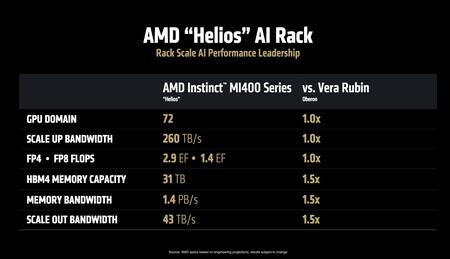
Set to release next year, AMD’s future Instinct MI400 family promises to raise the bar even further. These accelerators will feature up to 432 GB of HBM4 memory and a bandwidth of 19.6 TB/s, providing a staggering 40 PFLOPS in FP4 precision and 20 PFLOPS in FP8 precision. Designed to be housed in future racks with Helios infrastructure, these systems will have the capability to accommodate up to 72 MI400 chips, achieving a total bandwidth of 260 TB/s thanks to the Ultra Accelerator Link technology.
AMD’s EPYC Venice Servers
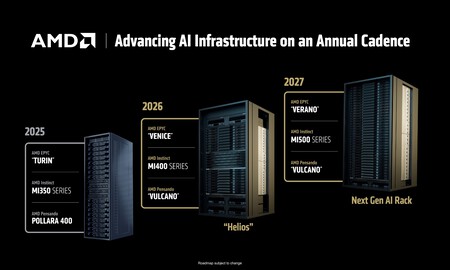
But AMD’s ambitions don’t stop at GPUs. The company is also in the process of developing its next-generation server processors known as EPYC Venice, expected to launch in 2026. Based on the Zen 6 architecture, these chips will include a variant boasting 256 cores, providing a remarkable 70% increase in performance compared to the previous generation. Furthermore, they’ll be paired with the upcoming Instinct MI400, manufactured using TSMC’s cutting-edge N2P 2 nm process.
Competitive Landscape: Helios vs. Oberon
The Helios rack is intended to directly compete with NVIDIA’s existing AI server, the GB200 NVL72, which combines 36 Grace CPUs with 72 Blackwell GPUs. Future developments, codenamed Oberon, will involve AI GPUs featuring the Vera Rubin architecture, promising extraordinary performance capabilities, including 1.4 ExaFLOPS in FP8 precision.
AMD claims it can match or even exceed NVIDIA in areas like memory bandwidth and capacity—vital metrics for effective AI training and inference. However, NVIDIA’s forthcoming Rubin Ultra architecture, expected to launch by the end of 2027, threatens to further broaden the performance gap by potentially offering 5 ExaFLOPS in FP8.
The Next Generation: EPYC Verano
AMD’s roadmap extends beyond immediate releases. They are also laying the groundwork for the next generation of EPYC processors known as Verano, which will replace EPYC Venice. These CPUs are expected to be coupled with the future Instinct MI500X, possibly utilizing the anticipated A16 1.6 nm technology from TSMC slated for late 2026. No specifications have been disclosed, as it largely depends on the manufacturing process AMD decides to deploy.
AMD’s AI Strategy Revealed
AMD’s announcements signify its determination to catch up in the race for AI solutions in datacenters worldwide. Recently, Crusoe, which specializes in building large AI data centers, declared a $400 million investment in AMD’s AI chips. Notably, Sam Altman, CEO of OpenAI, appeared during AMD’s event, affirming that they will be utilizing AMD chips in their data centers while praising the potential of AMD’s new GPUs as “amazing.”
Cost Efficiency as a Competitive Edge
One of AMD’s key messaging points during the event highlighted the cost efficiency of its products. The company asserts that its MI355 GPUs provide higher efficiency and are more economically viable than NVIDIA’s offerings. While exact pricing details remain undisclosed, reports indicate that AMD’s MI300X can cost around $15,000, significantly lower than NVIDIA’s H100, which can exceed $40,000.
CUDA: The Major Hurdle
Despite promising performance figures, AMD’s major hurdle lies in the software domain. While previous assessments showed that AMD’s MI300X GPUs outperform NVIDIA’s H100 and H200 in raw performance, the industry’s reliance on CUDA, NVIDIA’s proprietary software, limits adoption. Developers find AMD’s native software inefficient and prone to errors, making AI model training a challenging endeavor.
Searching for Solutions: The Hope in ROCm
To tackle this issue, AMD introduced ROCm 7, the latest iteration of its open-source programming platform tailored for its GPUs. AMD claims that ROCm 7 is 3.5 times more powerful than its predecessor and purportedly surpasses CUDA by 30% in certain tasks. However, challenges remain in fully utilizing this software’s capabilities to unlock the potential of AMD’s AI chips.
In sum, AMD is on a strategic path to make significant strides in the AI GPU market. However, the company must focus on both hardware performance and software efficiency to establish a competitive edge over NVIDIA, whose CUDA framework remains a significant barrier to entry. As AMD gears up for future releases, the landscape will continue to evolve, and the race for AI supremacy is far from over.