
The Environmental Impact of AI: Water and Energy Consumption Insights
An email generated by GPT-4 consumes approximately 519 milliliters of water. This surprising conclusion comes from researchers at the University of California , who analyzed this model developed by OpenAI. Sam Altman, the CEO of OpenAI, recently provided his own estimates on the water and energy consumption for each query made through ChatGPT. His figures are significantly different.
1,000 times less than previously thought . According to Altman, an average query on ChatGPT consumes much less energy than previously indicated in various studies. His data is eye-opening, and to contextualize it, he draws some interesting analogies :
“As production in data centers becomes automated, the cost of intelligence should converge to that of electricity. People often wonder how much energy a ChatGPT query consumes; the average query uses about 0.34 watt-hours , roughly equivalent to the energy consumed by an oven in just over a second or by an efficient bulb in a couple of minutes. It also utilizes approximately 0.000085 gallons of water (0.32 ml) ; roughly one-fifteenth of a teaspoon.”
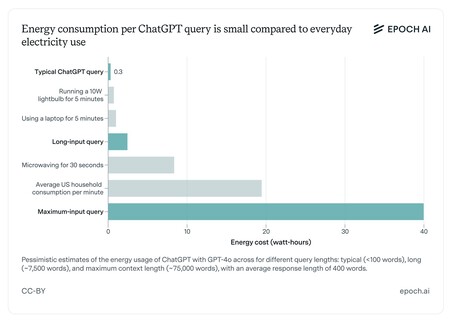
Previous studies by Epoch AI corroborate the data now presented by Sam Altman. Source: Epoch AI.
What about the proof? Altman’s data lacks visible backing. He presents it without citing sources or providing clarification, which makes it hard to trust. A former Meta executive humorously replied to a query about AI inference consumption a year and a half ago, suggesting it would take two nuclear reactors to cover the demand.
Previous studies support Altman . While he does not cite any evidence, researchers from Epoch AI published a study in February estimating ChatGPT’s energy consumption. They concluded that an average query with GPT-4 consumes merely 0.3 watt-hours , “ten times less than the old estimates,” which originated from a previous report by researcher Alex de Vries. Much has transpired since then.

Too pessimistic . As pointed out in the Epoch AI study, the difference lies in the sheer efficiency of current models compared to those of 2023, the year De Vries conducted his study. The hardware that runs these models has also improved, leading to much lower energy estimates . OpenAI’s study also suggested that “most requests to ChatGPT are likely much cheaper” in energy costs.
More studies . An independent study published by Andy Masley in January 2025 reached a similar conclusion, stating, “Using ChatGPT is not harmful to the environment.” This study relied on EPRI data from May 2024, which estimated a higher consumption of 2.9 Wh per ChatGPT query. The estimated water usage in data centers, from a Sunbird study , was also considerably modest compared to other online activities.
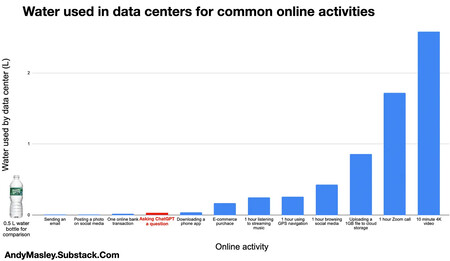
Water consumption in data centers for various online activities. Source: Andy Masley.
Fifteen queries per teaspoon of water . Altman’s intriguing water consumption figure indicated that from a ChatGPT query , only 0.32 ml of water is needed—”one-fifteenth of a teaspoon.” This suggests that the water required for cooling the data centers processing these queries is significantly lower than previously thought.
And what about training costs? These estimates focus on the AI inference aspect, where a ChatGPT query is processed to generate textual output. Altman does not clarify if he includes the energy and water costs of training AI models, which is substantially higher. Thousands of GPUs operate at full capacity for months, leading to significant water expenditure for cooling all components that dissipate heat. Researcher Ethan Mollick noted that GPT-4 likely consumed over 50 GW for training, enough energy to supply 5,500 homes for a year.
Still no definitive data . Altman’s statements are striking, but the lack of clear evidence makes it hard to accept these figures at face value. More recent studies give a better reflection of the declining costs—both in energy and water—of using AI. However, no standards or agreed-upon measures exist concerning the actual environmental impact of using ChatGPT or other AI models.
Image | Lukáš Lehotský | Village Global
In summary, while the figures presented by Altman spark intrigue, the ongoing lack of consensus and credible data surrounding the true energy and water consumption of AI models remains a topic for further exploration. As technology evolves, clearer standards and benchmarks will be essential to understand the environmental impact better.