
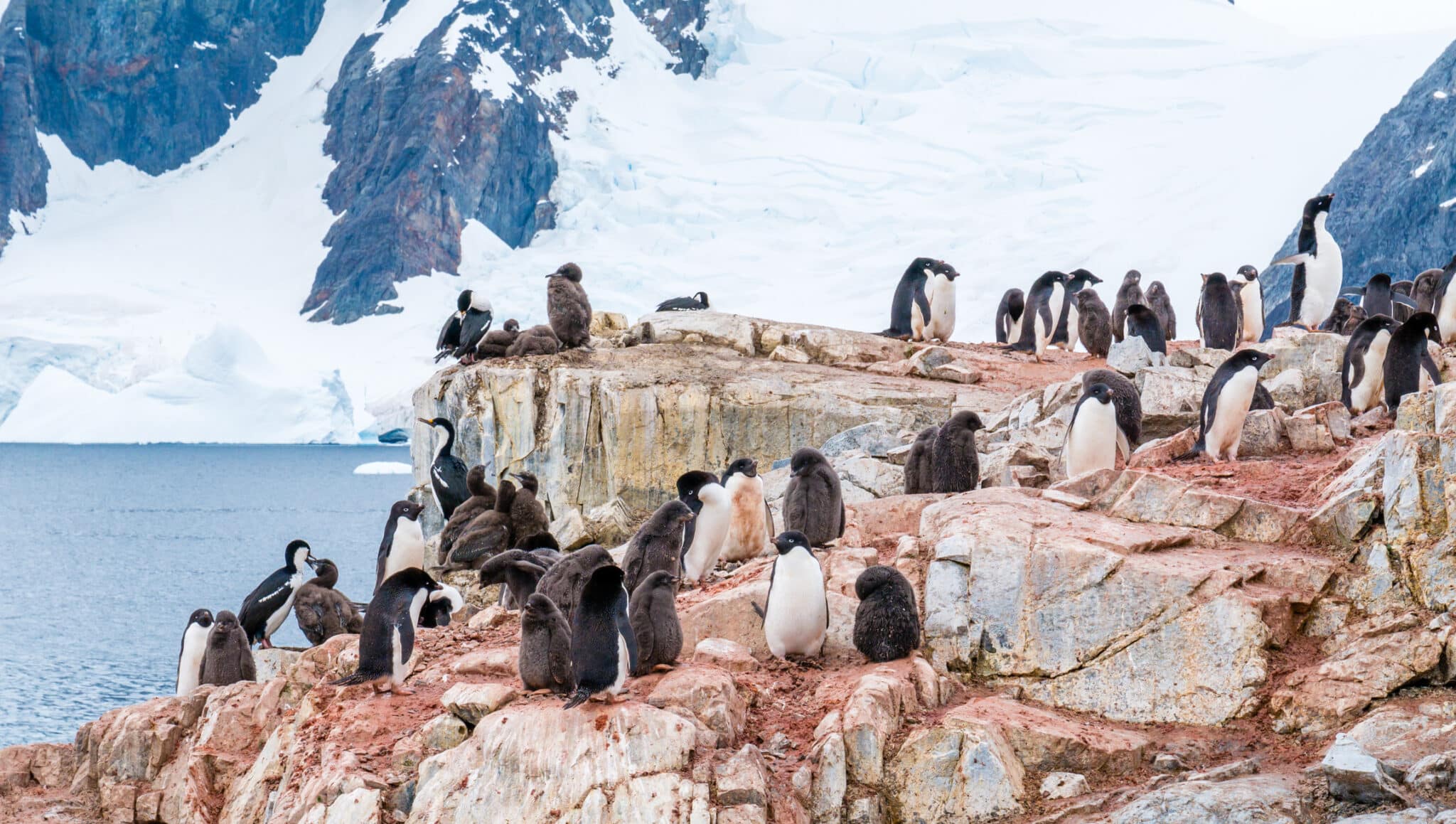
The image we have of Adélie penguins—small, plump, and waddling awkwardly on the ice—hides a crucial role they play in the ecosystem. According to a recent study by the University of Helsinki, these iconic marine birds from Antarctica may serve as local climate regulators. Their unexpected tool? Guano, or simply… their droppings.
When Biology Influences the Atmosphere
At the beginning of 2023, a team of researchers set up camp near the Argentine base of Marambio on the Antarctic Peninsula with an original objective: to measure the impact of biological emissions on cloud formation. Their attention turned to a giant colony of 60,000 Adélie penguins (Pygoscelis adeliae), nesting nearby.
By defecating in large quantities on the ice and frozen soil, the penguins release ammonia (NH₃). This gas, well-known among climatologists, plays a key role in the formation of atmospheric aerosols. These microscopic particles act as condensation nuclei, enabling water vapor to form clouds.
A Measurable… and Massive Influence
The results from the team are astounding. With winds blowing from the colony, sensors measured up to 13.5 parts per billion of ammonia, which is a 1,000-fold increase compared to levels recorded in areas without penguins. This sudden spike led to a 10,000-fold increase in aerosol particle concentrations.
The result: a rapid formation of thick fog followed by low clouds visible to the naked eye. These clouds reflect part of the incoming solar radiation, contributing to the local cooling of the earth’s surface, a process known as negative radiative forcing.
What surprised researchers was the persistence of this effect even after the penguins migrated. One month after their departure, the guano-soaked ground continued to release ammonia at levels 100 times higher than normal. The local climate remained influenced by a delayed biological footprint, a phenomenon rarely observed on this scale.
A Natural Feedback Loop
This discovery reveals a positive feedback loop for the environment: by encouraging cloud formation, the penguins inadvertently help slow the melting of sea ice, which is their essential habitat. More clouds mean less solar radiation absorbed, leading to colder temperatures and more ice—a protective mechanism that could contribute to stabilizing certain threatened areas of Antarctica.
This illustrates how interconnected wildlife and climate cycles are. While it was already known that some species could influence their ecosystem, seeing a marine bird contribute to regional atmospheric regulation through simple natural processes is rare and fascinating.
A Lesson in Humility for Science
As climate models struggle to incorporate all interactions between biology and the atmosphere, this study serves as a reminder that natural mechanisms are often subtler—and more powerful—than one might imagine. Even a seemingly trivial “waste” like guano can, on a large scale, affect local climate and weigh heavily on the future of an entire continent.