

| IN BRIEF |
|
The speed of data transfer is a critical issue for supporting emerging technologies like AI , virtual reality , and the Internet of Things . A group of Japanese researchers has recently made an impressive breakthrough in Internet speed using a specially designed fiber optic technology. This advancement is not merely about speed; it is an essential preparation for a future where data traffic will surge exponentially.
Incredible Internet Speeds Through Science
For years, scientists have aimed to increase the volume of data that can pass through fiber optics . While petabit-per-second speeds have been reached before, they were only over short distances. Long-distance transmission remains a significant challenge because signals weaken over distance, and amplifying the signals without interference is complex.
The researchers innovated by designing a 19-core fiber optic , transforming what was once a single lane into a superhighway of 19 lanes , all while maintaining the same thickness as current fibers, which is 0.125 mm . Each core independently carries data, enabling the movement of vast amounts of information simultaneously.
Moreover, they developed an intelligent amplification system . Optical signals lose strength during transmission, necessitating the use of amplifiers. However, each core needed to be amplified simultaneously across two different light bands. This system enabled simultaneous amplification of signals in the 19 cores without mixing signals, thanks to advanced digital processing and recirculation loops .
Powerful and Practical Fiber Technology
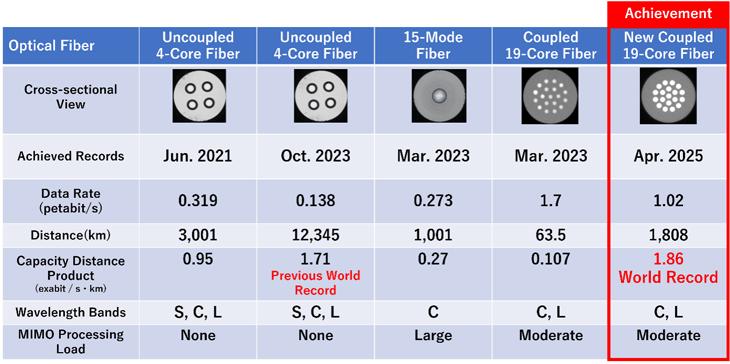
This is not the first instance of testing a 19-core fiber optic system . However, this time, the technology has pushed the boundaries of distance, successfully transmitting data over more than 1,800 km . This could alter how we structure the Internet of the future .
| Type of Fiber | Capacity | Distance |
|---|---|---|
| Previous Generation 19-Cores | 1.7 petabits/s | 63.5 km |
| New Generation 19-Cores | 1.02 petabits/s | 1,808 km |
As we enter the post-5G era with autonomous vehicles, AI assistants, and connected devices, massive data highways will be essential for everything to operate seamlessly. This research demonstrates that constructing ultra-fast , long-distance fiber networks is feasible without modifying the existing infrastructure, thus facilitating their real-world deployment.
Implications for the Future of Networks
The implementation of this technology could have significant implications for the future of communication networks. By enabling massive data rates over long distances without requiring major modifications to existing infrastructure, this advancement could lower costs and accelerate the development of new technologies.
Standardized fiber optics facilitate large-scale adoption, and the development of intelligent amplification systems could become a key element in the design of future networks. This advancement underscores the need for continuous innovation in telecommunications to meet the growing demands of our connected society.
Moreover, the increased data transmission capacity could revolutionize sectors such as healthcare , education , and public services by enabling faster and more reliable connectivity.
Toward a New Technological Era
The development of this new fiber optic technology marks the beginning of a new technological era , where the boundaries of digital communication are pushed further. The potential applications are vast, ranging from significant improvements in telemedicine to advancements in online education and industrial automation .
Researchers continue to explore the possibilities this technology offers, hoping to integrate it into existing infrastructures. However, questions remain about how quickly these innovations will be adopted globally. The recent fiber communication conference highlighted these advancements and paved the way for future research and development. This technological breakthrough prompts critical questions about how and when these innovations will become part of our daily lives and how much they will transform our way of communicating in the years to come.
The author utilized artificial intelligence to enrich this article.
Did you enjoy this? 4.5/5 (25)