
| IN BRIEF |
|
The advancements in technology for monitoring cognitive stress have taken a decisive turn with the development of a wireless e-tattoo directly applied to the forehead. This innovative device, the product of research by engineers at the University of Texas at Austin, promises to revolutionize how we track mental load in real-time. Unlike traditional methods, which are often subjective and time-consuming, this portable tool could transform preventative practices against burnout in high-pressure professions such as truck driving or air traffic control.
A Flexible and Personalized Window into the Brain
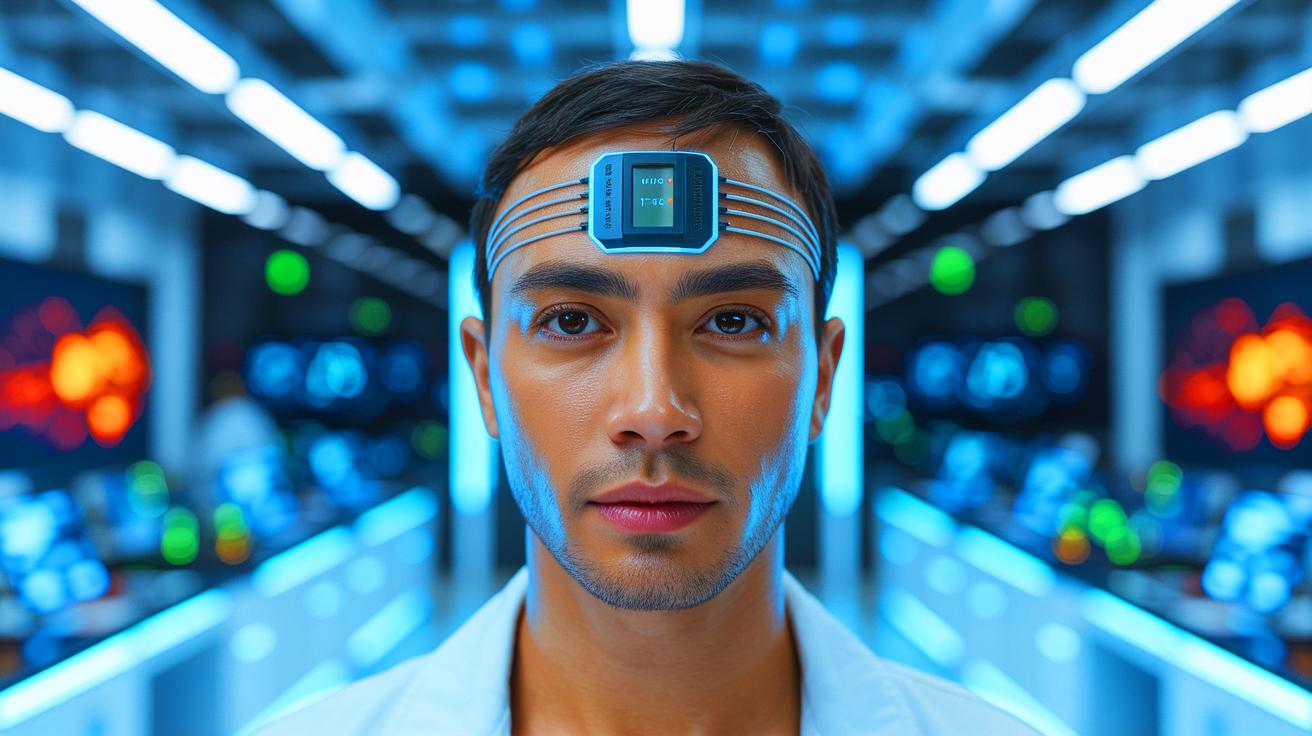
This new portable tool, resembling a temporary tattoo, is designed to measure electrical signals from the brain and eye movements using electroencephalography (EEG) and electrooculography (EOG) . Compared to traditional EEG headsets, which are often bulky and require the application of gel, the e-tattoo comfortably adheres to the forehead like a sticker. Its flexible and contoured circuit adapts to individual facial features, ensuring optimal signal quality without compromising comfort or movement.
Interestingly, traditional headsets, equipped with numerous sensors for various brain regions, never achieve perfect signals due to variations in head shape. Conversely, the e-tattoo is custom-designed to conform to each participant’s facial characteristics, guaranteeing that the sensors are consistently well-positioned to capture signals effectively.
During tests, six participants wore the e-tattoo while performing a progressively challenging memory task. As cognitive demand increased, predictable changes in brain activity were observed: theta and delta waves increased, indicating growing effort, while alpha and beta waves decreased, suggesting rising mental fatigue.
Significant Impact at a Low Cost
Traditional EEG systems can cost over €14,000 and require specialized training to operate. In contrast, the core materials for the e-tattoo cost about €185, with each disposable sensor priced around €18. This financial accessibility could enable widespread availability in homes and workplaces.
However, despite the lowered costs making the device more accessible, some limitations exist. Currently, the device functions only on hairless skin, such as the forehead. The team is already working on ink sensors designed for hairy areas, which would allow comprehensive monitoring across the head and contribute to more extensive data collection.
With its ability to track mental tension, the e-tattoo could fundamentally change how organizations ensure the overall well-being of their employees. Monitoring mental health alongside physical health could become a standard practice across various sectors.
Towards Proactive Burnout Prevention
This device not only detects signs of mental fatigue; it anticipates them. By integrating brain data into a machine learning model, the team has trained the system to predict mental load levels. This opens up possibilities for real-time alerts when an individual’s brain approaches cognitive limits.
This predictive ability could prove essential in professions where cognitive overload can lead to severe consequences. By preventing mistakes caused by mental fatigue, the e-tattoo could enhance safety and efficiency in high-risk work environments.
The customization of the device allows for individual differences in optimal mental load, thus offering a flexible and adaptable tool that meets the specific needs of each user. This tailored approach could facilitate better stress management and productivity across various professional contexts.
Promising Future Perspectives
Although the device is still in its early stages, its implications for mental health monitoring are significant. Its capacity to provide real-time data on cognitive load paves the way for new strategies to manage workplace stress and prevent burnout.
As technology continues to advance rapidly, tools like the e-tattoo demonstrate the potential of innovation to enhance our understanding and management of mental health. The ability to monitor and predict stress levels could transform how we approach well-being in both the workplace and daily life.
With ongoing research aimed at improving and expanding the capabilities of the e-tattoo, what other innovations may emerge to revolutionize our approach to mental health?
The author utilized artificial intelligence to enrich this article.
Did you enjoy this? 4.6/5 (24)