
| IN BRIEF |
|
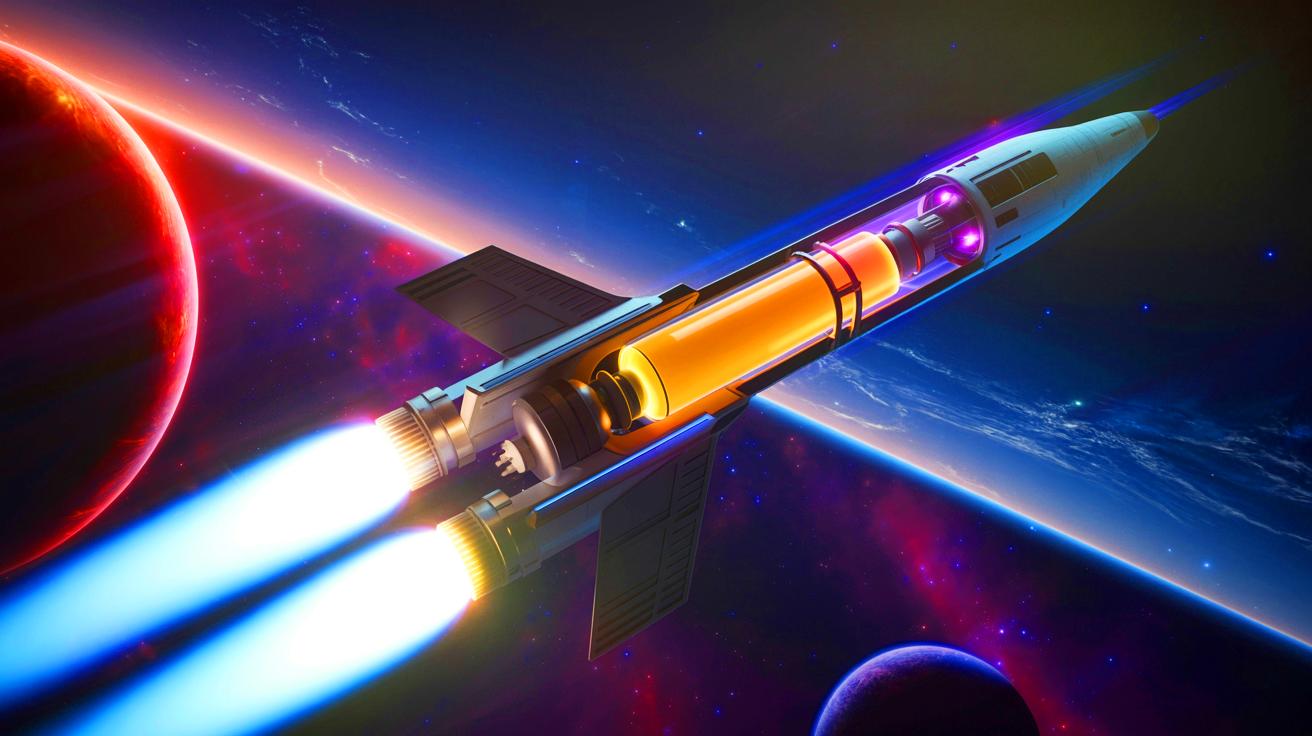
The development of a revolutionary thermal nuclear propulsion technology, based on the use of liquid uranium , promises to transform space exploration . This new technology, dubbed the “ Centrifugal Nuclear Thermal Rocket ” (CNTR), is being developed by researchers from the University of Alabama in Huntsville and Ohio State University . Its aim is to double the efficiency of current propulsion systems, representing a major advance for long-duration space missions. By utilizing liquid uranium fuel directly heated by reactors, this technology could significantly reduce travel time to Mars while drastically enhancing the capabilities of spacecraft.
Double the Efficiency for Spacecraft with Uranium
Nuclear Thermal Propulsion (NTP) has long been seen as a promising alternative to chemical rockets , primarily focusing on increasing efficiency rather than just cutting costs. NASA’s DRACO program , which employs a solid-core NTP system, aims for a specific impulse of about 900 seconds— twice that of chemical rockets but only half that of many ion engines. In contrast, the CNTR uses liquid uranium fuel rather than solid fuel as in traditional NTP designs, achieving a specific impulse of approximately 1500 seconds . This improvement could significantly enhance the delta-v (change of velocity) capabilities of spacecraft while maintaining similar thrust levels. In the CNTR design, the liquid uranium fuel is rapidly spun in a centrifuge, with hydrogen gas injected through the superheated liquid to generate thrust. The main distinction between the CNTR concept and conventional NTP systems lies in the use of liquid fuel contained in rotating cylinders via centrifugal force.
Tackling the Challenges
The development of the CNTR presents substantial engineering challenges . A recent article in Acta Astronautica , part of a series on the evolution of the engine, describes ten of these challenges. Research teams have recently concentrated on four of them, making progress in managing the engine’s nuclear reactions, or “neutronics.” The introduction of Erbium-167 into their models aims to stabilize internal temperatures. Researchers have stressed that fission byproducts such as xenon and samarium could negatively impact the reaction if not properly eliminated, an area requiring further simulations. Understanding how hydrogen bubbles move in the liquid fuel has become another focal research point. Experiments using Ant Farm (static) and BLENDER II (rotating) systems provide valuable data. The BLENDER II system uses X-rays to study bubble behavior in uranium substitutes, though mathematically modeling these dynamics remains a significant challenge.
Future Developments and Potential
The authors indicate that the CNTR is not yet ready for a complete prototype and requires additional modeling and optimization. Future research will focus on uranium loss and testing the DEP solution through bench experiments. The CNTR concept offers a revolutionary potential for space propulsion, with an expected performance increase of two times compared to NASA’s solid fuel NTP effort for the DRACO mission. Researchers are confident that this technology could fundamentally alter space exploration by significantly reducing travel times to far-off destinations.
Accelerating Space Exploration
The possibilities offered by the CNTR are vast and could change the game for future space exploration. By increasing the efficiency of space propulsion, missions to Mars and other distant destinations could become more feasible and frequent. The technology continues to evolve, with ongoing research aimed at optimizing performance and addressing remaining challenges. The introduction of new technologies, such as the DEP for uranium recovery, highlights the innovative approach taken by researchers. As we move toward a future where interplanetary travel becomes more commonplace, what other technological advancements will emerge to support these ambitious endeavors?
This article was enriched using artificial intelligence to provide comprehensive insights.
Did you like it? 4.4/5 (29 ratings)