
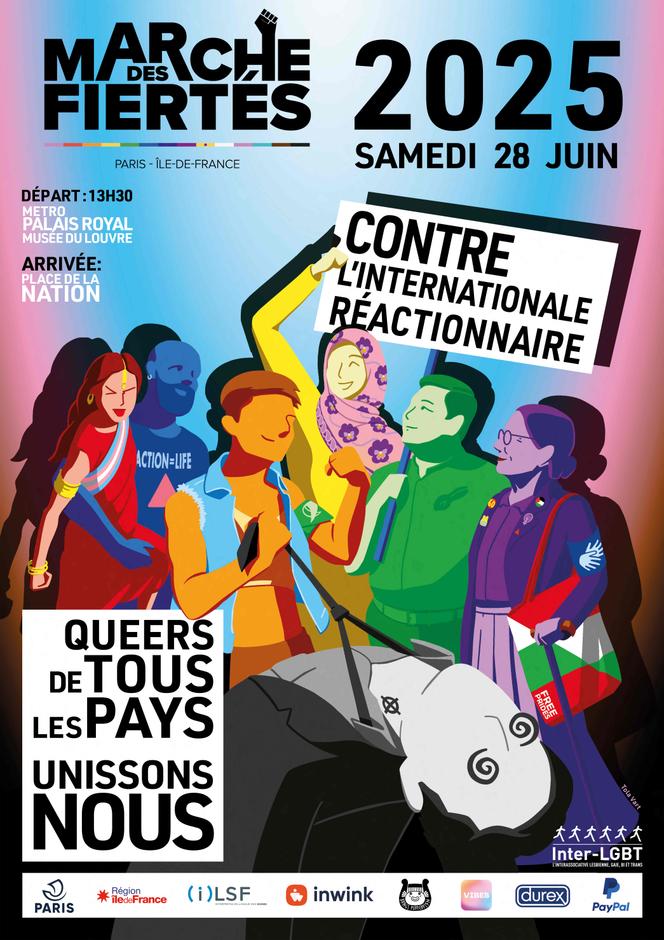
The upcoming Pride March in Paris is under scrutiny due to a controversial poster released for the event. Scheduled for June 28, 2025 , the poster features a diverse group of individuals, including a person wearing a veil holding a sign that reads “ Against the Reactionary International .” Critics are voicing their concerns over the imagery and its potential implications in the politically charged environment surrounding LGBTQ+ rights.
This announcement has met with intense backlash from various groups, including the French gay and lesbian Jewish association, Beit Haverim . They have criticized the “thoughtless communication choices” that could incite hostility or aggression . According to Beit Haverim, the incorporation of Palestinian flag colors represents a political exploitation that does not reflect the consensus of the diverse LGBTQ+ community.
“A Reactionary International that Kills LGBT People”
The InterLGBT , another prominent LGBTQ+ group, also condemned the portrayal, describing it as a “gross misunderstanding.” The imagery supposedly represents not the Palestinian flag, but flags from countries like Hungary and Bulgaria, where pride events are currently banned. Their president, Alexandre Schon , expressed that the pins depicted in the visuals symbolize the unity of struggles among various marginalized communities.
In the spirit of activism, Schon elaborated that the artwork aims to depict queer individuals uniting against a reactionary ideology that restricts LGBTQ+ rights and expressions. “Thousands of our comrades are dying today; it is crucial that this message isn’t distorted into a political agenda based on misconceptions,” he emphasized.
Reacting to the poster, Valérie Pécresse , President of the Île-de-France region, voiced her concerns on social media, accusing the creator of inciting violence through the disturbing imagery presented, particularly referencing the depiction of a knocked-over corpse. She has formally requested the withdrawal of regional logos from the event and has stated that the region will not be providing any funding.
Further fueling the controversy, Sébastien Chenu , the vice-president of the National Rally, echoed Pécresse’s sentiments, criticizing the poster as propagating extreme ideology through its caricatures of identity.
As the Pride March approaches, the debates surrounding the inclusivity, representation, and political affiliations highlighted in the promotional material bring to light the diverse and sometimes conflicting messages within the LGBTQ+ community. Supporters of the march argue that visibility in activism is paramount for driving change, while detractors caution that some representations may end up alienating potential allies.
The unfolding discourse reflects deeper societal tensions surrounding identity, rights, and acceptance . As this controversy brews, it serves as a poignant reminder of the complexities that underlie the intersection of politics and social movements within the LGBTQ+ sphere. The challenge remains to find common ground that respects the diverse identities while fostering a unified front against discrimination and violence.
General News – 2