
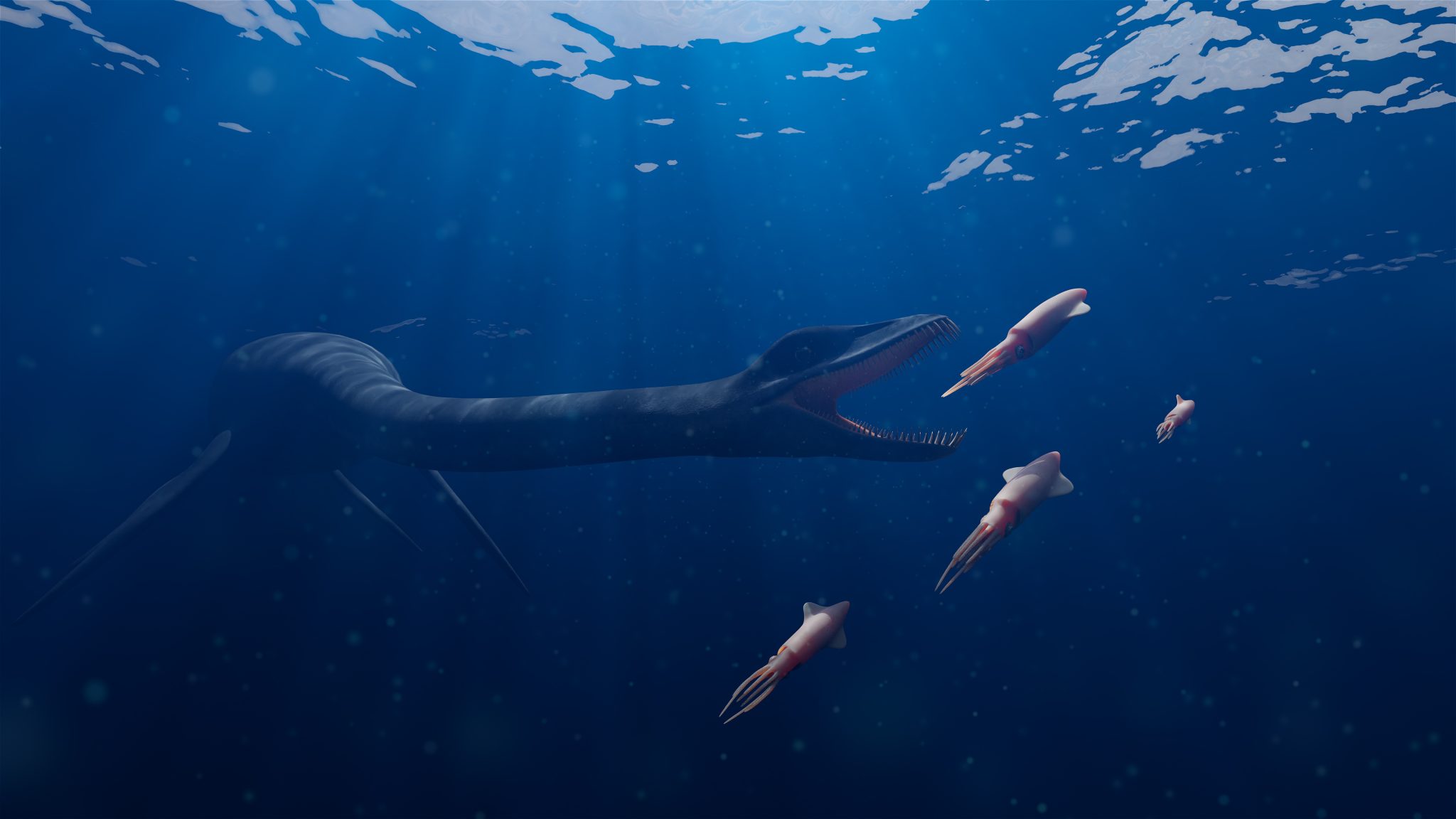
A major paleoanthropological discovery is reshaping our understanding of ancient marine reptiles . Researchers have recently identified a new species of plesiosaur , named *Traskasaura sandrae*, a creature as bizarre as it is formidable, which lived around 85 million years ago , during the late Cretaceous period .
This “marine monster” measured nearly 12 meters in length, boasted an endless neck , and possessed powerful dentition capable of crushing the shells of ammonites , its likely prey. However, what intrigues scientists most is its unprecedented hunting style and anatomical features never before seen in other members of its family.
A Plesiosaur Like No Other
*Traskasaura* belongs to the group of elasmosaurs , long-necked marine reptiles that haunted the oceans alongside dinosaurs. Yet, this species stands out markedly from other known fossils. It presents a confusing mix of primitive and evolved traits, perplexing researchers for decades.
Its skeleton reveals at least 36 well-preserved cervical vertebrae , suggesting a total likely exceeding 50 , setting a record within its group. The shoulder structure, in particular, surprised paleontologists: its downward-opening formation is unique among known plesiosaurs.
Another surprising feature is its wing-like flippers, curved on the underside, seemingly an adaptation for powerful downward thrusts . This leads to a bold hypothesis: *Traskasaura* may have been the first plesiosaur capable of diving at its prey, akin to a marine bird of prey .
A Rediscovery After 35 Years of Mystery
The first fossil of *Traskasaura* was discovered in 1988 , along the Puntledge River on Vancouver Island (Canada), by Michael and Heather Trask, after whom the creature is named. Despite a remarkably complete skeleton (including skull, neck, limbs, and tail), its identity remained elusive for decades due to its unusual features .
Only with the discovery of a second, better-preserved juvenile specimen were researchers able to confirm that it indeed represented a new taxon .
A Fossil Emblem… and a Human Story
The species name, *sandrae*, honors Sandra Lee O’Keefe , the wife of lead paleontologist F. Robin O’Keefe, celebrated as a “valiant warrior in the fight against breast cancer.”
Since 2023, *Traskasaura* has been adopted as the official fossil emblem of British Columbia , and its fossils are now displayed at the Courtenay and District Museum and Palaeontology Centre , where the public can marvel at this extraordinary creature.
An Evolutionary Enigma
For researchers, the discovery of *Traskasaura* serves as evidence of convergent evolution : similar forms appearing independently in different lineages as a response to similar ecological constraints. A descending hunting strategy , for example, could emerge in multiple species without a direct link.
“This creature is different from anything I have studied,” asserts O’Keefe. “The fossils are full of surprises.”
And this one, rising from the depths of the past, may very well redefine what we thought we knew about Cretaceous marine predators . The details of the study are published in the Journal of Systematic Palaeontology.