

Understanding the Puzzle of Numbers
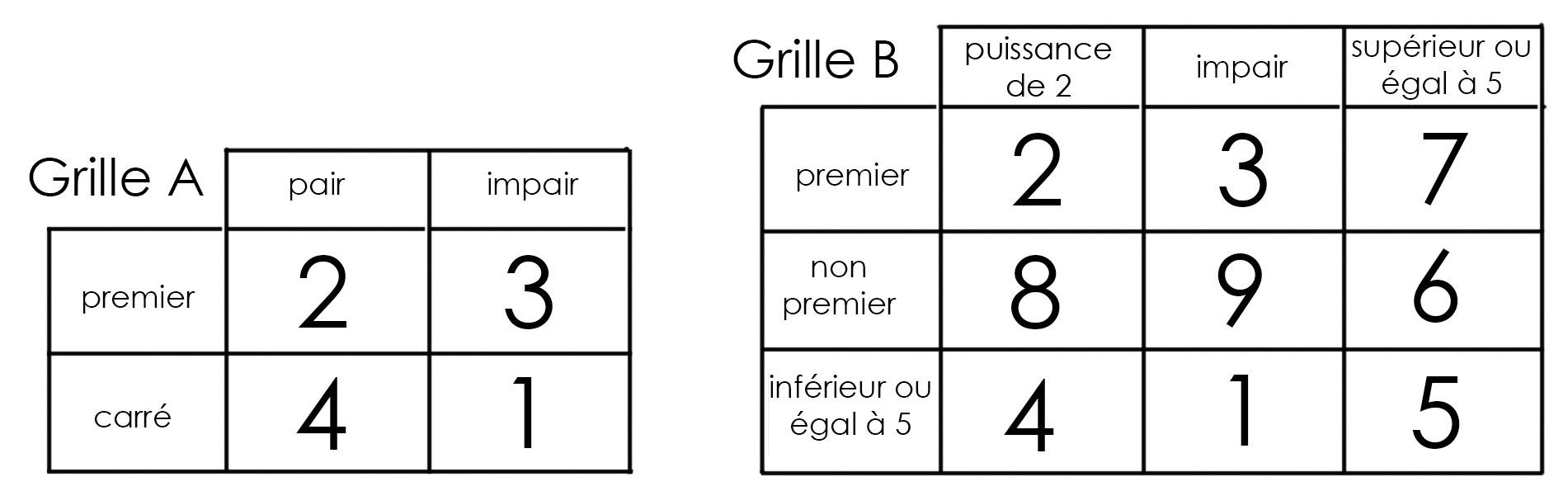
The grid A presented above is a fascinating mathematical challenge that consists of two lines and two columns. Each line and column is defined by specific mathematical properties. The objective is to fill the grid with the numbers 1 to 4 in such a way that each number fits the criteria set by its respective line and column.
The Rules of the Game
Can you fill the four boxes with the numbers of 1 to 4, so that each of them simultaneously checks the properties of their line and column?
To better understand the task, note that the first column is designated to contain only even numbers , while the first line is comprised solely of prime numbers . This foundational knowledge sets the stage for solving these grids effectively. The number 2 is the only even prime number, while 4 qualifies as an even number as well.
Extending the Challenge: Grid B
Following the same principles, we also have Grid B , where the challenge extends to filling in the numbers from 1 to 9 . Each number must simultaneously meet the designated conditions of its row and column. Observing the numerical properties is essential for successfully completing this puzzle.
The Properties of Numbers
To tackle both grids efficiently, one must familiarize themselves with the characteristics of even numbers , odd numbers , and prime numbers . In simpler terms:
- Even numbers: These are numbers divisible by 2. Examples include 2, 4, 6, 8 , etc.
- Odd numbers: These are numbers not divisible by 2. Examples are 1, 3, 5, 7 , etc.
- Prime numbers: A prime number is greater than 1 and has no divisors other than 1 and itself. Examples are 2, 3, 5, 7 , etc.
Solving Strategies
When approaching these puzzles, it can be helpful to start by identifying which numbers can fit in each box based on the constraints given by the grid definition. Keeping a list of possibilities for each box may yield clearer insights into the potential placements.
For example, in the case of Grid A:
- The top-left box (1st row, 1st column) can take 2 .
- The top-right box (1st row, 2nd column) can accept 3 .
- The bottom-left box (2nd row, 1st column) may take 4 .
- The bottom-right box (2nd row, 2nd column) must contain the number 1 .
By utilizing such systematic strategies in evaluating potential placements, you can enhance your ability to solve such mathematical puzzles effectively.
The Importance of Logical Reasoning in Puzzles
Engaging in puzzles isn’t simply an exercise in filling out numbers; it’s also about developing critical thinking and logical reasoning skills. These skills are valuable across various aspects of life, from problem-solving in everyday challenges to complex mathematical theories in academics.
The act of carefully analyzing each situation and assessing outcomes fosters a mindset that is adaptive and analytical. This not only makes one skilled in mathematics but enhances cognitive abilities and promotes a growth mindset.
Conclusion
In essence, solving number grids such as Grid A and Grid B not only serves as an entertaining puzzle but also enriches one’s understanding of numbers and mathematical properties. Whether for fun, educational purposes, or to develop essential skills, the importance of these logical challenges cannot be overstated. By engaging with these numerical puzzles, we sharpen our brains and improve our problem-solving abilities significantly.