

What long-term trends must investors consider when assessing bitcoin’s volatility? How did President Trump’s tariff announcement impact bitcoin’s correlation with traditional markets in April? What does bitcoin’s recovery following recent market turbulence suggest about its emerging role in investment portfolios? Can bitcoin be considered a safe asset like gold during financial stress? How has the perception of bitcoin shifted among institutional investors over recent months?
In financial markets, making assumptions based on short-term observations is a fool’s errand, as significant trends develop over months and years, not days or weeks. But as investors evaluate bitcoin’s role in their portfolios, the events of April are worth analyzing in order to understand the asset’s emerging reputation as a store of value.
Backdrop of Volatility
The turbulence sparked by President Trump’s tariffs announcement on April 2 sent stock prices plummeting the following day, with the Nasdaq 100 and S&P 500 falling 4.8% and 5.4%, respectively. Bitcoin followed suit as the VIX Volatility Index hit levels not seen since the early days of COVID and fears of retaliatory trade measures prevailed.
However, bitcoin’s price began to recover sharply within days of the announcement, causing its correlation with both the Nasdaq 100 and S&P 500 to fall below 0.50, before those correlations rose again as the April 9 pause on tariffs brought back “risk-on” mode.
Bitcoin’s Correlations to Traditional Markets in April
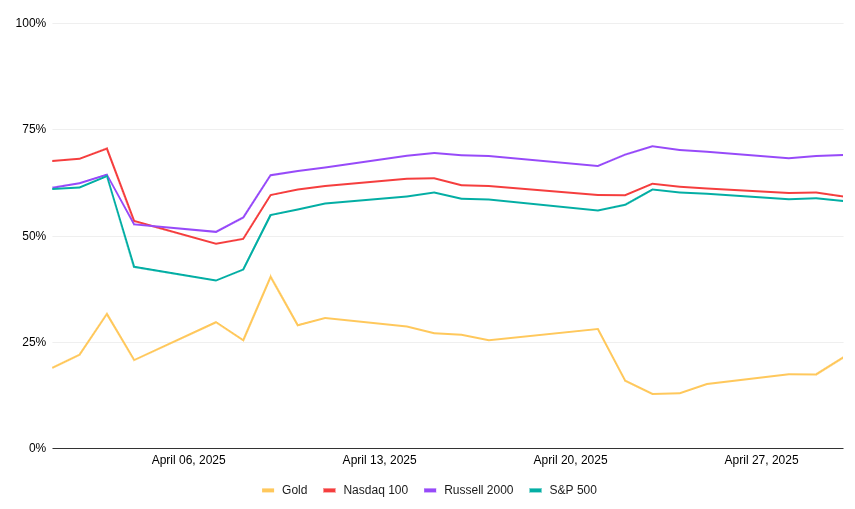
Source: Hashdex Research with data from CF Benchmarks and Bloomberg (April 01, 2025 to April 30, 2025). 30-day rolling correlations (considering only workdays) between bitcoin (represented by the Nasdaq Bitcoin Reference Price Index) and TradFi indices.
This short-term observation matters because it supports the changing nature of how investors perceive bitcoin. While some still categorize bitcoin as a high-beta “risk-on” asset, institutional sentiment is beginning to reflect a more nuanced understanding. Bitcoin recovered faster than the S&P 500 in the 60 days that followed the COVID outbreak, Russia’s invasion of Ukraine, and the U.S. banking crisis in 2023, events in which it demonstrated resilience and a profile increasingly aligned with that of gold during stress.
These periods of decoupling establish a pattern where bitcoin displays its antifragile properties, allowing allocators to protect capital during systemic events, while still outpacing the performance of stocks, bonds, and gold over the long haul.
Bitcoin vs. Traditional Assets, 5-Year Returns
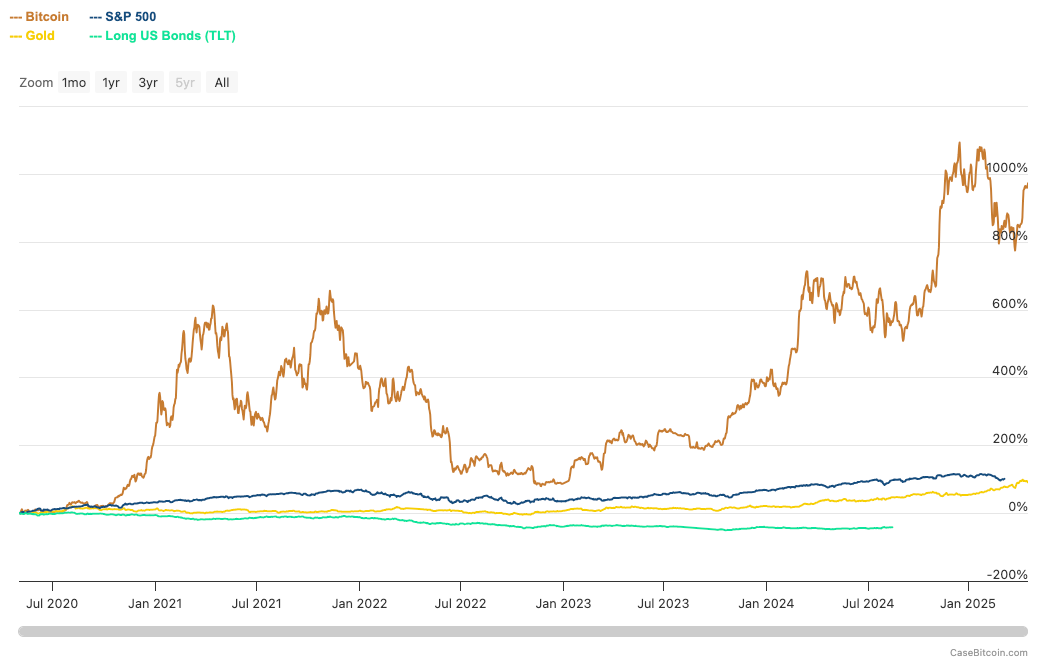
Source: CaseBitcoin, Return data from May 1, 2020 to April 30, 2025 (CaseBitcoin.com)
The Path to Digital Gold
Maybe more compelling than bitcoin’s longer-term returns are the long-term portfolio effects. Even a small allocation to bitcoin within a traditional 60% stock/40% bond portfolio would have improved risk-adjusted returns in 98% of rolling three-year periods over the last decade. And these risk-adjusted returns are markedly higher over longer time frames, suggesting that bitcoin’s volatility from positive returns more than counterbalances short-term drawdowns.
It might still be premature to claim that bitcoin has been universally accepted as “digital gold,” but that narrative, supported by its response to geopolitical events, is gaining momentum. The combination of bitcoin’s fixed supply, liquidity, accessibility, and immunity to central bank interference gives it properties no traditional asset can replicate. This should be appealing to any investor, large or small, in search of portfolio diversification and long-term wealth preservation.
Bitcoin as Digital Gold? Analyzing April’s Market Events & Long-Term Store of Value
As April 2023 unfolded, Bitcoin continued to solidify its reputation as a formidable asset akin to gold. The discourse surrounding Bitcoin as "digital gold" intensified, fueled by various market events that highlighted its potential as a long-term store of value. In this article, we delve into the nature of Bitcoin, the key market developments throughout April, and the implications for its status as a safe-haven asset.
Historical Context and Bitcoin’s Evolution
Bitcoin was created in 2009 by an anonymous entity known as Satoshi Nakamoto. Initially conceived as a peer-to-peer electronic cash system, its features and decentralized nature quickly drew attention from a diverse array of investors, financiers, and technology enthusiasts. Over the years, Bitcoin has evolved beyond a mere currency; it has been increasingly recognized as a digital asset that can serve as a hedge against inflation and economic uncertainty, much like traditional gold.
The Case for Bitcoin as Digital Gold
Limited Supply:
One of the primary arguments in favor of Bitcoin as digital gold is its capped supply of 21 million coins. This limitation mimics gold’s scarcity, making it potentially a hedge against inflation. Unlike fiat currencies, which can be printed at will by central banks, Bitcoin’s protocol ensures that no more than 21 million coins can ever be mined, fostering a secure environment for long-term investment.Decentralization:
Much like gold, Bitcoin’s decentralized nature provides a level of security and independence from government policies or geopolitical risks. Investors can hold their Bitcoin in personal wallets, ensuring control over their assets without reliance on centralized financial institutions.- Increasing Institutional Adoption:
The influx of institutional capital into the Bitcoin market has further reinforced its status as a store of value. Major financial institutions, including banks and investment firms, are finally recognizing Bitcoin as a legitimate asset class. This adoption has contributed to a more stable valuation, aligning with the traditional view of gold as a safe haven.
Market Events of April 2023
April 2023 was a notable month for Bitcoin, marked by several key market events that influenced its value and market perception.
1. Price Volatility
April began with Bitcoin trading around $28,000, with substantial fluctuations throughout the month. A surge in purchasing activity drove Bitcoin to surpass $30,000 for the first time in months. This spike was partly driven by renewed optimism in the broader cryptocurrency market, fueled by discussions about regulatory clarity and acceptance in mainstream finance.
2. Regulatory Developments
The month saw significant regulatory developments, particularly in the U.S., where the Securities and Exchange Commission (SEC) stepped up its engagement with cryptocurrency exchanges. Manifesting as a tightening or clarification of existing regulations, these actions initially incited selling pressures in some coins but ultimately established a framework that could bolster Bitcoin’s legitimacy as an asset.
3. Ethical and Environmental Considerations
The ongoing debate surrounding Bitcoin’s energy consumption also gained momentum during April. Environmental concerns related to mining processes were at the forefront, yet many Bitcoin advocates emphasized the growing transition toward renewable energy sources. This conversation is critical, as it affects public perception and regulatory attitudes, both of which have implications for Bitcoin’s investment narrative as a long-term store of value.
Bitcoin and Gold: A Comparative Analysis
Resilience during Crises
One of the pivotal arguments for Bitcoin’s status as digital gold lies in its performance during periods of economic turmoil. Gold has long served as a safe haven during financial crises, and Bitcoin has begun to occupy a similar role. In April, as inflationary fears persisted and geopolitical tensions simmered, investors turned to Bitcoin in search of stability. The correlation between Bitcoin and gold during these turbulent times suggests that Bitcoin may very well act as a non-correlated asset class akin to gold.
Liquidity and Market Accessibility
Another factor is Bitcoin’s comparative liquidity and market accessibility. Unlike physical gold, which can be cumbersome to trade and store, Bitcoin can be easily bought and sold in fractional amounts across multiple exchanges. This convenience has made Bitcoin an attractive option for both small and large investors alike.
Long-Term Perspectives: Possibilities and Challenges
In considering Bitcoin as a long-term store of value, it is essential to acknowledge both its potential and the challenges ahead. While its digital nature and limited supply present compelling arguments, Bitcoin continues to grapple with issues such as regulatory hurdles, volatility, and public perception related to its use cases.
Investor Sentiment
Long-term success in transitioning to a mainstream asset class will largely depend on investor sentiment. As more individuals and institutional players recognize Bitcoin’s potential, confidence in its status as a store of value may solidify. Education and awareness will be crucial in driving this sentiment.
Conclusion
As we close April 2023, Bitcoin continues to uphold its reputation as digital gold, particularly amidst a complex, evolving financial landscape. Its limited supply, decentralized nature, and growing institutional acceptance all contribute to its attractiveness as a long-term store of value. However, the asset faces challenges that will need to be navigated carefully to fulfill its potential. The coming months will be pivotal in determining whether Bitcoin can establish itself firmly as the digital counterpart to gold.
Bitcoin has increasingly been referred to as “digital gold,” particularly amid economic uncertainty. This narrative gained traction in April, influenced by several market events and macroeconomic factors.
In April, significant volatility was observed in the cryptocurrency market, driven by regulatory news and macroeconomic developments. Bitcoin’s price surged toward the end of the month, reflecting renewed investor interest and a flight toward perceived safe assets.
Additionally, the concept of Bitcoin as a long-term store of value was underscored by the ongoing debates surrounding inflation and currency devaluation. As central banks proceed with expansive monetary policies, Bitcoin’s limited supply is often cited as an appealing hedge against inflation.
Institutional adoption also played a key role, with notable companies investing in Bitcoin, further legitimizing its status as an asset class comparable to gold.
In assessing its potential as “digital gold,” factors such as network security, accessibility, and demand dynamics come into play. While Bitcoin displays characteristics of a store of value, market volatility and regulatory concerns continue to pose significant challenges.
Overall, the evolution of Bitcoin’s role in the market is complex, but its positioning as a digital asset akin to gold merits ongoing analysis.