
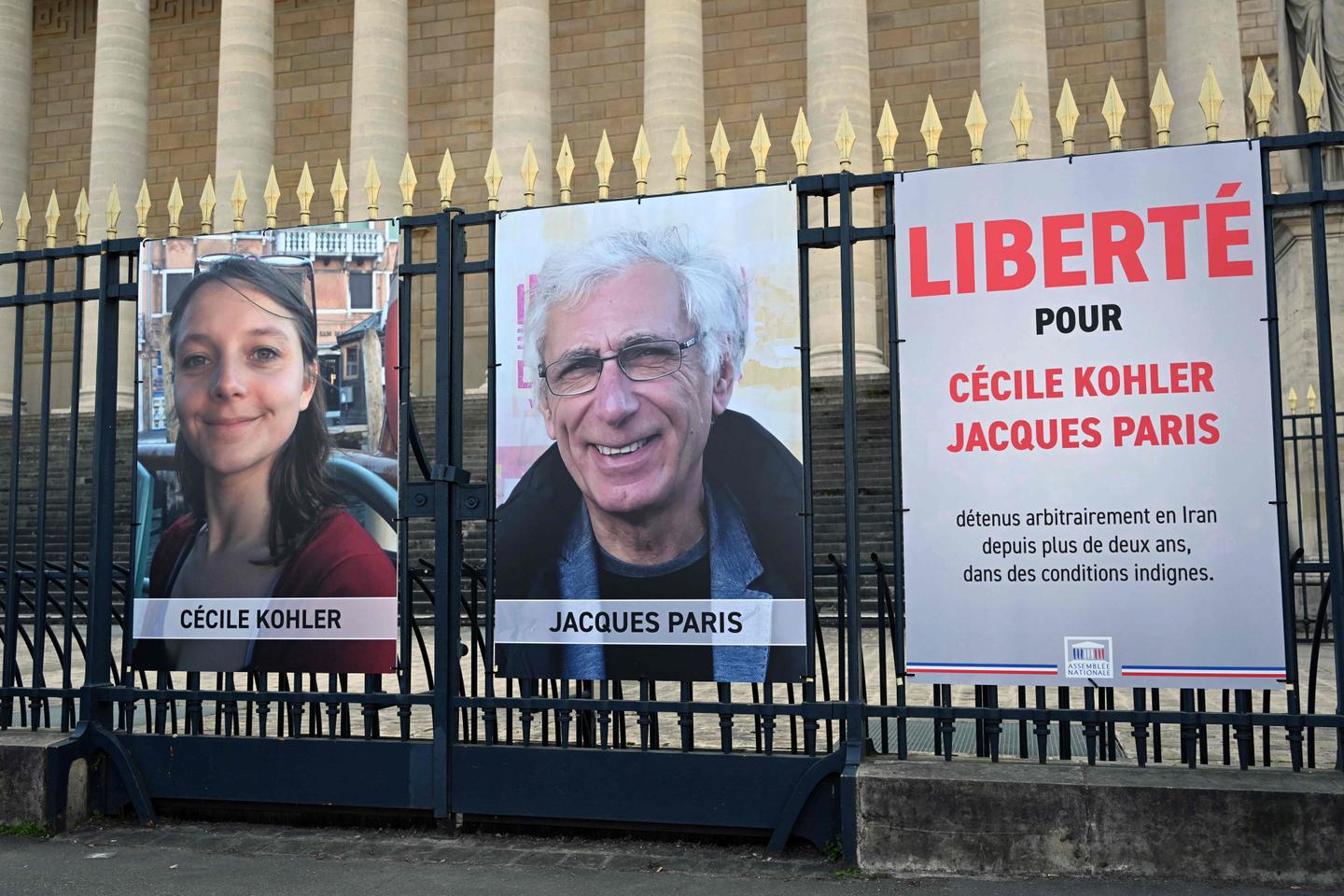
The French Cécile Kohler and Jacques Paris, accused of “espionage” by Iran, crossed the three -year CAP of the three years of detention on Wednesday, May 7, considered as “State hostages” by Paris. They are officially the last two French people imprisoned in Iran, which holds several other Europeans.
This 40 -year -old professor of letters from eastern France, and his septuagenarian companion was arrested on May 7, 2022, on the last day of a tourist trip to Iran. They are incarcerated in the sinister section 209, reserved for political prisoners, from Evin prison, in Tehran.
This file remains “An absolute priority” of France, assured the chief of French diplomacy, Jean-Noël Barrot, who promised not to spare “No effort to obtain the release of Cécile Kohler and Jacques Paris. Adding that“They were arrested without foundation”in a video posted on X. The President of the Republic, Emmanuel Macron also guaranteed that France “Acts relentlessly to get [la] Liberation ” of the two French hostages. “I assure their families with our unwavering support”he continued in a message posted on X.
“Forced confessions”
“It’s very, very hard. We are tired, we would never have imagined that it could last so long ”said to the agency France-Presse (AFP) Noémie Kohler, Cécile’s sister, on the eve of the anniversary date, on the occasion of which will be organized around forty solidarity rallies throughout France. “Cécile and Jacques are increasingly desperate and believe it less and less”explains the young woman, who alerts tirelessly to the fate of the prisoners and their conditions of incarceration “Absolutely destructive”.
Tuesday evening, the relatives of Cécile Kohler and former French detainees in Iran, Benjamin Brière, Bernard Phelan and Olivier Rumbleau, organized a rally in front of the Iran Embassy in Paris to claim the liberation of the two detainees.
Forced to “Forced confessions” Broadcast by Iranian state television a few months after their arrest, having had only four consular visits in three years, the two French people are subject, according to French diplomacy, to provisions “Assimilable in international law to torture”. Light lit twenty-four hours a day, thirty minutes outing two or three times a week, rare and short calls under close surveillance to their relatives, the last date of April 14. Families describe incarceration conditions corroborated by the testimonies of former French prisoners in Iran.
They are also subject to intense psychological pressure. “It’s been several months since we told them that a verdict is imminent, that it will be extremely severe, they are announced each time deadlines and nothing happens”reports Noémie Kohler.
“Hosting diplomacy”
Between 2023 and 2025 at least five French people were released, after several months, or even several years, of detention, but Cécile Kohler and Jacques Paris have now lived three complete years in prison, including three months in total isolation.
The memorable world
Test your general culture with the writing of the “world”
Test your general culture with the writing of the “world”
Discover
No explanation has never been officially delivered on the conditions for the release of other prisoners who, ensure the French authorities, have given rise to any consideration. Paris and the other European Chancellery whose nationals are held in Iran accuse Tehran of practicing the “Hosting diplomacy”to obtain the enlargement of some of its own nationals or to weigh in the very sensitive discussions on Iranian nuclear, in the impasse for years, and to obtain a lifting of the sanctions.
Relations between France and Iran have still been tense in recent weeks with the threats of Paris to impose new sanctions in Tehran, the arrest in France at the end of February of an Iranian, Mahdieh Esfandiari, for apology for terrorism, and the next judgment of a Franco-Iranian influencer for the same chief.
France is also on the way to file a complaint before the International Court of Justice (CIJ) “For violation of the right to consular protection” to which its two imprisoned nationals should be entitled; A decision welcomed as a “Major turning point” by families, but without short -term effect. “Unfortunately, there are not really any signals of hope”recognizes Noémie Kohler. “Our only lever is mobilization, making a maximum of noise hoping that this will happen in Iran. »»
The young woman is in contact with the elders “Hostages” French. “There is great solidarity, it helps us enormously because it allows us to have an open window on what is happening there, and also keys to understanding to prepare the return”relates mme Kohler. She is also in contact with the families of certain other European prisoners, including the wife of Ahmadreza Djalali, an Irano-Swedish academic, sentenced to death and detained in Tehran for nine years now.