

What implications does BlackRock’s confirmation of institutional investment in Bitcoin ETFs have for the broader market? How does the perception of Bitcoin as a macro hedge differ from its prior image as a speculative asset? What economic conditions are prompting investors to consider Bitcoin a safe haven? How do technical indicators currently signal potential price movements for Bitcoin? What unique features distinguish the BTC Bull Token from typical meme tokens? How does BlackRock’s CEO’s price projection reflect the current attitudes towards Bitcoin as a store of value?
Bitcoin is once again in the spotlight after Robert Mitchnick, Head of Digital Assets at BlackRock, confirmed at Token2049 Dubai that institutional investors are ramping up exposure to spot Bitcoin ETFs. Speaking alongside leaders from VanEck and CME Group, Mitchnick explained that while retail investors dominated the early ETF inflows, institutional and wealth management clients now lead the charge.
“The flows are back in a big way,” he said, adding that “every quarter, the percentage held by retail clients has gone down.”
This transition underscores a broader adoption cycle—one driven less by hype and more by portfolio strategy. According to BlackRock executives, institutions are increasingly viewing BTC as a macro hedge, not just a speculative asset.
Bitcoin as a Safe Haven in an Uncertain Economy
The rise in institutional interest appears to be fueled by rising concerns over global financial stability. BlackRock’s Jay Jacobs recently noted, “Bitcoin thrives when you have more uncertainty.”
With U.S. GDP contracting 0.3% in Q1 and inflation moderating, investors are hedging against long-term currency debasement and geopolitical instability.
JUST IN:
$11.5 trillion Blackrock's Jay Jacobs says, “#Bitcoin thrives when you have more uncertainty.”
It is “decoupled from the tech stocks.”pic.twitter.com/SB0yAVwBIj
— Bitcoin Magazine (@BitcoinMagazine) April 25, 2025
Larry Fink, BlackRock’s CEO, has even floated the possibility of BTC reaching $700,000 in extreme economic scenarios.
While such projections remain speculative, they highlight Bitcoin’s growing role as a non-sovereign store of value, especially in times of macro stress.
Key drivers supporting Bitcoin’s appeal:
- Institutional reallocation amid rate uncertainty
- Rising distrust in fiat systems
- Scarcity and predictable monetary policy
- Regulatory clarity around Bitcoin ETFs
Technical Setup: BTC Eyes Breakout Toward $97K
Bitcoin (BTC/USD) is trading just shy of resistance at $95,441, forming an ascending triangle pattern on the 2-hour chart—often a precursor to bullish continuation. The 50 EMA at $94,426 is providing strong support, and MACD is flipping positive.
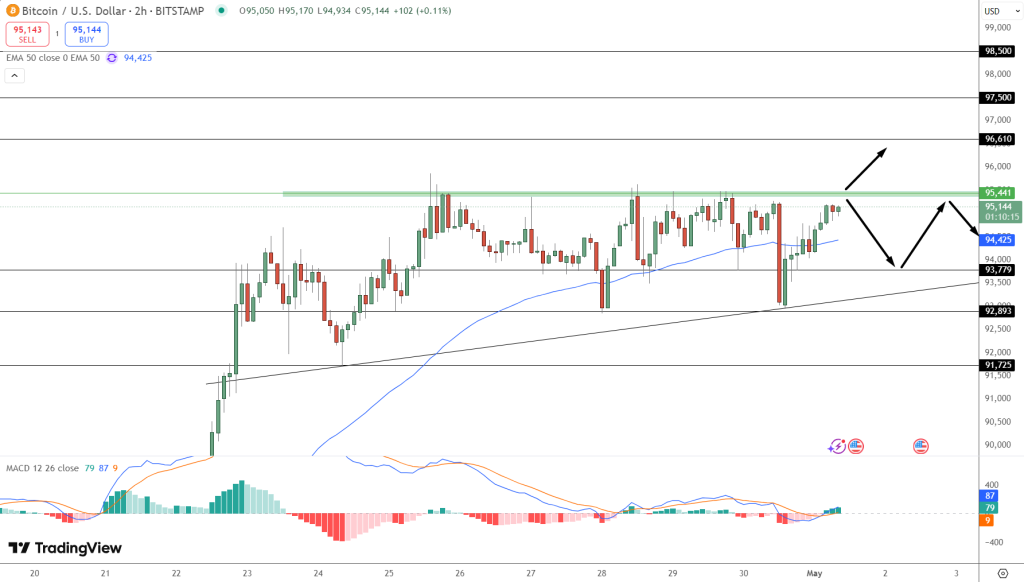
Should BTC close above $95,441 with volume, the next price targets stand at $96,610 and $97,500. If bulls fail to clear resistance, support rests at $94,400, which also marks a prudent stop-loss level.
Trade Setup:
- Entry: Break and close above $95,441
- Target 1: $96,610
- Target 2: $97,500
- Stop-loss: Below $94,400
This is a textbook breakout structure. Traders should remain patient, waiting for confirmation to avoid false breakouts—momentum favors upside as long as BTC stays above the 50 EMA.
BTC Bull Token Crosses $5.2M Milestone as 80% Yield Fuels Staking Surge
Investor interest in BTC Bull Token ($BTCBULL) remains strong, with $5.2 million raised out of a $5.9 million target. The token is now priced at $0.00249 as the presale rapidly approaches its next price increase.
BTCBULL stands apart from typical meme tokens by offering utility-driven staking rewards. Investors can earn an estimated 80% annual yield while retaining full liquidity—unstaking is available anytime with no penalties.
High-Yield Staking with Flexible Access
BTCBULL continues to set itself apart from typical meme assets by focusing on sustainable utility. The project’s staking program offers an estimated 81% annual yield, complemented by Bitcoin-backed distribution rewards.
Crucially, users retain full liquidity with the ability to unstake anytime—no mandatory lockup periods or penalties.

Latest Staking Snapshot:
- Tokens Staked: 1,304,753,147 BTCBULL
- Annual Yield: 80% APY
- Unstaking: Available at any time
This flexible structure appeals to both yield hunters and investors seeking upside potential without giving up liquidity.
BTCBULL’s flexible, high-yield model offers an attractive entry point for investors seeking strong returns and liquidity as crypto market momentum builds.
The post Bitcoin Price Prediction: BlackRock Confirms Institutional Demand Is Surging – $1 Million BTC Possible? appeared first on Cryptonews.
Bitcoin Price Prediction: BlackRock Confirms Institutional Demand Is Surging – $1 Million BTC Possible?
In the ever-evolving landscape of cryptocurrencies, Bitcoin remains a standout player. Over the years, Bitcoin has undergone significant price fluctuations, often driven by various factors, including regulatory changes, technological advancements, and most importantly, shifts in institutional sentiment. Recent news from BlackRock, the world’s largest asset manager, indicates an increasing interest from institutional investors, raising questions about the future trajectory of Bitcoin’s price. Could we see Bitcoin hitting a staggering $1 million in the coming years?
The Surge of Institutional Demand
BlackRock’s recent foray into cryptocurrencies has attracted widespread attention and speculation. As traditional financial institutions embrace Bitcoin and other digital assets, the narrative surrounding cryptocurrency is shifting. BlackRock’s move to file for a Bitcoin exchange-traded fund (ETF) signals not just institutional interest but a belief in Bitcoin as a legitimate asset class.
The significance of this cannot be overstated. Institutional players have traditionally been regarded as the gatekeepers of market legitimacy. Their endorsements can lead to wider acceptance and integration of Bitcoin within traditional financial markets. This paradigm shift can potentially serve as a catalyst for Bitcoin’s price increase. The demand from institutional investors is essential for the long-term sustainability and growth of Bitcoin, creating a greater likelihood of price appreciation.
Bitcoin’s Market Cap and Adoption
Currently, Bitcoin holds the lion’s share of the cryptocurrency market, boasting a market capitalization that often eclipses that of entire nations. As institutions begin to diversify their portfolios, Bitcoin may emerge as a viable hedge against inflation and a safeguard in uncertain economic climates. This adoption pattern echoes sentiments from public figures and financial analysts, who increasingly regard Bitcoin as “digital gold.”
Historically, Bitcoin has shown a positive correlation with increased institutional participation. According to various market studies, periods marked by high institutional engagement often coincide with significant price rallies. With influential entities like BlackRock entering the fray, the ramifications could propel Bitcoin’s market cap to unprecedented heights.
Potential Drivers of Bitcoin Price Growth
Several factors could contribute to Bitcoin reaching the $1 million mark. First and foremost is the notion of scarcity. Bitcoin’s supply is capped at 21 million coins, which creates an innate scarcity that can drive demand. As institutional interest amplifies, the pressure on available supply may drive prices higher over time.
Additionally, macroeconomic conditions play a pivotal role. The current global economic climate, characterized by rising inflation and uncertainty, has led many investors to seek alternative stores of value. Bitcoin, often portrayed as a hedge against inflation, may see further adoption as institutions look for stability amidst market volatility.
Technological advancements in blockchain technology, robust security protocols, and improvements in user experience within crypto exchanges also add to Bitcoin’s appeal. As the ecosystem matures, it becomes increasingly accessible to a broader range of investors, further driving demand.
The Role of Regulation
Regulatory clarity has been a long-standing concern for the cryptocurrency space. The involvement of institutional players like BlackRock may push regulators to craft frameworks that establish more certainty in the market. A conducive regulatory environment can foster greater institutional participation, leading to price increases.
However, potential regulatory setbacks—such as stringent rules or outright bans—could also pose risks to Bitcoin’s price trajectory. The delicate balance between regulation and innovation will play a crucial role in determining Bitcoin’s future.
Speculative Predictions: Is $1 Million Possible?
Skeptics often raise eyebrows at the thought of Bitcoin hitting $1 million. However, considering the trends and underlying dynamics of the market, some analysts project that a $1 million valuation is not merely a pipe dream. Predictions from various experts encapsulate a range of views; some assert that if Bitcoin achieves widespread adoption—and with institutions representing significant buying power—the $1 million mark could become a reality, albeit perhaps several years down the line.
Consider the previous bull rallies where Bitcoin has experienced exponential growth. If similar patterns recur, and if the number of institutional holdings escalates significantly, accelerated price growth could follow. A fundamental decoupling of Bitcoin’s price from traditional asset classes may further enhance this scenario, establishing Bitcoin as a distinct asset with its own supply-demand dynamics.
Conclusion
The intersection of institutional demand and technological progress presents a compelling narrative for Bitcoin’s future. As BlackRock and other major players validate Bitcoin as an asset class, the probability of a significant price trajectory toward $1 million becomes more plausible. While uncertainty remains, the combination of scarcity, increasing demand, macroeconomic conditions, and potential regulatory support may set the stage for Bitcoin to achieve unprecedented heights.
Investors must remain cautious and informed, as the path toward reaching these heights will likely include volatility. Nonetheless, the surge of institutional demand is a watershed moment for Bitcoin, promising a transformative phase in its already storied journey. The coming years may very well redefine our understanding of digital currencies and their place in the global economy.
The recent developments surrounding Bitcoin, particularly the confirmation of institutional demand from significant players like BlackRock, have reignited discussions about its price potential. Analysts suggest that the growing interest from institutions could drive Bitcoin’s value higher, with some even speculating about a potential price of $1 million per BTC.
The increasing inflow of institutional capital indicates a shift in perception, transforming Bitcoin from a speculative asset to a viable store of value. Factors such as economic uncertainties, inflation hedges, and diversification strategies are prompting corporations and investment firms to consider Bitcoin as part of their portfolios.
The outlook remains optimistic, but various factors, including regulatory changes and market dynamics, could influence Bitcoin’s trajectory. As more institutions enter the space, monitoring their strategies and the overall market response will be crucial for understanding future price movements.