

What specific factors contributed to the inflows of nearly $1 billion into BlackRock’s iShares Bitcoin Trust? How does IBIT’s performance compare to other Bitcoin ETFs like Fidelity’s FBTC and Grayscale’s GBTC? What role does President Trump’s silence on crypto matters play in shaping market sentiment? In what ways is Bitcoin being perceived as a safe-haven asset amidst economic uncertainty?
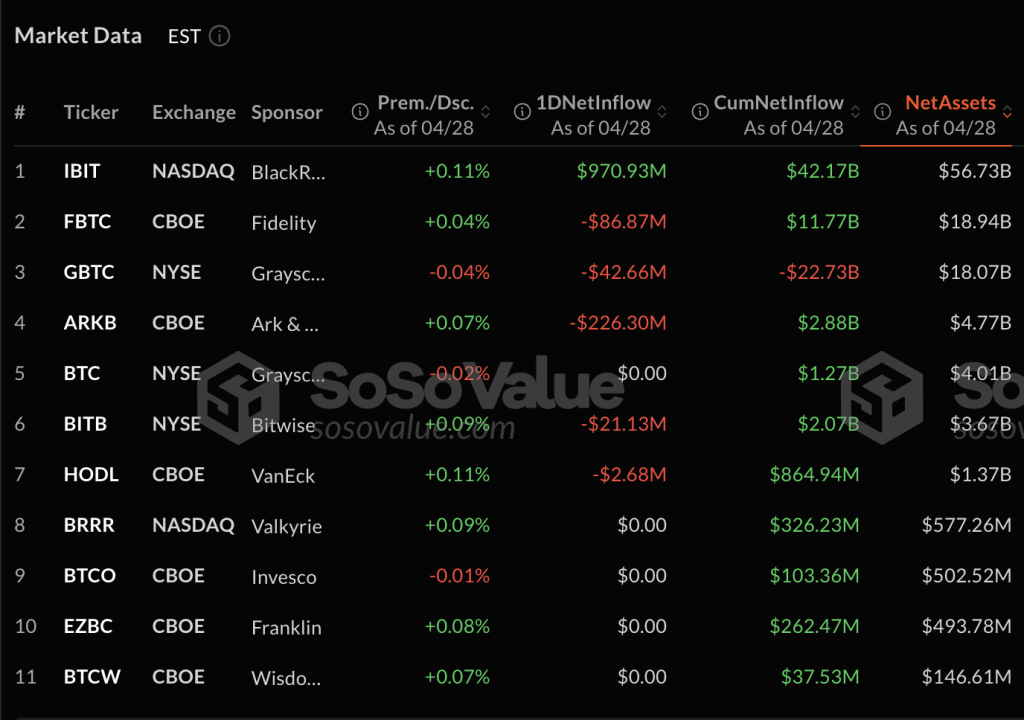
BlackRock’s spot Bitcoin ETF, iShares Bitcoin Trust (IBIT), recorded nearly $1 billion in inflows on Monday, marking its second-largest single-day intake since its debut earlier this year. According to SoSoValue data, IBIT pulled in $970.93 million, underlining the renewed appetite among institutional investors for crypto assets. The surge comes amid a broader recovery in Bitcoin markets. Investors have been steadily returning to Bitcoin-linked products, buoyed by signs of resilience in the asset despite volatility in equities. Crypto supporters have pointed out Bitcoin’s relative stability compared to US stocks during periods of economic uncertainty, a trend that has reignited discussions around Bitcoin’s potential as a safe-haven asset.
James Toledano, chief operating officer at Unity Wallet, said the current momentum stems from multiple factors. He noted that President Donald Trump’s recent silence on crypto matters had helped market sentiment. “Historically, his comments have coincided with price drops, though correlation is not causation,” he said. Toledano added that easing rhetoric around tariffs and the Federal Reserve has lifted investor confidence, alongside the strong inflows into Bitcoin ETFs that reflect renewed institutional support. Despite IBIT’s strong performance, the broader Bitcoin ETF market showed mixed momentum, signaling that investor demand remains selective.
Monday’s inflows were heavily concentrated in BlackRock’s IBIT, which brought in $970 million. In contrast, Fidelity’s FBTC recorded outflows of $86.8 million, while Grayscale’s GBTC saw $42.66 million in net outflows. Ark Invest’s ARKB fund posted the largest single-day outflow among major ETFs at $226.3 million. The rising demand shows how Bitcoin’s narrative as a hedge against macroeconomic uncertainty is gaining traction again. With US equities under pressure and global markets seeking direction, both gold and Bitcoin have benefited from a pivot toward alternative stores of value.
The post BlackRock’s Bitcoin ETF Posts Second-Largest Inflow Since January Launch appeared first on Cryptonews.
BlackRock’s Bitcoin ETF Posts Second-Largest Inflow Since January Launch
The cryptocurrency landscape is always evolving, and one of the most significant developments in recent times has been the launch of BlackRock’s Bitcoin Exchange-Traded Fund (ETF). Since its inception in January, the ETF has drawn considerable attention, not just for its backing by one of the world’s largest asset management firms but also for its performance in a volatile market. Recently, the ETF recorded its second-largest inflow since its launch, signaling a growing interest among institutional investors in Bitcoin and the broader cryptocurrency market.
The Significance of ETFs in the Crypto Space
ETFs have transformed how investors engage with various asset classes. By allowing individuals and institutions to gain exposure to assets without direct ownership, these financial products lower the barrier to entry for many investors. BlackRock, with over $9 trillion in assets under management, stepped into the Bitcoin market to provide a more structured and regulatory-compliant avenue for investing in cryptocurrencies.
Bitcoin, often hailed as digital gold, is seen by many as a hedge against inflation and economic instability. With its fixed supply and decentralized nature, it has attracted both retail and institutional investors who view it as an opportunity for capital appreciation. However, volatility remains a constant in crypto markets. The introduction of an ETF simplifies the investment process, enabling both seasoned investors and newcomers to enter the market with less complexity.
Insights into Recent Inflows
The recent inflow into BlackRock’s Bitcoin ETF reflects a larger trend in the financial markets where institutions are increasingly looking to incorporate cryptocurrencies into their portfolios. According to reports, this inflow comes on the heels of a broader recovery in Bitcoin prices, which have seen a resurgence after a protracted bearish trend. The allure of Bitcoin as an inflation hedge and a digital asset that can deliver potentially high returns has made it especially attractive in current economic conditions marked by rising interest rates and geopolitical uncertainties.
This second-largest inflow since the ETF’s launch suggests that investors are not just temporarily dipping their toes into the Bitcoin market; rather, they are reallocating significant portions of their portfolios to accommodate digital assets.
The Role of Institutional Investors
Institutional interest in Bitcoin has grown dramatically over the past few years, a trend that has bolstered the asset’s legitimacy in traditional finance. Early adopters were primarily hedge funds and family offices, but as discussions around cryptocurrencies have become more mainstream, larger institutions have started to take notice. Firms like Fidelity, Goldman Sachs, and now BlackRock are paving the way for wider market acceptance of Bitcoin.
With the growing focus on environmental sustainability, many institutions are also keeping an eye on Bitcoin’s energy consumption. Bitcoin’s proof-of-work mining process emits significant carbon emissions, which has led to growing advocacy for sustainable practices within the industry. In response, some ETFs and funds are beginning to prioritize investments in digital currencies that adhere to stricter environmental standards.
Challenges Ahead
Despite the encouraging inflows and growing institutional interest, challenges remain for Bitcoin and other cryptocurrencies. Regulatory scrutiny from governments and financial authorities continues to loom large, affecting investor sentiment. Questions about regulatory frameworks around cryptocurrency trading, taxation, and compliance can create uncertainty in the market.
Furthermore, Bitcoin’s price remains subject to extreme volatility. Significant price fluctuations can deter potential investors who are cautious about losing capital. While the ETF model reduces some of this risk, the underlying asset’s volatility still poses a challenge that investors must navigate.
The Future of Bitcoin ETFs
As more investors look for ways to gain exposure to Bitcoin and other cryptocurrencies, the future of Bitcoin ETFs appears promising. Analysts suggest that as Bitcoin matures, the regulatory environment will likely become clearer, paving the way for additional crypto-related financial products. This could lead to more competition among asset managers and potentially more innovative structures that cater to different investor needs.
BlackRock’s recent success with its Bitcoin ETF may encourage other asset management firms to launch similar products, further enhancing the cryptocurrency ecosystem. An influx of Bitcoin ETFs could introduce more liquidity to the market, making it a more robust financial vehicle for investors.
Conclusion
The recent inflow into BlackRock’s Bitcoin ETF is a testament to the growing acceptance and interest in cryptocurrencies from institutional investors. While challenges remain, such as regulatory uncertainty and market volatility, the trend towards digital asset investment appears to be gaining momentum. As the financial world continues to evolve, Bitcoin’s role within traditional financial systems may expand, making ETFs an essential gateway for investors keen to explore the opportunities presented by cryptocurrencies.
With influential players like BlackRock stepping in, the future of Bitcoin and digital assets looks increasingly promising, reflecting a significant shift in how we understand and engage with money in the digital age. As the market matures and becomes more accessible, it will undoubtedly be exciting to see how Bitcoin and its associated financial instruments shape the investment landscape in the coming years.
BlackRock’s Bitcoin ETF has recently experienced significant traction, marking its second-largest inflow since its launch in January. The surge in investment signals growing interest in Bitcoin from institutional investors, with BlackRock leading the charge in the push for mainstream acceptance of cryptocurrencies. This inflow highlights a shift in market confidence and the potential for greater adoption of Bitcoin as a legitimate asset class. The ETF’s performance could influence other financial institutions to explore similar products, further legitimizing the cryptocurrency market.