

What recent trends have been observed in institutional Bitcoin purchases? Who are some of the prominent institutional buyers mentioned in the article? How has Bitcoin’s performance compared to other cryptocurrencies in recent months? What factors have influenced market sentiment regarding Bitcoin, according to the article? What key technical indicators suggest Bitcoin’s potential to reach another all-time high?
Institutional holders have been buying thousands of Bitcoin (BTC) tokens in the past few weeks as market sentiment appears to be improving. Prominent buyers include Strategy, the company headed by Michael Saylor whose BTC treasury currently holds 528,185 tokens after it bought over $2.5 billion worth of the digital asset in March. Meanwhile, the Chief Executive Officer of Tether, the company behind the popular stablecoin USDT, informed that they bought 8,888 BTC tokens as well and now hold nearly $8 billion worth of Bitcoin.
Finally, a Japanese Bitcoin treasury company called Metaplanet bought another 696 BTC as well and now holds 4,046 tokens. This level of institutional buying is a vote of confidence for cryptocurrencies at a point when most digital assets have lost a significant percentage of their value since the year started. Bitcoin has been one of the most resilient cryptocurrencies this year as its yearly losses currently stand at 9.4%. In the past week, BTC has dropped by 4% as market sentiment soured once again after President Donald Trump pushed forward additional tariffs. These hostilities on the trade front caused panic among investors as they fear that the Federal Reserve could scrap one of the two interest rate cuts it has planned for this year if inflation starts to go up.
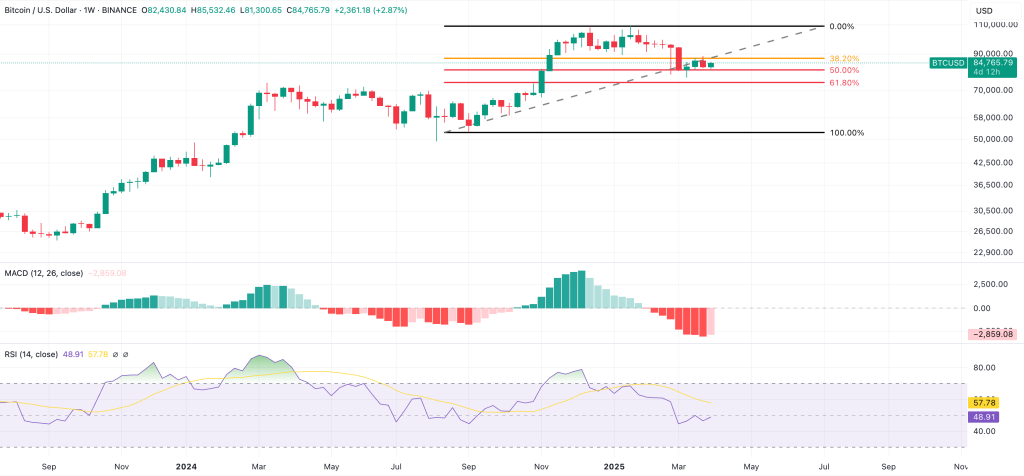
Moving to the charts, the weekly chart for BTC shows that the asset has tagged a key area of support at the 50% Fibonacci and has managed to stay above this level despite the latest downturn. Momentum indicators are bearish as the Relative Strength Index (RSI) currently stands below the signal line. However, it appears to have found a temporary floor as the price has entered a stage of consolidation. Meanwhile, the MACD’s histogram has flashed its first light red bar this week, meaning that negative momentum could be weakening. If BTC bounces off this key area, it could mean that the token will rise to a fresh all-time high in the next few months. As cryptos become a larger part of investors’ portfolios, storing these digital assets safely is a top priority.
Best Wallet (BEST) is an innovative crypto wallet that will support over 60 different blockchains to help investors consolidate their holdings with a single provider. Beyond its secure Web3 storage capabilities, Best Wallet stands out with unique tools like Upcoming Tokens – a built-in crypto screener designed to help users discover high-potential presales before they hit the market. Since launching its presale in December, the project has raised nearly $12 million, fueling an ambitious roadmap that includes a decentralized exchange and a crypto-enabled debit card for everyday spending. To invest in $BEST, you can visit the Best Wallet website and connect your crypto wallet. If you don’t yet have one, you can easily download the Best Wallet app. $BEST can be purchased using USDT, ETH, or even a bank card, making it simple for anyone to get started.
The post Institutional FOMO? Bitcoin Treasury Holdings Skyrocket as Big Players Accumulate appeared first on Cryptonews.
Institutional FOMO? Bitcoin Treasury Holdings Skyrocket as Big Players Accumulate
In recent months, the cryptocurrency market has witnessed a notable shift, highlighted by a significant rise in Bitcoin treasury holdings among institutional investors. This trend, often referred to as "institutional FOMO" (Fear of Missing Out), signals a growing acceptance of Bitcoin as a legitimate asset class. The surge in acquisitions is reshaping the landscape of cryptocurrency investment, suggesting that major players are increasingly viewing Bitcoin not just as digital currency but as a strategic addition to their portfolios.
The Rise of Institutional Investment in Bitcoin
Historically, Bitcoin was associated with retail investors, crypto enthusiasts, and speculative trading. However, the environment has dramatically transformed. Major institutions such as Tesla, MicroStrategy, and Square have publicly endorsed Bitcoin, integrating it into their corporate treasury strategies. For these heavyweight players, Bitcoin represents more than just an alternative investment; it’s a hedge against inflation, a store of value, and a potential growth asset in an increasingly digital economy.
The strategic accumulation of Bitcoin by these corporations has resulted in a phenomenon that many analysts describe as a gold rush, encouraging others to follow suit. As more companies adopt Bitcoin on their balance sheets, the risk of missing out on potential gains creates pressure for others to enter the market. This collective momentum not only increases Bitcoin’s legitimacy but also potentially stabilizes its value over the long term.
Factors Driving Institutional FOMO
Inflation Concerns: One of the primary drivers behind the increased interest from institutional investors is the widespread fear of inflation. As central banks around the globe continue to implement expansive monetary policies, concerns about the long-term value of traditional fiat currencies have grown. Bitcoin, with its capped supply of 21 million coins, is often perceived as a digital antidote to inflation—an asset that can preserve value when fiat currencies face devaluation.
Regulatory Clarity: Over the past few years, there has been a concerted effort from various governments and regulatory bodies to provide clarity around cryptocurrency regulations. This has allowed institutional investors to feel more secure in their investments, paving the way for larger allocations. Clear regulations mean less uncertainty, encouraging investment from entities that require compliance to operate.
Market Maturity: The Bitcoin ecosystem has matured significantly since its inception in 2009. The development of sophisticated financial instruments such as Bitcoin futures and exchange-traded funds (ETFs) has helped institutions gain exposure to Bitcoin without necessarily holding the asset directly. Additionally, secure custodial services, insurance products, and transaction platforms that cater specifically to institutional investors have made it easier and safer for these players to navigate the crypto landscape.
- Diverse Portfolio Strategies: Institutional investors, including hedge funds and family offices, are continuously seeking diversification to manage risk and enhance potential returns. Bitcoin has emerged as a unique asset that exhibits low correlation with traditional equities and bonds, making it an attractive addition to a diversified portfolio. This diversification can help mitigate risks associated with economic downturns or volatility in traditional markets.
Impact of Bitcoin Treasury Holdings
As institutional investors continue to accumulate Bitcoin, the impact on the overall ecosystem can be profound. Increased demand from these players contributes to rising prices, which can, in turn, attract even more institutional interest. This “FOMO effect” can lead to exponential growth in Bitcoin’s value, creating a self-reinforcing cycle of investment and appreciation.
Moreover, as institutional players reveal their treasury holdings, it draws attention from the public and smaller investors, fostering a greater sense of legitimacy and acceptance for cryptocurrencies. The more corporations incorporate Bitcoin, the less it is seen as a speculative gamble and the more it is recognized as a valid asset class.
The Future Outlook: Sustainable Growth or a Bubble?
While the trend of institutional FOMO could lead to continued growth in Bitcoin treasury holdings, it is crucial to approach this momentum with caution. Rapid price increases can attract speculation and create a bubble-like environment. Sustainable growth will depend on a variety of factors, including regulatory developments, technological advancements, and macroeconomic conditions.
Furthermore, as more institutions enter the market, Bitcoin could lose some of its volatility as it matures into a more stable asset class. This stability may paradoxically reduce FOMO in some investors, especially those who seek quick gains rather than long-term value appreciation.
In conclusion, as institutional interest in Bitcoin continues to rise, the phenomenon of institutional FOMO is reshaping how crypto is perceived and traded. While the long-term outlook is largely optimistic, the market remains unpredictable. Investors would be wise to proceed with cautious optimism, mindful of the potential for both significant gains and risks inherent in an evolving financial landscape. As institutions continue to accumulate Bitcoin, the asset’s destiny seems increasingly intertwined with that of traditional finance, ultimately shaping the future of both worlds.
Recent trends indicate a significant surge in Bitcoin treasury holdings among large institutional players, highlighting a growing sense of urgency to accumulate Bitcoin amidst market fluctuations. This phenomenon, often referred to as “institutional FOMO” (fear of missing out), reflects a strategic move by major companies and investment firms to secure digital assets that are increasingly viewed as a hedge against inflation and economic instability.
Factors contributing to this trend include rising inflation rates, geopolitical tensions, and a general shift towards digital assets as part of diversified investment portfolios. Institutions are recognizing Bitcoin not only as a speculative asset but also as a valuable store of value. The accumulation by these big players often leads to increased market confidence, stirring interest among smaller investors and retail participants.
The increase in treasury holdings also spurs discussions about the potential implications for Bitcoin’s price stability and overall market dynamics. With more institutional investments, Bitcoin’s liquidity could see an uptick, affecting its accessibility and adoption in broader financial markets.
As institutional interest continues to grow, it remains crucial for market observers to monitor developments that might influence this trajectory. The interaction between institutional accumulation and retail participation could ultimately reshape the landscape of Bitcoin and cryptocurrencies as a whole.