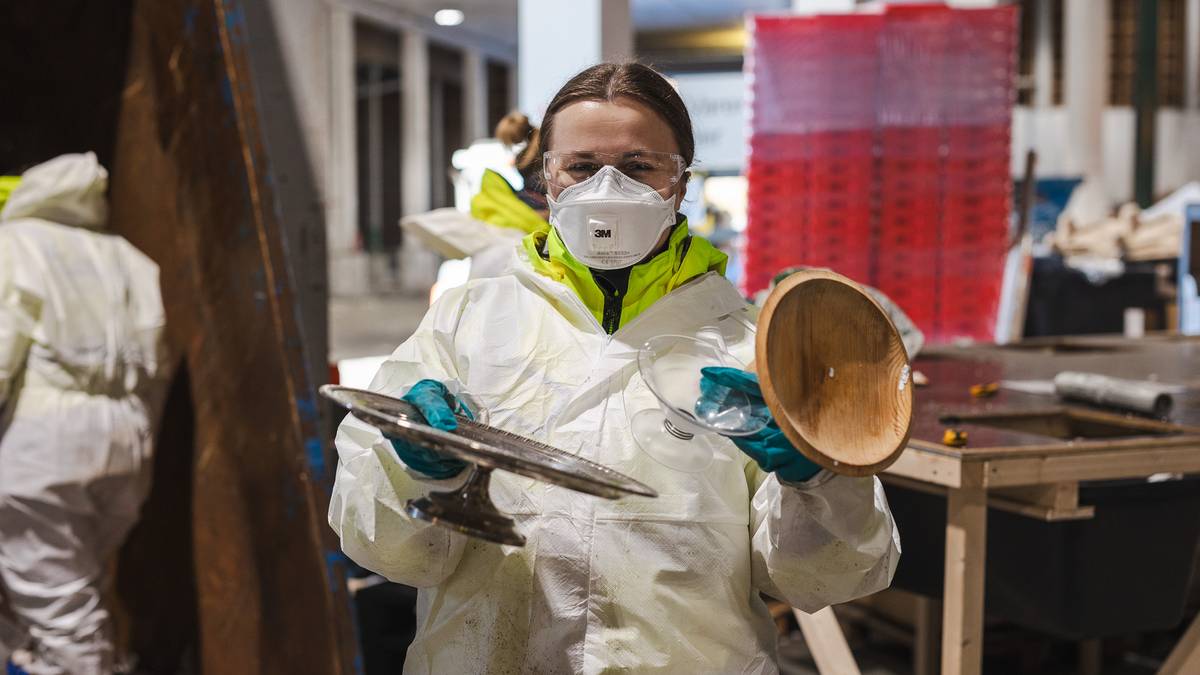
Inside the sorting hall at Iris Salten, random bags of residual waste are selected. They are cut up, before the content is divided into the various sorting categories. After the waste is weighed, the employees find out how much residual waste is actually in the bags. 60 percent of what ended up in the residual waste at the salt treatment plants was sorted incorrectly. – Only 40 percent of what is in the residual waste bags is actually residual waste. The resources could be used better, for material recovery, reuse, or energy recovery. It’s too bad, says Kristina Naasen Hellesnes, environmental advisor at Iris Salten. But it is not only in the north that people fail to sort correctly. Norway does not meet the target, because Norway is far below the EU’s target for material recycling, says a report from earlier this autumn. Now time is almost up – and by all accounts, Norway will not reach the targets for 2025. Only 37.3 percent of the waste in Norway was sent for recycling, shows a report from earlier this year. That is 18 percentage points below the target. HAZARDOUS WASTE: Batteries must be sorted as hazardous waste. Here they have appeared in the residual waste. – Unfortunately, we find some hazardous waste in the residual waste which can lead to a fire. We have between 40-50 fire incidents here in the course of a year, explains Naasen Hellesnes. Photo: Iris Salten Other countries such as Germany, Austria, Belgium and the Netherlands report that they have already reached the targets for 2025, according to the Norwegian Environment Agency. These are the EU targets for recycling Household waste (incl. household-like waste from businesses): 55 per cent must be prepared for reuse or material recycled. Packaging waste: 65 percent must be recycled, more specifically: Wood (25 percent) Plastic (50 percent) Aluminum (50 percent) Metal (70 percent) Glass (70 percent) Cardboard and paper (75 percent) The target in the Landfill Directive 1999/31/EC = disposal of household waste and household-like commercial waste must be reduced to 10 percent or less by 2035 The EU’s binding target that 50 percent of such waste should be prepared for reuse or material recycled by 2020 was then not reached by Norway. The target is gradually being increased with an increase to 55 per cent by 2025, 60 per cent by 2030 and 65 per cent by 2035. Through the EEA agreement, these targets also apply to Norway. Source: Environmental indicator/Directorate of the Environment. But what happens if we don’t reach our goals? Then it can become more expensive to, among other things, burn waste, and companies like Iris Salten have to make it more expensive for people to throw away residual waste. – In addition, you would need a smaller residual waste bin, and in that way save money on waste disposal fees, if you sorted better, she encourages. Are you careful with sorting? Little, I don’t think it matters Yes, of course. Down to the smallest piece of plastic Yes, I try to be careful Show result Poorer sorting in densely built-up areas The Norwegian Environment Agency does not have updated figures for the composition of residual waste at national level, but they estimate that the figures from Iris Salten are representative for the whole country. – In general, it is often the case that sorting is a little worse in cities where more people live in apartments with shared waste systems. It is better in less densely built-up areas, where most have their own waste containers, says Jone Rivrud Rygg, head of the section for circular waste management. Section leader Jone Rivrud Rygg in the Norwegian Environment Agency believes that a lack of knowledge, or an attitude that source sorting is not important, may be among the reasons why we are so bad at source sorting. Photo: The Norwegian Environment Agency From 1 January 2023, municipalities and businesses had to start sorting food waste, plastic waste and park and garden waste. – It is a little too early to say anything concrete about the effect of this change, but figures from Statistics Norway show that the proportion of household waste sent for material recycling increased somewhat from 2022 to 2023, says Rygg. According to him, the figures also showed that the amount of food waste increased, while the amount of residual waste decreased, which may indicate an increased sorting of food waste. PICKING ANALYSIS: Here, employees at Iris Salten go through random bags of residual waste. A third of what ended up in the residual waste in Salten could have been sorted as food waste, they state after the investigation. Photo: Per-Magne Steen / news New rules from New Year At the turn of the year, Norwegians must sort several types of waste, the authorities have decided. From 1 January, municipalities and businesses must sort cardboard, paper, glass, metal and textile waste. – We expect that the obligation to sort out several types of waste will help to increase the sorting rate, and thus reduce the amount of residual waste, says Rygg in the Norwegian Environment Agency. At the same time, he says that further measures will be necessary in the coming years to achieve the EU goals. – We know that there is a big connection between the reuse of clothes and less production of clothes. You are a long way off, if you ensure the reuse of clothes instead of just throwing them in the residual waste, says Tor Gausemel Kristensen. From left, Christina Larsos, responsible for marketing, Kristina Naasen Hellesnes, environmental advisor, Tor Gausemel Kristensen, head of development and sustainability and Bjørn Ove Moum, managing director, all at Iris Salten IKS. Photo: Per-Magne Steen / news He is head of development and sustainability at Iris Salten, and has a particularly strong commitment to the reuse of textiles. – By thinking about sorting, that you take out what can be reused and which many people today throw in the residual waste, that is the best thing you can do for the environment, he concludes. This belongs in the residual waste: Used vacuum cleaner bags Nappies and nappies Books with stiff covers Dirty cardboard and paper Styrofoam (large quantities of Styrofoam must be delivered directly to your local environmental market) Leather and rubber Brushes, markers and pens Cooled ashes Cotton, plasters and gauze Dog bags and cat litter Carpets (only rugs are used as textiles) Important! Hazardous waste and electrical waste must not be thrown away with the rest of the waste, but delivered free of charge at the nearest environmental square. Source: Iris Salten You may be sorting this incorrectly It can be difficult to know how everything should be sorted. And to make it all a little more complicated, there are also differences from municipality to municipality. Because while the waste company Iris Salten, which is based in Bodø in Nordland, believes that egg cartons, toilet and dryer cores should go in the food waste, the rule is completely different in Oslo municipality. In the municipality of Oslo, this is sorted as cardboard and paper, while in Bergen it goes to residual waste. IN THE FOOD WASTE: Iris Salten’s sorting guide shows that egg cartons, toilet and dryer cores should go in the food waste. Photo: Iris salten Here are some other things you might not have known: Books with a hard cover should be left in – while books with a soft cover should be in cardboard and paper. Chewing gum must be sorted into residual waste, and not food waste as you might think. Drinking glasses, refractory forms, mirrors or window glass should not be in the glass collection, but delivered at the environmental station. Used snuff bags must be disposed of in the residual waste. Straws must be sorted as residual waste and not as plastic, while plastic wood sacks must be sorted as residual waste. Glossy and brightly colored wrapping paper is residual waste, while wrapping paper made from natural materials is paper. Nail polish, spray cans, glue and paint are hazardous waste. In Norway, sorting marks have been established for source sorting. These marks can be found on everything from packaging, waste containers and at recycling stations. SORTING MARK: In Norway, packaging, such as this potato chip bag, has been given a sorting mark. Here you see the sign for residual waste. Photo: Leif Rune Løland / news Published 13.12.2024, at 18.53 Updated 13.12.2024, at 21.37
ttn-69