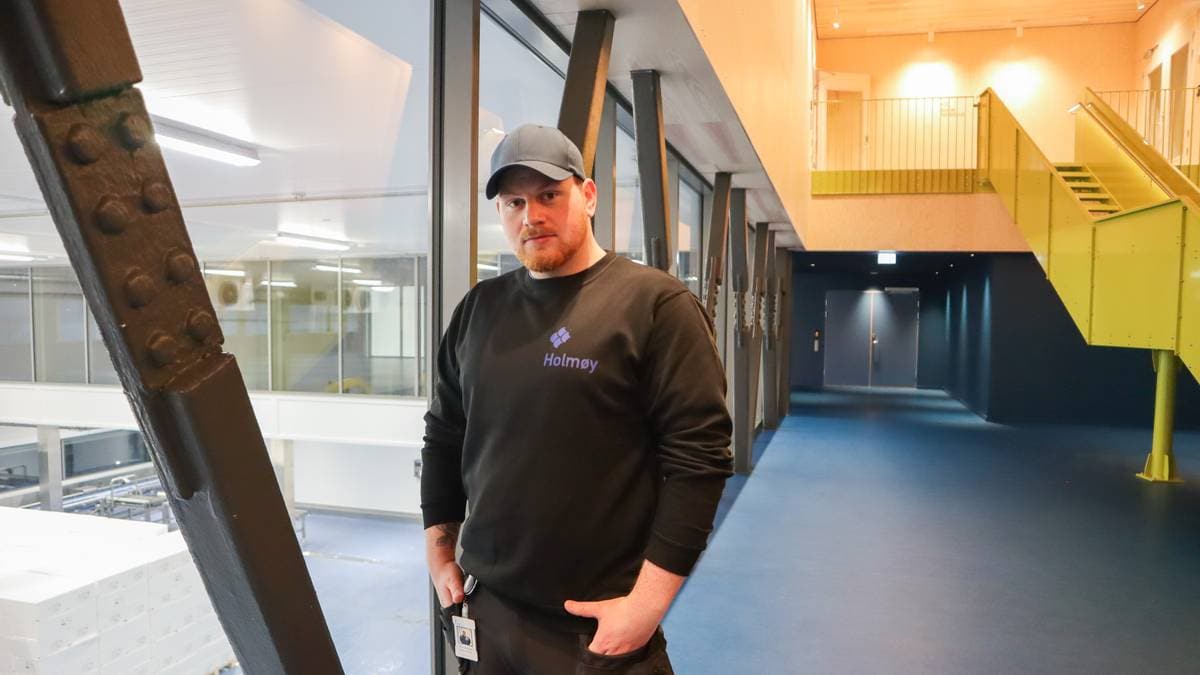
26-year-old Sivert Klaussen works as a service technician at a slaughterhouse. In the previous jobs he has had, he has stood in a concrete-clad room under a cold ceiling light for seven and a half hours every day. But in this job it is different. It cost around NOK 1 billion to build the salmon slaughterhouse in Holmøy. Photo: Torgeir Sørensen Because when the salmon slaughterhouse at home in Sortland in Vesterålen built a new industrial building, they made moves that lured Klaussen and other workers to them. Large windows, viewing benches, roof terrace, a colorful environment and lots of daylight especially for the employees. – It is very important when you are inside a slaughterhouse and the sun is shining through the window, says Klaussen. According to architectural experts, it can affect how efficiently the employees work. Have spent NOK 100 million The salmon slaughterhouse was completed in April, and cost around NOK 1 billion to build. 100 million of them were used to make the workplace bright and pleasant. – Not all slaughterhouses have such measures. It is much cozier to look out on a fjord instead of a white concrete wall, says Klaussen. The architectural firm Snøhetta has designed the industrial building and ensured plenty of natural light and a colorful environment. – Indoors, we have a large and spacious canteen that serves hot food every day. And what the employees might otherwise need during the working day, says group developer, Ida Holmøy, referring to, among other things, good wardrobe solutions and a relaxation area. -Snøhetta sounds fancy. One still thinks about opera. Is it something for a fishing group? – We think so. They have challenged us in many areas, including the use of colour. It is something we might not have wanted to do by ourselves. So we have received very good guidance and help from Snøhetta, says Holmøy. Job applications flood in. Many industries are struggling to get hold of people in today’s labor market. And it is particularly difficult in Northern Norway. According to Nav’s annual business survey, almost one in four businesses in Nordland and Finnmark experience receiving no or few qualified applicants for vacant positions. In Troms, the number is one in three businesses. Holmøy hires 100 new employees for the new slaughterhouse. – We already had the raw material, i.e. the salmon, but one of the biggest challenges we faced when we started the project was getting hold of people. Group developer at Holmøy, Ida Holmøy, says it was necessary to spend NOK 100 million on well-being measures. Photo: Lars-Bjørn Martinsen / news Then the big question was: Would they be able to get it with these measures? – We have received a lot of positive comments about the slaughterhouse. We have received an incredible number of good applications. So there are many people who want a job with us, says Holmøy. – Was it then necessary to use this money when the recruitment went well? – Yes, I would certainly say that. Because we don’t know what it would be like if we hadn’t taken the measures. Become more efficient with light and color Kine Angelo, Associate Professor at NTNU and is an expert on color and color in architecture. She says that it is not unusual for some workplaces to spend more money on a bright and colorful environment. – There has been more focus on this in schools, hospitals and care for the elderly. But it has not been widespread in other workplaces yet. Kine Angelo, Associate Professor at NTNU Photo: Kirsti Kringstad / news Now they see tendencies for larger companies to invest in upgrading the environment for employees in order to increase productivity, says the expert. – The aim of light is to get enough to see what we need to see. Colors should underpin form, highlight what needs to be seen and dampen what should not be shown as much, explains Angelo. Large windows also contribute to good light and views. If our surroundings compensate for what we experience in nature in terms of light and colour, we become happier. – Research certainly indicates that more colors and light have an effect on work efficiency, health and well-being, says the expert. – Looking forward to work Logistics operator at Holmøy, Jonas Vestly Hanssen was also one of the 20 workers who moved to Sortland municipality because of the job in the slaughterhouse. And for him, like Klaussen, the temptation was local. – They have done a good job. I am glad they have done it, and I feel that I am looking forward to coming to work. Logistics operator at Holmøy, Jonas Vestly Hanssen, thinks it is right for the slaughterhouse to spend NOK 100 million on well-being measures. Photo: Lars Bjørn Martinsen / news He notices that the measure means that employees talk more as a team during the working day. The fact that the company has spent NOK 100 million on making it bright and pleasant, he thinks is important. – I think they have done absolutely right to spend extra money on how it looks and have it open with large windows. It is the architectural firm Snøhetta that has designed the slaughterhouse in Holmøy. Photo: Torgeir Sørensen – Couldn’t they also use NOK 100 million in extra wages for the employees. Wouldn’t that be just as pleasant? – Of course, it would have been good with that money and, but you have to be comfortable at work, he says and adds: – It is not certain that it would have been as pleasant here if they had done it that way. Published 11.12.2024, at 05.51
ttn-69