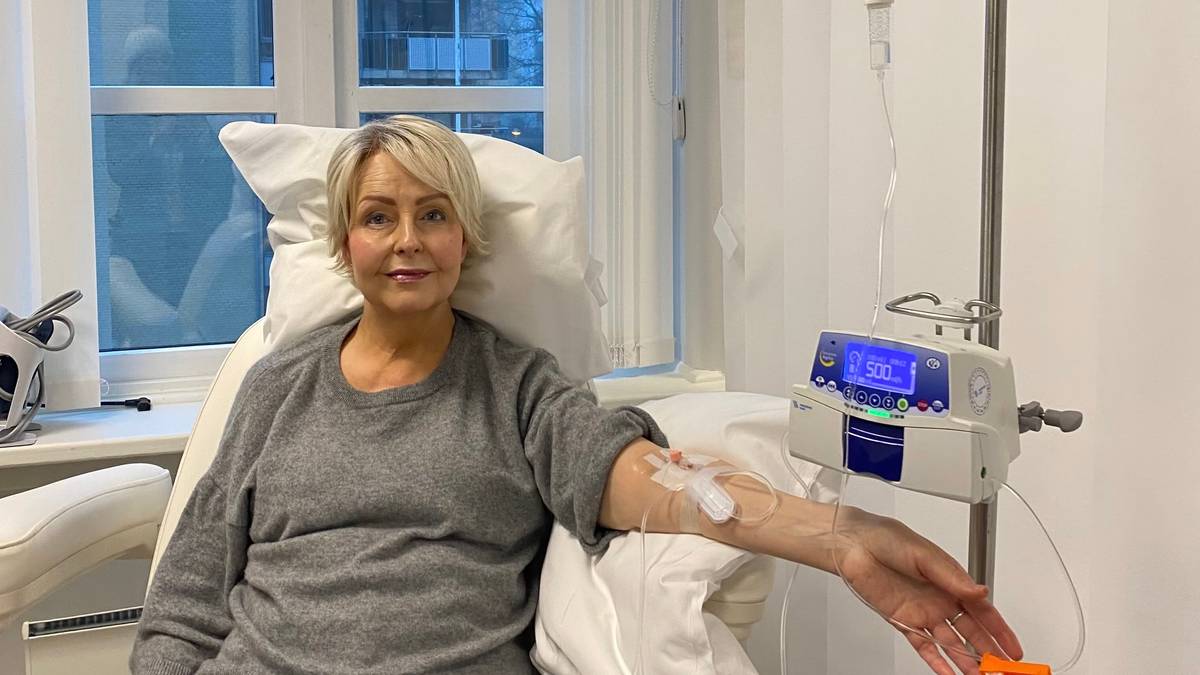
Katrine Rakeng has breast cancer. She has lived with it for 14 years. Over the years, her doctor has tried various treatments to keep the disease at bay. She has been able to do that, right up until April this year. She was then diagnosed with spread to the liver. – So then the doctor told me that Trodelvy is your only option, but you have to buy it privately. Katrine Rakeng on her way through Frognerparken for a new treatment. Photo: Marianne Ytre-Eide / news Trodelvy (Sacituzumabgovitekan) is a drug that is approved in Norway, but only for patients with triple negative breast cancer. It is not Katrine’s, it is classified as HER2 negative. Expensive medicine However, studies from the USA and Japan have shown that Trodelvy can also have an effect on Katrine’s breast cancer. Also in the Joint Catalog, which contains guidelines for what medicines are used for, it is stated that Trodelvy can be used for Katrine’s type of breast cancer. At the same time, it is a very expensive treatment. The decision-making forum, which is the body that decides who is entitled to the various treatments available in Norway, has decided that only one group of patients can receive this treatment. They believe that women who have triple-negative breast cancer have the best and most long-lasting effect of the medicine, and that the price is then commensurate with the benefit for this patient group. But the forum has therefore not approved its use for cancer patients with cancer that is classified as HER2-negative. Hospitals can make exceptions When the management at Oslo University Hospital said no to Rakeng being able to receive Trodelvy, she called the private hospital Aleris. – I got an appointment the next day. Then I started the treatment. It was like no question. I don’t have money. So, I live alone and have no savings. Nothing. Rate on self-financed treatment. Photo: Marianne Ytre-Eide / news The treatment she started costs about NOK 150,000 a month. She got the money from family, friends and others through a Spleis action. After a few weeks of treatment, she improved significantly. – My liver tests were normal after a short time and the CT scan was taken after just seven weeks. It showed that all the metastases had shrunk. “All the tumors had shrunk, so they all got smaller in size.”Katrine Rakeng cancer patientPhoto: Marianne Ytre-Eide / NRKPhoto: Marianne Ytre-Eide / news At the same time, her doctor at OUS, Inger Thune, collected information and sent an application for exception, so that Katrine could still get the medicine through the public sector. Hospitals can grant exceptions for patients with Katrine’s type of cancer, but according to Helse Sørøst, it is up to each hospital to assess. Rakeng has soon spent a million out of his own pocket. Photo: Marianne Ytre-Eide / news In the applications, which news has seen, the doctor justified the documented effect and the demand for health care. Rakeng was refused. news has also seen the refusal from OUS. The rejection letter from OUS states, as news has seen, the following among other things: “Further treatment with Sacituzumab govitekan in this patient will not give the possibility of healing and the available documentation does not provide a basis for expecting future long-term remission.” The conclusion was therefore that Katrine cannot recover, and that the medication would not have a long-term effect. In the rejection letter, it is pointed out, among other things, that there is little research into the consequences of Rakeng’s type of breast cancer. Rakeng and the Norwegian Cancer Society have appealed the decision. Now OUS says that they will reassess the refusal. “We have great understanding that this patient is in a difficult situation. We are now processing the appeal against the refusal to continue the treatment with Trodelvy at Oslo University Hospital. We will make a thorough assessment of the elements that come out in the complaint, but cannot now advance how this assessment will conclude” Acting specialist director Oslo University Hospital Morten Tandberg-Eriksen – Difficult Inger Thune is a professor at the University of Oslo and senior physician at OUS. She is Katrine’s doctor will not comment specifically on Katrine’s case, but says on a general basis that it is ethically very difficult to be a doctor for a patient and know that there is a treatment, but at the same time not be allowed to use it . Professor and senior physician at OUS, Inger Thune, experiences these cases as ethically difficult. Photo: Marianne Ytre-Eide / news – It is an ethical dilemma that is difficult, which as of today has a different social impact. Because there will be variations in how patients and relatives manage to fight to get a medicine. Thune points out that some patients manage to collect enough money to buy a treatment privately, because they themselves have good finances, or manage to create commitment to their case. – The way we solve it today is perceived as non-optimal and unfair, says Thune. She calls for a fairer system, where the doctors who are national experts in the various diseases are more involved in the decisions before the decisions are taken by the management at each individual hospital. Responsible health care The Ministry of Health and Care says they cannot comment on why a single patient, like Rakeng, is not offered treatment. But State Secretary Karl Kristian Bekeng emphasizes the hospitals’ responsibility. State Secretary Karl Kristian Bekeng emphasizes the hospital’s responsibility. Photo: Esten Borgos – Decisions made during the patient process must be individual and justifiable. This is how we safeguard patients’ right to necessary healthcare. He says they are concerned that priority decisions safeguard access to new methods. Minister of Health Vestre therefore announced before the summer that an arrangement will be established which can give patients with very specific characteristics access to methods, even if the method has not been introduced for the entire patient group, says Bekeng. In June, the Minister of Health commissioned the regional health organizations to investigate and prepare for the introduction of the scheme. – It is important that such a scheme is well prepared and widely introduced so that patients can have the opportunity to apply throughout the country. – Rigid system Professor of health law at the University of Oslo, Anne Kjersti Befring, believes that it is questionable that the regional health authorities should make such decisions, when they are also supposed to provide necessary services. Professor of health law at the University of Oslo Anne Kjersti Befring says the current system is rigid. – Conflicts of interest will regularly arise between consideration for patients and consideration for spending money on large investments such as buildings and ICT systems. She believes the regional health organizations are ignoring the parliamentary resolution, which states, among other things, that “the individual assessments must be based on the individual’s needs and actual possibilities for diagnosing and treating illness”. – A rigid system has been established for general decisions concerning treatment methods that cannot be appealed. This is a uniquely Norwegian system. No other country has a similar system. High price Katrine Rakeng wants to live and is painfully aware that it has its price. After the meeting with news, she goes to the private clinic Aleris for a new single treatment for which she must pay NOK 49,500. In total, she has paid NOK 980,428 out of her own pocket since May. – I get really upset about them. That I have to pay so much money to get that treatment. You feel that when you need the public healthcare system the most, they just fail you. Katrine Rakeng on her way in for new treatment. Photo: Marianne Ytre-Eide / news Published 09.12.2024, at 22.38
ttn-69