
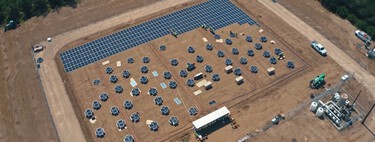
The Solar Revolution in the Arctic: Vertical Panels in Tromsø
The world is currently in the midst of a renewable energy revolution . While China stands as a dominant force in this arena, Europe is witnessing a remarkable surge in renewable energy adoption, and even Texas is embracing wind and photovoltaic technologies. However, the Arctic region poses unique challenges for solar energy deployment. With a sun that barely rises above the horizon for much of the year, traditional solar panels seem inefficient. The innovative solution? Vertical solar panels .
In the city of Tromsø , located just north of the Arctic Circle, a pioneering project has just been completed, marking the largest installation of bifacial solar panels in the world. This groundbreaking installation, known as Tromsøterminalen , boasts an impressive 1,600 vertical photovoltaic units, collectively consisting of 6,400 individual solar panels.
This installation covers an area of approximately 2,670 square meters and has an installed capacity of 320 kWp. As highlighted by Interesting Engineering , the CEO of Over Easy Solar , the Norwegian company responsible for this project, notes that Tromsøterminalen is home to the largest vertical solar system on a single roof globally. This ambitious project aims to address the specific energy needs of the region.
Understanding Vertical Panels. The solar conditions in northern Norway are remarkably unique. During the summer months, specifically from May to July, Tromsø experiences a phenomenon known as the midnight sun , where the sun shines for 24 hours a day. In contrast, from late November to mid-January, the region plunges into polar night , resulting in minimal sunlight.
Given the extreme variations in sunlight exposure, vertical solar panels (VPV) have proven to be significantly more effective in harnessing solar energy. Traditional panels struggle to generate energy when sunlight hits at sharp angles, whereas VPVs can capture sunlight more efficiently. In optimal conditions, a typical panel may yield around 485 kWh; however, VPVs can generate up to 55% more energy, resulting in approximately 750 kWh per year.
The Role of Snow. Interestingly, during winter months, the energy production of these vertical panels can increase three to four times over traditional panels. This improvement is partly thanks to the Albedo effect , whereby the snow that accumulates between the panels reflects sunlight, enhancing energy capture. Consequently, VPVs are able to harness both direct sunlight and light reflected from the surrounding snow.
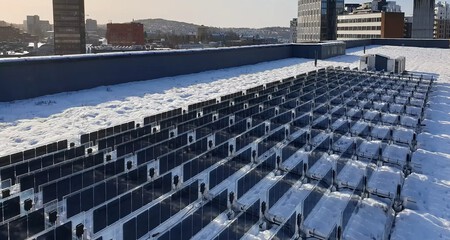
This innovative design has led to an estimated increase in energy production of over 30% . One of the significant benefits of vertical orientation is that snow does not accumulate on the panels themselves, making maintenance much easier and ensuring uninterrupted energy generation.
Interestingly, Tromsø’s system builds on the success of an earlier project involving 1,200 VPV units at the Oslo Ullevaal Stadium . Not only does the Tromsø installation showcase the potential for renewable energy at extreme latitudes, but it also serves as a model for other regions facing similar climatic conditions. Over Easy Solar asserts that these systems could find applications in roads and agrovoltaic setups as well.
Scalability in Other Regions. Over Easy Solar is conducting tests outside Arctic conditions as well, including in Spain . A cluster of these vertical panels installed on a roof in Elche has shown promising results, demonstrating the scalability of this innovative technology.
This approach proves especially beneficial, given the weight limitations of traditional solar installations. While a typical solar panel generally weighs between 15 to 25 kg/m² , the Tromsø panels weigh just 11 kg/m² , simplifying installation and enabling urban environments to accommodate more solar energy solutions.
Innovations like these demonstrate that even in challenging conditions, such as the Arctic, it is possible to maximize solar energy potential. The Tromsøvertical installation serves as an inspiring example for cities around the world to rethink their approach to solar energy. As technology continues to advance, the opportunities for sustainable energy evolution are boundless.