
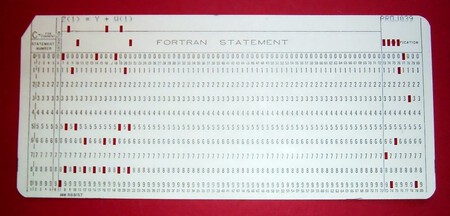
In today’s technology landscape, programming has become a more accessible and streamlined process. Modern integrated development environments (IDEs) have transformed coding into a user-friendly experience, allowing developers to focus on innovation rather than battling with cumbersome tools. However, this was not always the case. Sixty years ago, the world of programming was characterized by significant hurdles, including the use of punched cards—a method that feels almost archaic by contemporary standards.
Who Needs a Screen?
In 1962, a technology historian shared insights about how programmers operated without the luxury of personal computers or even monitors. Access to mainframes was a privilege reserved for large corporations, and the face of programming was quite different. Most programmers were adults, often dressed in formal attire, working within the confines of corporate structures.
A prime example of the era was the IBM 7090, which represented a significant leap in computing technology. Unlike its vacuum tube predecessors, the IBM 7090 utilized transistors, enabling it to perform up to 100,000 floating-point operations per second. However, this powerful machine lacked a user interface as we know it today—it could only be operated by one person at a time, making it incredibly valuable but also prohibitively expensive.
Costly Computing
Renting an IBM 7090 for a month in 1962 cost an astonishing $63,500—equivalent to over $421,000 today when adjusted for inflation. Every minute spent on the machine could cost around $10, emphasizing the urgent need for efficiency. To maximize that time, programmers employed punched cards with a capacity of 80 characters each, although only 72 were typically utilized.
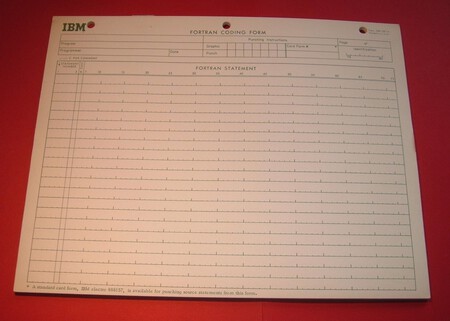
The IBM template allowed for programming on paper without exceeding character limits.
Punched cards were created using specialized machines—mechanical or electromechanical—that translated typed characters into physical perforations on card stock. Each program required meticulous sequencing; any error necessitated re-editing the appropriate card(s) and reprocessing the entire deck.
Running Codes: A Waiting Game
Once the card deck was assembled, it was handed over to computer operators, who would queue it for execution alongside other programs. The system processed jobs one at a time, meaning that programmers had to wait for results, often leaving their decks and receiving printed outputs later. This lag time could lead to significant delays in debugging since any errors meant starting back at square one.
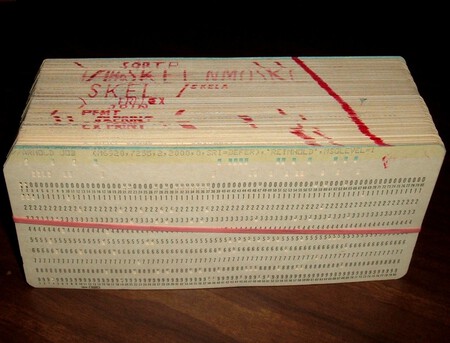
This is what a computer program looked like in the ’60s.
Despite the laborious process, advances were made during this era. For instance, IBM soon developed methods to convert punched cards into stored programs on magnetic tapes, speeding up the reading process significantly. Languages like FORTRAN and COBOL became staples for programmers who often utilized these cards to manage complex computing tasks.
Historical Achievements
Punched cards weren’t just for mundane tasks; they played pivotal roles in groundbreaking projects. NASA used them extensively in the Mercury and Gemini missions, and even during the Apollo missions, showcasing how far technology had come while highlighting its limitations.
In 1962, mathematicians used these machines for advanced calculations, such as determining the first 100,000 decimals of π and identifying the largest prime numbers of the time. The legacy of punched cards serves as a testament to the ingenuity and resourcefulness of early programmers.