
Zapatero Imputation in Plus Ultra Case: An International Scandal?
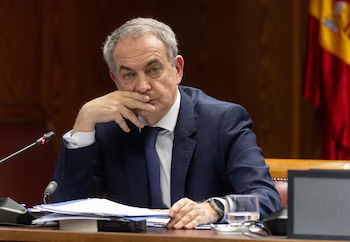
The recent developments surrounding the Plus Ultra case have ignited significant political debate and controversy in Spain. Former Prime Minister José Luis Rodríguez Zapatero has been summoned by the National Court judge José Luis Calama to testify concerning the government’s pandemic-era rescue of Plus Ultra, a Venezuelan airline that received a staggering €53 million during the COVID-19 crisis. This case has raised suspicions around the alleged collection of €1.95 million in commissions, leading to questions about transparency and accountability in governmental actions.
Ayuso’s Stance: “An International Scandal”
Isabel Díaz Ayuso, the President of the Community of Madrid, has condemned the government’s handling of this matter. She labeled it an “international scandal,” expressing disbelief that instead of investigating, the government has opted to “cover it up.” In a statement made during the Plan Vive promotion, she argued that the Executive should not manipulate the Prosecutor’s Office or the State Attorney’s Office to obscure the truth, emphasizing the need for transparency.
Ayuso’s vehement criticism reflects broader concerns about governmental integrity, as she accused the current administration of being “at the epicenter of scandals.” She categorizes the judiciary’s questioning as an essential act in revealing the truth, calling out any attempts to undermine judicial authority as populist.
Almeida’s Accusations Against the PSOE
Following Ayuso, José Luis Martínez-Almeida, the Mayor of Madrid, has also voiced his concerns regarding the accusations against Zapatero. He highlighted that Zapatero is the first former president to face charges of corruption, pointing to what he termed the “sad record” of the PSOE under which this charge arose. Almeida contended that the intricate global financial networks surrounding the government and Zapatero present an outrage, suggesting that such corruption levels are emblematic of a broader issue within Sanchismo—a term he coined to describe the alleged corrupt nature of Pedro Sánchez’s administration.
He firmly believes that this will lead to broader investigations and that Sánchez’s evasion will only prolong the inevitable scrutiny the administration faces.
Calls for Explanations from the Opposition
The PP’s Alfonso Rueda emphasized the “very serious” implications of the allegations against Zapatero, demanding swift clarification from the PSOE. Rueda argued that a matter involving a former president poses “enormous institutional impact.” He chastised the PSOE for potentially ignoring the gravity of the situation, urging public accountability as more details emerge.
The Government’s Response: Defense of Zapatero
In contrast, government representatives have mounted a defensive stance regarding Zapatero, pointing out that he represents a period of significant social transformation in Spain. Minister Elma Saíz remarked on the transparency of the pandemic-related financial processes, dismissing allegations as stemming from an ultra-organization, Clean Hands. By emphasizing Zapatero’s contributions to society, the administration endeavors to reinforce his innocence and the presumption of good faith.
The Role of Bildu in the Ongoing Controversy
The Basque nationalist party, EH Bildu, has introduced the concept of lawfare in its discourse, suggesting that Zapatero’s situation may be politically motivated. However, they have affirmed that this accusation does not alter their supportive stance toward the government, highlighting the necessity for complete clarity before jumping to conclusions.
Conclusion: The Future of the Plus Ultra Case
The implications of the Plus Ultra case continue to unfold, revealing deep political fissures and concerns within Spanish governance. As accusations swirl around figures like Zapatero and the allegations of corruption take center stage, the focus remains on political accountability, transparency, and the judicial process’s integrity. The coming weeks will be crucial in determining the ramifications of these ongoing investigations for the future of Spanish politics.