
Understanding the Intricacies of Earworms
You are silent. Walking down the street, serving a coffee, or distracted by your phone. And suddenly… there is it again. A melody you have not chosen but that insists on returning, like a drip from a tap or a notification you cannot silence.
In my case, it’s been the same song fragment for days, repeating like a broken record. It doesn’t bother me, but it made me reflect: why does this happen? Does our brain sometimes work like a scratched disk, looping the same track?
What exactly is an Earworm? The Earworm-also called “ear worms”-are musical fragments lodged in our minds, repeating incessantly, often without our choice. The term originates from the German word Ohrwurm, and it describes a mental phenomenon that is as recognizable as it is elusive.
This experience is not uncommon: the National Library of Medicine in the United States indicates that up to 98% of the Western population have encountered them at some point. Most experience it as a benign curiosity, but for others, it can become a source of annoyance or even distress. It involves spontaneous mental activity that scientists are eager to understand.
Why do some songs get stuck? Earworms result from a combination of musical and neurological factors. The songs most likely to repeat in our minds often have simple structures, brisk tempos, and catchy melodies. A study by musicologist Kelly Jakubowski analyzed over 3,000 songs and found that those deemed ‘earworms’ shared common melodic patterns and moderate, upbeat tempos.

Among the songs identified in Jakubowski’s study are numerous familiar pop hits. Not surprisingly, the majority of these tracks are in English, given the study’s demographic focus:
- ‘Bad Romance’ – Lady Gaga
- ‘Can’t Get You Out of My Head’ – Kylie Minogue
- ‘Don’t Stop Believin” – Journey
- ‘Somebody That I Used to Know’ – Gotye
- ‘Moves Like Jagger’ – Maroon 5
- ‘California Gurls’ – Katy Perry
- ‘Bohemian Rhapsody’ – Queen
- ‘Alejandro’ – Lady Gaga
- ‘Poker Face’ – Lady Gaga
The real action occurs in the brain: the auditory cortex (the same part we activate when listening to music) is reactivated even when we merely imagine a tune. Emotional states such as stress, distraction, or nostalgia can create conditions for melodies to implant themselves in our minds unexpectedly.
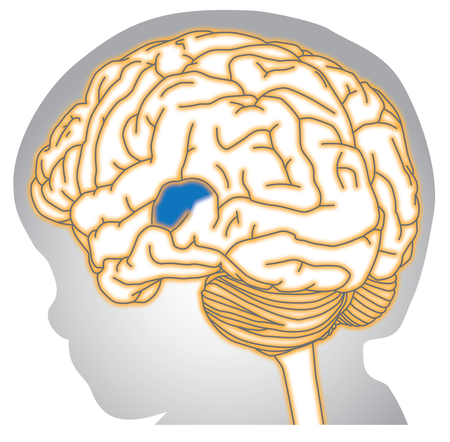
<span>Auditory cortex</span>Some minds are more prone to looping. Not everyone experiences earworms in the same way. While some hardly notice them, others find themselves trapped in an endless loop. In most cases, earworms are simply indecipherable but entertaining phenomena. When the repetition becomes incessant and irritating, it may signal deeper psychological issues. Dr. Srini Pillay, a psychiatrist at Harvard, has observed that these persistent musical loops could be linked to conditions like obsessive-compulsive disorder, migraines, rare epilepsies, and even strokes.
What can you do if you want it to stop? While there is no foolproof method to eradicate an earworm, strategies can alleviate the situation. Curiously, trying to block the song is often the least effective approach: the more you resist, the more it sticks, an issue described by psychologist Daniel Wegner as the “ironic process.”
Instead, accepting the phenomenon without resistance usually works more effectively. As suggested by the Kennedy Center, some people find relief by listening to the entire song or swapping it out for a different melody. Additionally, chewing gum has also been pointed out by experts as a tangible way to interrupt these persistent loops.

And you, what song is playing on repeat in your head? As I delved into the world of earworms, that song loop hasn’t left my mind. Now, I recognize that I am not alone, that there are scientific underpinnings to this experience, and that, in essence, this repetitive phenomenon forms part of our brain’s natural function.
What about you? Have you ever experienced an earworm you couldn’t shake off? What song was it, and do you have any techniques to banish it? We invite you to share your thoughts in the comments.
Images | Xataka with Gemini 2.5 Flash | Amanz | Kennedy Center
In Xataka | I put myself in the hands of some “sleep headphones” in the hope of reconciling sleep. It turned out to be a mixed experience.