
Walking my dogs under the starry night sky has become a cherished routine for me. Despite the chill of winter mornings or the stillness of late nights, these peaceful walks allow me to connect with the cosmos. I love to lift my gaze and spot different celestial bodies, including The Polar Star, El Carro, and bright stars like Sirius and Aldebaran. Despite light pollution in my area, the nearby municipalities designated as starlight destinations still offer breathtaking nights filled with twinkling wonders. Yet, through all my observations, I have never come across a green star.
The Color Perception of Stars
With nothing but my eyes to guide me, I can only see the stars bright enough to ignite the cones in my retina, responsible for color perception. The colors I can distinguish are primarily white, blue, red, orange, or yellow. While utilizing a telescope changes the dynamic, revealing fainter celestial objects, the elusive green star remains unseen. This intriguing absence is both a matter of stellar physics and our own color perception.
Why Don’t We See Green Stars?
The peak emission of our Sun, which behaves like a black body, is in the green spectrum. As stars emit light based on temperature, their color is a direct reflection of this temperature. Cooler stars shine red, while hotter stars display blue hues. However, even though a star with a temperature of about 5,500K would peak in the green zone, we’ve never actually perceived the Sun as specifically green.
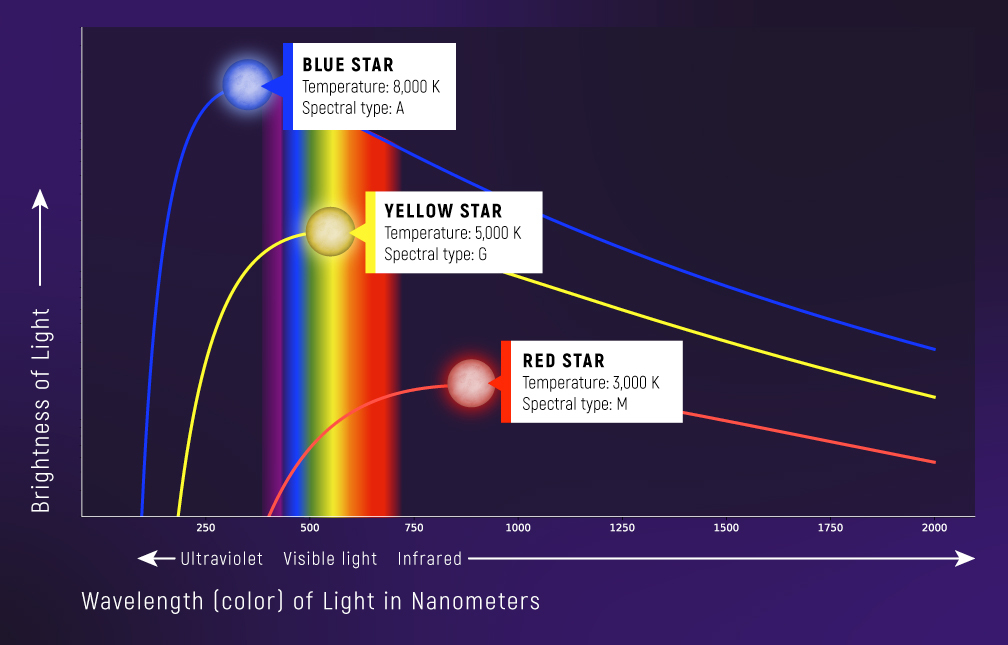
Different Planck curves for stars of classic colors: blue, yellow, red. POT
Our perceptual system is to blame for this peculiar phenomenon. Stars emit light across various wavelengths in a compound way, leading to a mixture of colors perceived by our eyes. Thus, even though the Sun emits a significant amount of green and blue light, when combined with red, our brain interprets it as white. This complexity suggests there is no stellar temperature capable of solely stimulating only the green cones of our eyes.
The Illusion of Green Stars
Some people report seeing green stars, but this perception is typically a trick of the mind rather than an actual display of color. Notably, stars like Almach, a system consisting of a bright orange giant and blue dwarf stars, can create an optical illusion. Our brains perceive the blend of light and mistakenly balance it with its complementary color, green. Similarly, Zubeneschamali might deceive us due to atmospheric effects or subjective perception.
Green Celestial Objects
While green stars are a stark absence, that doesn’t mean the cosmos is devoid of greenish objects. Certain nebulae emit captivating green hues due to intense oxygen atom emissions. We’ve also observed emerald green comets due to diatomic carbon and planets like Earth and Uranus, which have atmospheres that alter how light is absorbed and emitted.
In conclusion, the cosmic tapestry that stretches above us is filled with color and wonder. Although green stars may forever remain beyond our perception, the universe offers a kaleidoscope of intriguing celestial sights waiting to be admired.