
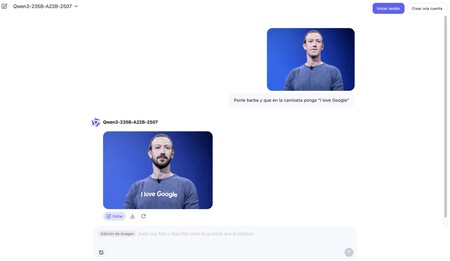
Revolutionizing Image Editing with Qwen-Image-Editor
Until recently, transforming an image from a basic form into something extraordinary required advanced knowledge of complex software like Photoshop and a significant investment of time. With the advent of generative AI , this task has become remarkably simple. The new Qwen-Image-Editor from Alibaba exemplifies how technology can simplify processes that once seemed daunting.
Hello, Qwen-Image-Editor. This name is now synonymous with cutting-edge image editing. The model, launched by Alibaba, is part of its growing family of Qwen models . What sets this editor apart is its intuitive user interface; it responds to user prompts effectively, making editing photos simpler than ever.
Using this AI is much easier than using Photoshop in a traditional way, and in many cases the results are exceptional.
Input and Output Made Easy. Trying the Qwen-Image-Editor is remarkably easy via the model’s website, where users can access the preloaded “Image Edition” mode. The interface allows for multiple edits on a single image, making it possible for users to iteratively refine their work.

Powered by Advanced AI. The Qwen-Image-Editor is based on a robust model that features around 20 billion parameters , making it highly capable of sophisticated image transformations. Originally focused on text rendering in images, this model now extends its functionality to comprehensive photo editing. Users can access it on various platforms, including Hugging Face, Modelscope, and even through the Alibaba Cloud API.
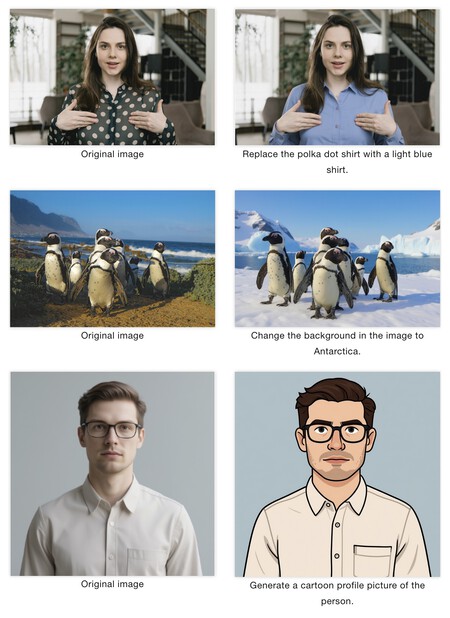
Source: Alibaba Cloud.
Flexibility of Use. While the Qwen Chat interface allows for easy access to this powerful tool, users can also download it for local use on PCs or laptops with sufficient graphic memory. Although running it locally is a bit more complex, it offers the advantage of advanced processing power.
Experts like Simon Willinson have tested it on high-performance machines, noting that complex modifications can take significant time locally, compared to almost instantaneous results in the Qwen Chat interface.

Intelligent Image Analysis. A standout feature of the Qwen-Image-Editor is its double coding mechanism . This method first analyzes input images with the QWEN2.5-VL Visual Recognition model to understand the content. It then employs a variable autoencoder (VAE) to add the user-specified edits. This multi-step approach ensures that the original image is preserved while only the requested modifications are made.
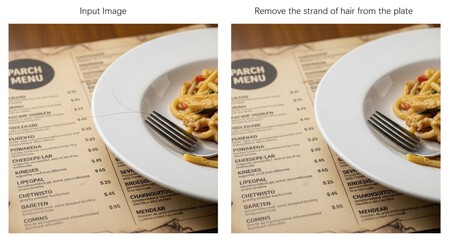
Plate with hair, dish without hairs. The difference is subtle, but very relevant.
Junyang Lin, a researcher involved in developing this model, emphasized its precision, enabling users to execute delicate changes, like removing an unwanted hair from a plate while leaving the rest of the image completely intact.
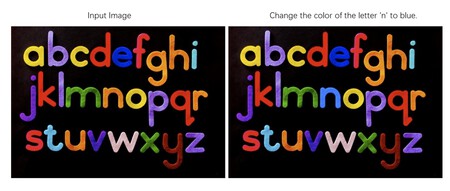
Prompting the model to change only the color of a letter illustrates its targeted editing capabilities.
Semantic Editing Capabilities. The Qwen-Image-Editor also excels in semantic editing . This allows users to change the meaning or structure of an image while maintaining the integrity of the original subjects. For instance, users can apply stylish effects while explicitly preserving identities within the image.
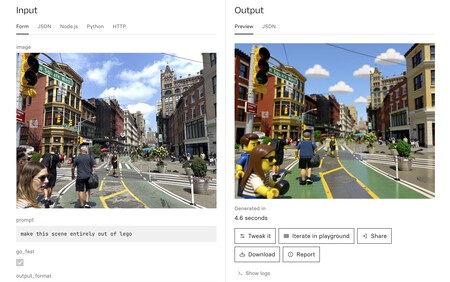
Transforming an image into something that resembles a scene from a Lego movie broadens the creative possibilities.
Changing Reality. Continual progress in generative AI models is visible in the Qwen-Image-Editor, which not only edits but also enhances fidelity to the original images. This allows for seamless integration of new elements, like text or graphics, into photos without compromising the original aesthetic.
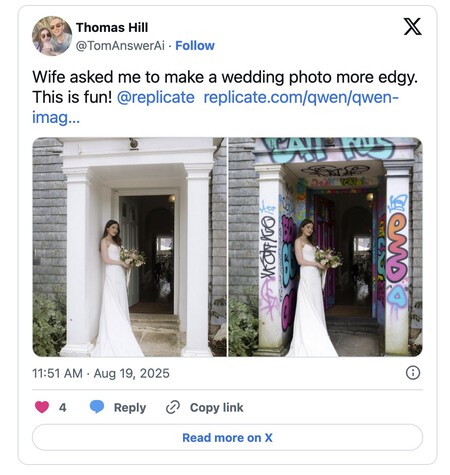
The ability to integrate text or graphics dynamically and realistically elevates this model over many existing options, making it a game-changer.
Emerging Trends in AI. The advancements seen in the Qwen-Image-Editor extend beyond mere photo editing; they hint at a future where complex applications like Photoshop may no longer be necessary for the everyday user. The shift towards AI-assisted design implies that technical skills may become less critical than creative vision and direction.
This shift can be seen in numerous applications, where traditional technical mastery is supplanted by simple interaction with AI. Users can simply articulate their needs, and the software will deliver what they envision, creating a future rich with potential for creativity without the steep learning curves associated with complex tools.
In conclusion, generative AI, exemplified by Qwen-Image-Editor, is not merely a fleeting trend. It signifies a potential paradigm shift in how we approach design and creative industries, paving the way for innovative expressions while minimizing the barriers to entry. The power and accessibility of such tools are reshaping our creative horizons, where the only limit is the user’s imagination.