
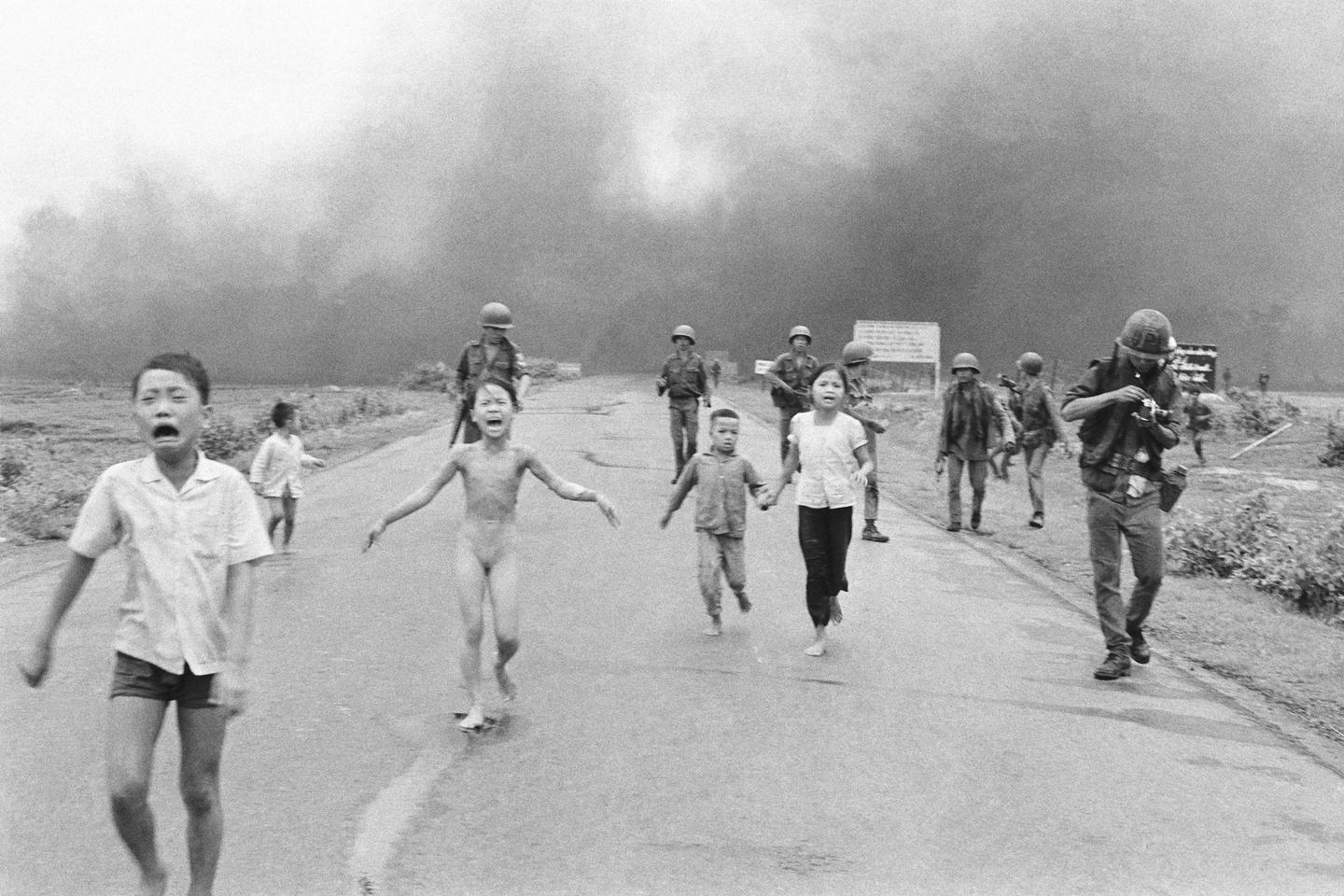
The decision follows a **strong controversy** questioning the origin of the photograph **The terror of war** (“The terror of war”), better known as “the little girl in napalm”. World Press Photo, which awarded its 1973 **annual prize** to the Vietnamese photographer **Nick UT** of the Associated Press agency (AP) for this historically significant photo, announced the suspension of the attribution on May 16, 2025.
A recent documentary directed by the **VII Foundation** suggests that **Nick Ut** might not be the true author of the photo. This revelation has prompted World Press Photo to conduct a thorough investigation from January to May 2025 concerning the paternity of the photo.
Sharing the results of this internal inquiry, World Press Photo stated, “**Based on the analysis of location, distance, and the camera used on that day, photographers **Nguyen Thanh NGH** or **Huynh Cong Phuc** could have been in a better position to take the photo than Nick Ut**.” Consequently, the attribution has been suspended until further evidence arises.
Accuser and Counter-Investigation Documentary
The iconic black-and-white photograph of a severely burnt Vietnamese girl on a road after a napalm bombing in Trang Bang in 1972 has profoundly changed the global perception of the Vietnam War and remains a symbol of its horrors even after more than fifty years.
**Joumana El Zein Khoury**, the executive director of World Press Photo, acknowledged in a press release that the photograph remains undisputed in its impact, asserting that the World Press Photo Prize awarded to this iconic moment in 20th-century history remains valid.
The ongoing controversy raises the possibility that the **author of the photograph may never be definitively confirmed**. The outcomes of the investigation conducted under the organization’s supervision are expected to be revealed in an upcoming press conference in **Amsterdam**.

At the end of January, the premiere of the documentary **The Stranger** by **Bao Nguyen** at the **Sundance Film Festival** stirred the photojournalism community by contesting the authenticity of the most famous photo in history. The film asserts that this image, symbolic of the suffering during the Vietnam War, was not taken by Nick Ut, but rather by another lesser-known Vietnamese photographer, **Nguyen Thanh Nghe**, now residing in the **United States**.
**Carl Robinson**, who was the publisher photo editor at **AP** in **Saigon** at the time, claims that he misrepresented the origin of the image at the direction of his editor, **Horst Faas**. In the film, Nguyen Thanh Nghe states, “Nick Ut accompanied me on the field. But it was not he who took this photo… It’s me.”
AP Continues to Credit Its Photographer
Following an exhaustive investigation, AP released a 97-page report earlier this month, asserting that “there is no definitive evidence to alter the credit of this fifty-three-year-old photograph,” thus maintaining that Nick Ut remains the credited photographer. The detailed visual analysis, interviews with witnesses, and examination of all photos captured on June 8, 1972 indicate that Nick Ut could likely be the sole photographer.
However, AP acknowledges that their investigation raises important questions that may never be fully answered due to the passage of time and the loss of many involved individuals. The report mentions, “Fifty years have passed, and many people have died, which undoubtedly complicates the efforts to confirm the photograph’s origins.”
According to the AP’s findings, it is likely that the photo was taken with a **Pentax** camera instead of the **Leica** and **Nikon** cameras that Nick Ut claimed to have used that day. The investigation revealed that while history suggests the photo was taken with a Leica, it was improbable given that **Ut** sometimes utilized a Pentax inherited from his late brother.