
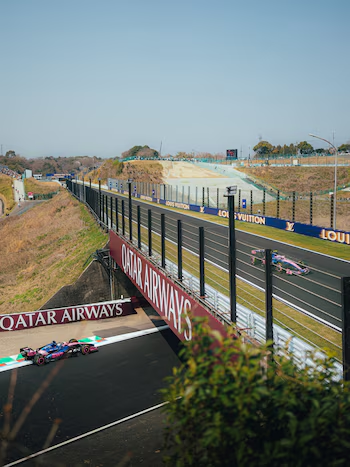
Why Gasly’s Alpine is Different from Colapinto’s After the First Formula 1 Races
Alpine Racing Overview
After three races in the 2026 Formula 1 season, the Alpine team finds itself in fifth place in the World Constructors Championship, largely due to the strong performances of Pierre Gasly. In contrast, rookie Franco Colapinto has faced challenges that have prevented him from scoring more points, despite showing significant potential.
Performance Insights: Gasly vs. Colapinto
Pierre Gasly has amassed 15 points, while Colapinto has only managed to secure a single point for his tenth-place finish in China. Various factors have hindered Colapinto’s ability to capitalize on his potential, including technical issues and race-day circumstances.
The Shift to a New Era of F1
This season marks a significant transition for Formula 1, introducing a new focus on energy management with both electric and combustion engines delivering equal power outputs. Drivers are now required to adopt new driving techniques, saving energy while maximizing performance. Notable changes to car designs, including size reductions and advancements in active aerodynamics, have added further complexity for drivers.
Technical Improvements and Challenges
One of the most significant upgrades for Alpine this season has been the shift to Mercedes engines, replacing the traditional Renault power units. This transformation has improved both the suspension and transmission systems, contributing to better overall performance.
Race Challenges for Colapinto
In his debut race in Australia, Colapinto started in 16th position but lost time due to a penalty incurred by his team. Although his team recognized the error, his final placement was a disappointing 14th, compared to Gasly’s tenth.
Fast forward to China, where Colapinto faced gearbox problems during crucial practice and qualifying sessions. Even with these hurdles, he showcased resilience by finishing in the points after starting from 12th position, signifying his ability to adapt quickly.
Comparisons in Race Conditions
In Japan, Gasly again demonstrated superior performance. Colapinto, on the other hand, struggled with front understeer, which affected his pace and confidence. Team engineer Stuart Barlow acknowledged the car’s issues, further underscoring the technical disparities that have complicated Colapinto’s progress.
Learning from Each Race
After a challenging weekend in Suzuka, Colapinto noted the inconsistencies that affected his performance. He expressed his admiration for Gasly’s predictability and consistency, recognizing that understanding his car’s dynamics is crucial for his development as a driver.
Future Outlook
Looking ahead, both drivers have opportunities to improve as the season progresses. Colapinto’s recent performances reveal a growing familiarity with the new cars and circuits, but he must continue to learn rapidly to close the gap with Gasly.
The upcoming hiatus offers Colapinto the opportunity to refine his skills with the Alpine team before the Miami Grand Prix on May 3. His social media updates indicate a commitment to review his performance and strategize for future races.
Conclusion
The distinct differences in performance between Pierre Gasly and Franco Colapinto are influenced by various factors, including experience, technical challenges, and race conditions. As Colapinto gains experience and continues to work on his car’s setup, he has the potential to elevate his performance and contribute more significantly to Alpine’s overall success in the championship. As patience is essential in Formula 1, the upcoming races could reveal whether Colapinto can leverage his talent for improved results.